Best Guide to Rental Property Inspections in the East Bay: Timing, Reports and Owner Oversight
Rental property inspections give East Bay owners a structured way to understand condition, document change and decide what needs attention. They are not one interchangeable walkthrough. A rental-readiness review before marketing has a different purpose from a move-in condition report. An occupied-property visit should not be treated like a move-out inspection, and a maintenance follow-up should focus on whether specific work was completed rather than reexamining the entire tenancy. Owners receive the most value when each visit has a defined reason, a lawful access plan and a clear record afterward.
The East Bay also includes many property situations that require different forms of oversight. A Fremont condominium may involve HOA access procedures, shared exterior areas and parking documentation. A Livermore single-family home may require attention to landscaping, irrigation and seasonal exterior conditions. A newer Brentwood rental may have several building systems that still need organized maintenance records, while an older home elsewhere in the region may require closer tracking of plumbing, roofing, windows or prior repairs. Remote owners and busy professionals often depend on inspection reports because they cannot visit the property personally.
Inspection quality matters most when the report can support a decision. A group of unlabeled photographs may show that someone entered the home, but it may not explain what changed, whether a condition is urgent, who is responsible for follow-up or whether the issue was already documented at move-in. At the other extreme, an inspection should not be described as a guarantee against damage, lease violations or maintenance failure. It is a visibility and documentation tool that works best when connected with leasing, maintenance, tenant communication, owner approvals and financial reporting.
Owners comparing the complete management relationship can begin with the Best Guide to East Bay Property Management. This article focuses on the inspection portion of that relationship, including the timing and purpose of common visits, the information owners should receive and the questions that reveal whether a management company has a dependable oversight process.
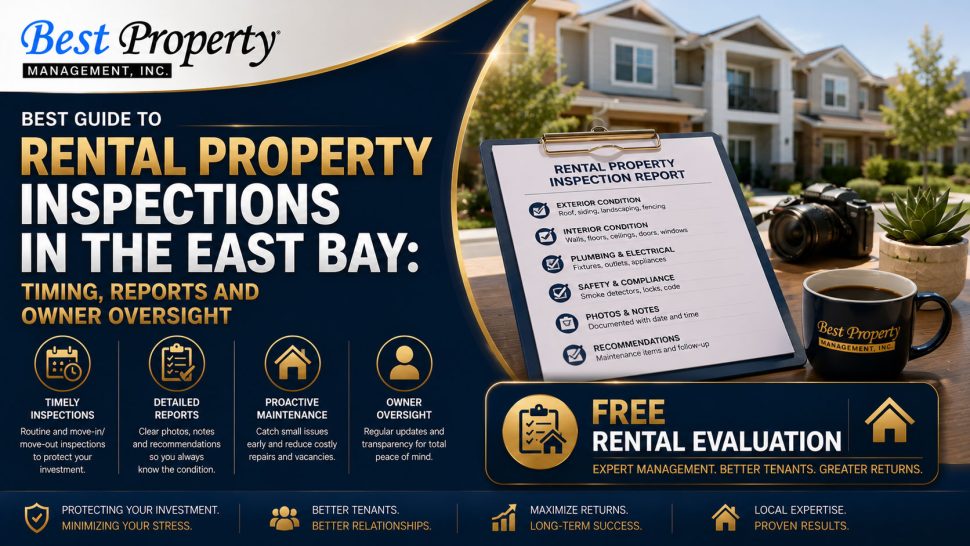
Quick Answer: East Bay rental owners should expect inspections to be organized by purpose: rental readiness before marketing, move-in condition documentation, lawful occupied-property visits, maintenance follow-up and move-out documentation. Each visit should have a defined scope, an access and communication plan, dated photographs or written observations when appropriate and a clear next step for the owner. Owners should ask who performs each inspection, what triggers it, what the report contains, how urgent conditions are escalated and whether follow-up is confirmed. California entry and security-deposit rules can affect occupied visits and move-out procedures, so a manager should distinguish routine operational oversight from formal legal inspections. No inspection system can guarantee that damage or disputes will never occur. Its value is creating timely visibility, a consistent record and a practical basis for maintenance, leasing and deposit decisions.
Ask Best Property Management to review which inspection stages may be appropriate for your East Bay rental and what owner documentation should accompany each one.
What Are Rental Property Inspections Intended to Accomplish?
Rental property inspections are intended to answer a specific condition or oversight question at a defined point in the tenancy. The owner may need to know whether a vacant home is ready to market, whether the move-in condition was documented, whether a reported leak was repaired or how the property changed after possession was returned. The inspection should be designed around that question rather than treated as a generic visit.
A useful inspection process also establishes a baseline. The move-in record shows what was already present when the tenant received possession. Later photographs and notes can then be compared with that starting point. This helps separate preexisting wear, ordinary aging, new damage and incomplete maintenance. The inspection itself does not decide every financial or legal issue, but the record can make later decisions more informed and easier to explain.
Owners should also understand the limits of an inspection. A scheduled walkthrough is a snapshot of visible conditions. It may not reveal an intermittent plumbing problem, a concealed leak or a defect inside a wall. A clean report does not guarantee future performance. Strong oversight combines tenant reports, work-order history, condition records and qualified vendor evaluation when a technical concern appears.
| Inspection Type | Typical Timing | Primary Purpose | Useful Owner Output |
|---|---|---|---|
| Rental-readiness review | Before marketing or between tenancies | Identify preparation, safety and presentation needs | Priority list, owner approvals and readiness status |
| Move-in condition inspection | Immediately before or at the start of possession | Create a starting record of condition | Dated photographs, room notes and condition report |
| Occupied-property visit | At a defined point during tenancy when lawful and appropriate | Observe specified conditions and identify follow-up needs | Summary of observations, exceptions and next actions |
| Maintenance follow-up | After selected repairs or recurring concerns | Confirm visible completion or determine whether more work is needed | Completion note, photographs and vendor follow-up |
| Move-out documentation | After possession is returned and during deposit processing | Record end condition and prepare for turnover | Before-repair photographs, repair scope and final documentation |
Owner takeaway: Every inspection should have a stated purpose, defined scope and owner-facing result. A visit without a clear question or deliverable provides limited oversight.
How Should Rental Readiness and Move-In Condition Be Documented?
Rental readiness and move-in documentation should create a reliable starting point before the tenant begins living in the property. Readiness focuses on whether the home is safe, functional, clean and prepared for the approved leasing plan. Move-in documentation records the condition that exists immediately before or when possession begins. The two steps are related, but they are not identical.
A readiness review may identify incomplete repairs, damaged screens, appliance concerns, missing keys, landscape problems, cleaning needs or HOA move-in requirements. The owner then needs a practical list that separates work required before marketing or occupancy from optional improvements. For an occupied home approaching turnover, preparation planning should respect the existing tenant’s possession and lawful entry requirements. For a vacant home, the manager can coordinate repairs and final checks before showings or move-in.
The verified Best Property move-in inspection service describes written condition reporting and photographs as part of the move-in record. Owners should still ask how rooms, fixtures, appliances, flooring, walls, windows, exterior areas and supplied items are identified in the final documentation. The record should be understandable months or years later, even if the person reviewing it was not present at move-in.
California Civil Code Section 1950.5 now requires landlords to take photographs immediately before or at the beginning of tenancies that start on or after July 1, 2025. That legal requirement makes an organized move-in file especially important. The article is educational rather than legal advice, so owners should verify how the current rule applies to their property and procedures.
| Condition Area | What to Verify or Document | Owner Decision Supported |
|---|---|---|
| Safety and function | Locks, lighting, visible trip hazards, smoke and carbon monoxide devices and working systems | Whether corrective work is needed before occupancy |
| Interior condition | Walls, flooring, windows, doors, fixtures, appliances and cleanliness | Starting baseline for later comparison |
| Exterior and site | Yards, irrigation, fences, gates, patios, balconies and assigned parking | Maintenance scope and tenant responsibility |
| Access and property items | Keys, remotes, mailbox access, manuals and included personal property | Accurate possession handoff |
| Known exceptions | Existing wear, approved unfinished work or owner-retained items | Clear written expectations and follow-up timing |
Owner takeaway: A move-in report should be detailed enough to establish what the property looked like at possession, not merely state that the home was inspected.
How Should Routine Occupied-Property Inspections and Lawful Access Work?
Occupied-property inspections should be carefully planned because the tenant has possession and privacy rights. The manager should identify the lawful purpose for entry, give the required notice, coordinate a reasonable time and limit the visit to the stated purpose. A broad desire to “check on the property” should not replace a clear access reason and documented process.
California Civil Code Section 1954 limits entry into an occupied dwelling. For most nonemergency entries, the landlord must provide reasonable written notice stating the date, approximate time and purpose, and entry generally occurs during normal business hours. The statute presumes 24 hours to be reasonable notice through permitted delivery methods. Emergencies, consent, abandonment and other listed circumstances are treated differently, and access may not be abused or used to harass a tenant.
For that reason, owners should not compare inspection companies only by advertised frequency. A fixed schedule may sound reassuring, but the more important questions are why each visit occurs, whether the entry basis is lawful, how the tenant is notified and what the manager will document. The Best Guide to Tri-Valley Property Management provides broader context for owners managing condos, townhomes and single-family rentals across nearby communities. The Fremont property management guide also explains why HOA procedures, parking and varied property types can affect local management decisions.
An occupied-property visit should stay focused on the stated purpose. Staff should observe the relevant areas, avoid unnecessary photographs of personal belongings and not expand the visit beyond the notice and applicable law. If a condition appears technical, a qualified vendor may be needed rather than relying on a general visual observation.
| Process Step | Management Responsibility | Owner Visibility |
|---|---|---|
| Define purpose | Identify the lawful and operational reason for entry | Know what question the visit should answer |
| Coordinate access | Provide appropriate notice and reasonable scheduling | See the planned date, scope and any exception |
| Conduct focused visit | Observe only the stated areas and relevant conditions | Receive concise findings rather than unrelated commentary |
| Classify concerns | Separate urgent, routine, monitor and no-action items | Understand priority and potential cost implications |
| Close the loop | Assign follow-up, communicate with tenant and update records | Know whether the issue is resolved or still open |
Owner takeaway: The best occupied-property inspection policy balances owner visibility with a lawful purpose, respectful tenant communication and disciplined scope.
When Are Maintenance Follow-Up and Specialized Property Visits Useful?
Maintenance follow-up visits are useful when the owner needs confirmation that a specific concern was addressed or when a repair reveals a broader condition that requires another look. They should not be confused with a full property inspection. A focused follow-up asks whether the approved work appears complete, whether the reported symptom continues and whether additional vendor evaluation is needed.
After a plumbing repair, a follow-up may document that visible moisture has stopped and the affected area is drying, but it cannot confirm hidden conditions. Exterior photographs may show that a gate was repaired or irrigation is operating, while a specialist may still need to evaluate drainage or plant health. A visual check should not be presented as a technical certification.
East Bay property types create different follow-up needs. A single-family rental in Brentwood may require coordination around irrigation, fencing or exterior upkeep. Owners can review the Brentwood property management guide for broader local management considerations. A Livermore rental may involve HOA procedures, landscaping, older components or newer systems depending on the property, and the Livermore property management guide provides related city-level context. Condos and townhomes may require the manager to determine whether an issue belongs to the owner, tenant or association before authorizing work.
Specialized visits may include vendor estimates, safety checks, exterior observations or turnover assessments. A useful follow-up note identifies the original issue, date of work, visible result, remaining concern and next assigned action. This prevents a repair from appearing closed merely because an invoice was received.
Owner takeaway: Maintenance follow-up should confirm a defined outcome and preserve the work history. It should not overstate what a visual visit can prove.
Before approving a recurring inspection or follow-up plan, ask how findings will be prioritized, assigned and reported until each open item is resolved.
How Should Move-Out Inspections, Photographs and Deposit Records Be Coordinated?
Move-out documentation should establish the condition after possession is returned, identify turnover work and support a careful security-deposit accounting process. It should not begin with a conclusion that every difference from move-in is tenant damage. The manager needs to compare the starting record, lease responsibilities, maintenance history, ordinary wear and tear and the condition visible at move-out.
California Civil Code Section 1950.5 gives tenants an option to request an initial inspection before the tenancy ends. The landlord must notify the tenant in writing of that option and the right to be present. When requested, the inspection occurs at a reasonable time no earlier than two weeks before the tenancy ends. The law generally requires at least 48 hours of written notice unless the parties sign a waiver, followed by an itemized statement of proposed cleaning or repair deductions.
The statute also requires photographs after possession is returned and before repairs or cleaning used for a security-deposit claim, plus photographs after the work is completed. It requires the itemized deposit statement and remaining security no later than 21 calendar days after the tenant vacates, subject to detailed procedures. Owners can also review California Courts security-deposit guidance for a plain-language overview while seeking qualified advice for a specific dispute.
Best Property maintains a verified move-out inspection service page. When comparing service scope, owners should ask whether the report distinguishes preexisting condition, ordinary wear, tenant-caused damage, owner maintenance and work that remains under evaluation. The manager should also explain who authorizes repairs, how estimates or invoices are retained and whether follow-up photographs are linked to the original condition.
A strong move-out file supports more than deposit accounting. It becomes the starting point for the next rental-readiness plan. The owner can see what must be completed before marketing, which systems may need preventive work and whether recurring issues should influence the next lease or maintenance schedule.
Owner takeaway: Move-out documentation should connect the move-in baseline, current condition, repair records and deposit process. Photographs are most useful when they are dated, labeled and tied to a written explanation.
What Should a Useful Rental Inspection Report Contain?
A useful inspection report should help an owner understand what was observed, what changed and what decision comes next. It does not need to be long for the sake of appearing thorough. It needs consistent identifiers, clear photographs, practical classifications and enough context to support follow-up.
The report should identify the property, inspection type, date, person completing the visit and stated purpose. Room or area labels should remain consistent across move-in, occupied and move-out records so comparisons are possible. Photographs should be clear enough to show the relevant condition and should not be presented without captions when the subject is unclear. Written notes should distinguish direct observation from tenant statements, vendor opinions or owner assumptions.
Prioritization is equally important. An active leak or visible safety concern should not appear in the same list as cosmetic wear. Practical categories may include urgent action, repair recommended, monitor, owner decision or no action. The report should assign the next step and recommend qualified evaluation rather than guessing when the cause is uncertain.
| Report Component | What Good Documentation Shows | Why It Matters |
|---|---|---|
| Property and visit details | Address, date, inspection type, purpose and inspector | Establishes the record and timing |
| Area-by-area observations | Consistent room names and concise condition notes | Supports comparison across the tenancy |
| Photographs | Dated, clear images tied to a location and issue | Adds visual context to written findings |
| Priority classification | Urgent, routine, monitor, owner decision or no action | Helps owners allocate attention and budget |
| Responsibility and next step | Assigned party, approval need and follow-up status | Prevents findings from remaining unresolved |
| Reference history | Move-in baseline, prior repair, tenant report or vendor note | Explains whether a condition is new or recurring |
Owners should also ask how reports are retained and delivered. The strategy packet does not provide a verified Best Property report format, inspection technology or storage schedule, so those details should be confirmed directly before hiring. The essential requirement is that the owner can retrieve the record when making maintenance, renewal, turnover or deposit decisions.
How Should Owners Compare Property Management Inspection Services?
Owners should compare inspection services by examining purpose, access procedures, report quality, follow-up and fees rather than choosing the company that advertises the most visits. A high inspection count does not automatically create better oversight. The process is valuable when the visits are lawful, property-specific and connected to action.
Start by asking which inspection types are included in leasing or ongoing management and which are separate charges. Confirm whether move-in and move-out documentation are standard, whether occupied visits are scheduled by policy or condition and what triggers a maintenance follow-up. Ask who performs the visit, what training or qualifications apply and when a specialized vendor is used. The company should also explain how urgent concerns reach the owner and how nonurgent recommendations are budgeted and approved.
Report access is another important comparison point. Ask to see a sample with identifying information removed. Look for dates, labels, photographs, condition categories and assigned next steps. Vague checkboxes, unlabeled image galleries or reports that simply say “good condition” are difficult to use later. Owners should know whether they receive the report automatically, only on request or through a portal and how long records are retained.
| Question to Ask | Strong Answer Should Explain | Possible Warning Sign |
|---|---|---|
| Which inspections are included and what costs extra? | Scope, timing, fee trigger and deliverable | Inspection charges are vague or discovered later |
| What lawful purpose and notice process applies to occupied visits? | Reason for entry, tenant communication and documentation | Company promises entry whenever the owner requests it |
| What does the owner receive after each visit? | Written findings, labeled photographs and next steps | Only a verbal summary or unlabeled photos |
| How are urgent and routine concerns separated? | Escalation path, approval process and assigned responsibility | Every item is treated the same or left unassigned |
| How is follow-up confirmed? | Work record, completion note and unresolved-item tracking | Invoice receipt is treated as proof of completion |
| How are move-in and move-out records compared? | Consistent baseline, condition analysis and deposit support | No organized starting record exists |
Owners should be cautious of guarantees that inspections will prevent damage, discover every lease violation or eliminate deposit disputes. They should also question arbitrary entry practices, reports that disclose unnecessary personal information, inspection schedules that ignore property type and companies that cannot explain how a finding becomes a completed maintenance action.
Owner takeaway: Compare the entire inspection-to-action system. The report matters, but the real value comes from lawful access, accurate context, owner decisions and documented follow-through.
How Does Best Property Management Support East Bay Rental Owners?
Best Property Management supports East Bay rental owners through published move-in inspection, move-out inspection and broader property management services. The verified service pages establish that inspections are part of a larger management relationship that also connects with leasing, maintenance and owner communication. The exact frequency, fee, report format and approval process for a particular property should be confirmed during the owner consultation rather than assumed.
That property-specific conversation matters because East Bay rentals are not identical. A remote owner may need readiness, move-in and turnover documentation. A condo owner may need HOA coordination and clear common-area boundaries. A small multi-unit owner may need reports organized by unit and shared system. An owner leaving self-management may need help assembling earlier leases, photographs and repair records.
Owners should bring the current lease, property details, known maintenance concerns, HOA information, prior condition reports, move-in photographs and any upcoming turnover timeline to the discussion. A manager can then explain which inspections are part of leasing, which may occur during management, what access coordination is required and how findings would be communicated. This keeps the inspection plan tied to the property’s actual needs rather than a generic checklist.
The practical goal is owner oversight without requiring the owner to manage every visit personally. A clear inspection system helps the owner see property condition, approve appropriate work and retain a useful record across the tenancy. It also gives the management company a consistent way to coordinate with tenants, vendors and future leasing activity.
FAQ
What types of rental property inspections should East Bay owners expect?
Owners may encounter rental-readiness reviews, move-in condition inspections, occupied-property visits, maintenance follow-ups, exterior observations, optional pre-move-out inspections and final move-out documentation. Not every property needs every visit on the same schedule. The management company should explain the purpose, lawful access basis, scope, fee and report for each inspection type. Owners should also ask how the move-in baseline is compared with later condition records and how open findings move into maintenance or owner approval.
How often should an occupied rental property be inspected?
There is no universal inspection frequency that fits every East Bay rental. Appropriate timing can depend on the management agreement, lease, property type, maintenance history, tenant communication and lawful reason for entry. Owners should be cautious of a company that promises an arbitrary schedule without explaining purpose and access procedures. A better policy defines when an occupied visit is appropriate, how the tenant is notified, what the visit covers and what report the owner receives afterward.
Can a property manager enter a tenant’s home whenever the owner requests an inspection?
No. California law limits entry into an occupied dwelling to specified circumstances. For most nonemergency entries, reasonable written notice must state the date, approximate time and purpose, and entry generally occurs during normal business hours. Access may not be abused or used to harass a tenant. An owner request does not replace these requirements, and a specific dispute may require qualified legal advice.
What should a move-in inspection report include?
A move-in report should identify the property, date and inspection purpose, then document the condition of rooms, flooring, walls, fixtures, appliances, windows, doors, exterior areas and included property items. Dated and labeled photographs should connect to written notes so the record remains understandable later. Existing wear, unfinished work and known exceptions should be stated clearly. California law now requires beginning-of-tenancy photographs for tenancies that start on or after July 1, 2025.
What is a California initial inspection before move-out?
California Civil Code Section 1950.5 requires written notice of the tenant’s option to request an initial inspection and the right to be present. When requested, it generally occurs no earlier than two weeks before the tenancy ends and requires at least 48 hours of written notice unless the parties sign a waiver. The purpose is to identify proposed cleaning or repair items and give the tenant an opportunity to address qualifying deficiencies before move-out.
Are move-out photographs required for security-deposit deductions?
California Civil Code Section 1950.5 requires photographs after possession is returned and before repairs or cleaning supporting a security-deposit claim, plus photographs after the work is completed. The statute also includes detailed itemization, documentation and timing requirements. A management company should explain how images are labeled and retained, while owners should verify current law for a disputed deduction.
Can inspections guarantee that a tenant will not damage the property?
No. An inspection is a condition snapshot and documentation tool, not a guarantee against damage, hidden defects, tenant misconduct or future maintenance failure. A scheduled visit may identify visible concerns and create an opportunity for follow-up, but it cannot reveal every condition or predict what will happen later. Owners should evaluate inspections as one part of a larger system that includes tenant communication, maintenance response, lease administration, vendor records and appropriate insurance.
What should owners ask about inspection fees and reports?
Ask which inspections are included, which trigger separate fees and when those fees are earned. Confirm who performs the visit, how occupied access is coordinated and what documentation the owner receives. Request a sample report with private information removed. Also ask how urgent findings are escalated, repair approvals are obtained, follow-up is confirmed and records remain available.
A dependable inspection system gives an East Bay rental owner a clearer view of condition across the full tenancy. The strongest process begins with a useful move-in baseline, respects lawful access, connects observations with maintenance and creates organized move-out records. Owners should choose a management company that can explain not only when it visits the property, but why the visit occurs, what the report contains and how each finding reaches a practical resolution.
Request a Free Rental Evaluation from Best Property Management to discuss inspection timing, condition documentation and owner oversight for your East Bay rental.
Blog
Company News
Landlord Resources
Landlords
Legal
Linkedin
Local Market Insights
Maintenance & Repairs
Market
Owners
Property
Property Law & Compliance
Property Management
Rental Property
Tenants
Video
FILTER BY EASTBAY & TRI-VALLEY CITIES
AB 1482
AI Rental Fraud
Antioch Property Management
Applicant Data Security
Applicant Information
Applicant Screening
Applicant Verification
Bank Statement Fraud
Brentwood
Brentwood property management
California Insurance
California Landlord Laws
California Property Management
California Rent Increase
Central Valley Property Management
Concord Property Management
Credit Reports
Danville Property Management
Danville rentals
Desert Hot Springs Property Management
Desert Property Maintenance
Desert Rentals
Document Fraud
Dublin property management
East Bay Landlords
East Bay Lease Renewals
East Bay property management
East Bay Rental Market
East Bay Rental Owners
East Bay Rental Property Maintenance
East Bay Rental Property Management
East Bay rental tips
East Bay Rentals
Eviction Notices
Eviction Support
Fair Housing
Fake Pay Stubs
Fall Leasing
find a property manager
Fremont
Fremont property management
full service property management
Full-Service Property Management
Good Tenants
Hayward Property Management
Hayward rentals
hiring a property manager
HOA Compliance
HOA Rental Management
HOA Rentals
Home Insurance Costs
Identity Verification
Income Verification
Indian Wells Property Management
Inherited Rental Property
Landlord Compliance
Landlord Data Security
Landlord Insurance
Landlord Resources
Landlord Tips
Lease Renewal Strategy
Lease Renewals
Leasing Fees
Leasing Services
Livermore
Livermore property management
Livermore Rentals
Local Development
Local Market Insights
Local Rental Support
Long-Term Rentals
Luxury Rentals
maintenance coordination
Maintenance Response
Management Services
Manteca Property Management
Milpitas Property Management
Mountain House Property Management
New Housing San Ramon
Newark CA Property Management
Oakley Property Management
Online Rent Payments
Owner Onboarding
owner reporting
Palm Desert Property Management
Palm Springs Area Property Management
Palm Springs Property Management
Palm Springs Rentals
Pittsburg CA Property Management
Pleasanton property management
Pleasanton rentals
Preventive Maintenance
Property Inspections
Property Maintenance
Property Management
Property Management Companies
Property Management Fees
Property Management Services
Property Management Transition
Property Manager
Rancho Mirage Property Management
Real Estate
real estate investing
Redfin Rentals
Remote Property Management
Rent Collection
Rent Control
Rent Trends
Rental Application Fraud
Rental Application Privacy
Rental Competition
Rental Fees
Rental Fraud
Rental History
Rental Inspections
rental leasing
Rental Market Analysis
Rental Market Trends
Rental Marketing
Rental Pricing
Rental Property
Rental Property Expenses
Rental Property Maintenance
rental property owners
rental property ROI
Renter Choice
Renter Experience
Repair Coordination
Resident Portal
Residential Leasing
San Lorenzo Property Management
San Ramon Landlords
San Ramon Orchards
San Ramon property management
San Ramon Rental Market
Screening Red Flags
Seasonal Rentals
Security Deposits
Sell or Rent
Silicon Valley Rentals
single family rentals
Single-Family Rentals
Tenant Background Checks
Tenant Communication
Tenant Complaints
Tenant Expectations
Tenant Issues
Tenant Placement
Tenant Protection Act
Tenant Retention
tenant screening
Tenant Screening Data Security
Tenant Screening Fraud
Tenant Screening Red Flags
Tenant Turnover
Tracy Property Management
Tri-Valley
Tri-Valley Housing Market
Tri-Valley property management
Tri-Valley Rentals
Union City Property Management
Vacation Rental Management
Wildfire Risk
Zillow Rentals
 FILTER
 SEARCH BLOG