Best Guide to Remote Rental Property Management in the East Bay and Tri-Valley
Remote rental ownership can be practical and profitable, but distance changes the way every routine decision is made. An owner who lives outside the East Bay cannot easily meet a plumber at a Fremont condominium, confirm whether a Livermore yard was restored after irrigation work or walk through a Dublin townhome before a tenant moves in. Even an owner who lives elsewhere in California may be several hours away when a tenant reports a leak, an HOA sends a notice or a lease is approaching expiration. Without a dependable local structure, small issues can become confusing because the owner receives partial information from tenants, contractors, neighbors and association managers.
The East Bay and Tri-Valley also contain very different rental situations. A Fremont condo may require careful HOA coordination and access planning. A San Ramon or Dublin townhome may involve shared-area rules, parking procedures and move-in requirements. A Livermore single-family home may need landscaping oversight, irrigation follow-up and exterior maintenance. A Brentwood rental may require local vendor coordination for a larger home, yard or newer mechanical systems. The owner’s location does not change these responsibilities. It makes organized communication, documentation and local follow-through more important.
Remote owners often include people who relocated for work, inherited a family home, moved outside California, retained a former residence as a rental or built a small portfolio across several cities. Some already have tenants and need to transition from self-management. Others are preparing a vacant property for leasing. In either case, professional management should not remove the owner from important decisions. It should give the owner a clear operating system for approvals, records, financial visibility and local execution.
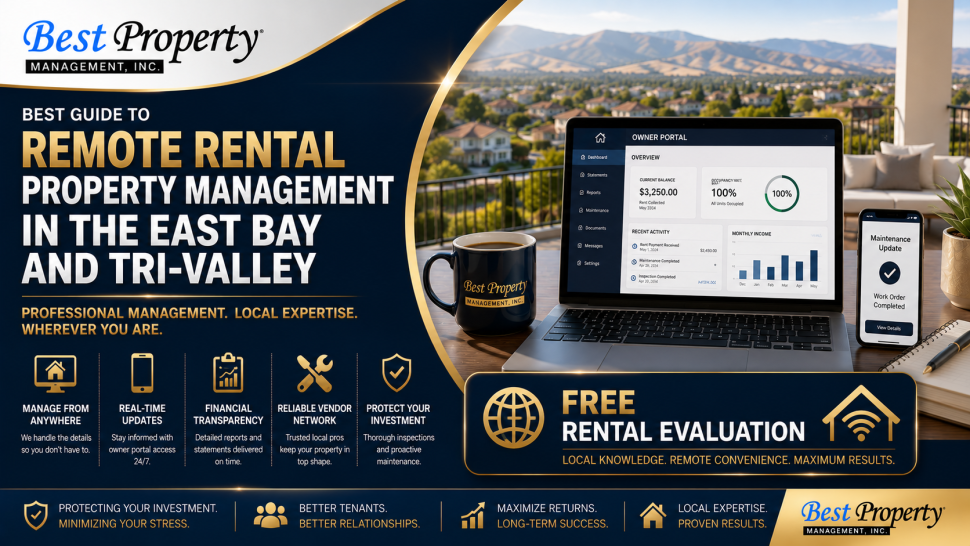
Owners comparing the larger regional relationship may begin with the Best Guide to East Bay Property Management and the Best Guide to Tri-Valley Property Management. These guides explain the broader service structure, while this article focuses specifically on how long-distance owners can maintain control without handling every local task themselves.
Quick Answer: Remote rental property management should give East Bay and Tri-Valley owners reliable local coordination, clear approval rules, documented tenant communication, organized maintenance handling, property-condition visibility and understandable financial reporting. The owner should know who receives tenant requests, how urgent repairs are evaluated, when approval is needed, what documentation follows a property visit and how leasing or turnover decisions are handled. A property manager cannot guarantee on-time rent, prevent every repair or eliminate the owner’s legal and financial responsibilities. The value is a repeatable operating structure that keeps the owner informed while a local professional coordinates day-to-day work. Before hiring, remote owners should review communication standards, maintenance authorization, emergency procedures, inspection practices, owner statements, service boundaries and the process for transitioning an occupied property.
Speak with Best Property Management about the local support, approval structure and reporting your remote East Bay or Tri-Valley rental may need.
What Should Remote Rental Property Management Accomplish?
Remote property management should replace scattered reactions with a dependable local operating structure. The owner still sets goals, approves major decisions, funds property expenses and remains responsible for ownership obligations. The manager’s role is to coordinate the rental locally, communicate with tenants, organize records and give the owner enough information to make decisions from a distance.
A strong arrangement begins with clarity. The owner and manager should know who handles routine tenant questions, how maintenance requests are categorized, which expenses require approval and how the owner is contacted when a decision is time-sensitive. The process should also define where leases, invoices, inspection records, HOA notices and tenant communications are stored. Remote ownership becomes difficult when information lives in personal text messages or when different people give the owner different versions of the same event.
Local context matters. A remote owner with a Fremont condo may need someone who can coordinate association access and work within building procedures. A Livermore owner may need stronger oversight of landscaping, fencing or irrigation. A Brentwood rental may require a local point of contact who can meet vendors and verify completed work. The operating system should adapt to the property rather than forcing every rental into one generic process.
| Owner Need | Local Management Function | Owner Visibility |
|---|---|---|
| Tenant contact | Receive and organize routine tenant communication | Updates on material issues and unresolved concerns |
| Maintenance | Assess urgency, schedule vendors and document follow-up | Approval requests, invoices and completion notes |
| Property condition | Coordinate appropriate observations or inspections | Written findings and photographs when provided |
| Financial activity | Track rent, expenses and account transactions | Owner statements and supporting records |
| Leasing and turnover | Coordinate preparation, marketing and move-in tasks | Recommendations, approvals and final documentation |
Owner takeaway: Remote management works best when the owner can see the system without having to operate it. The goal is not constant messaging. It is dependable information at the right decision points.
How Should Communication and Approval Limits Be Structured?
Communication and approval rules should be documented before the first urgent situation occurs. Remote owners need to know who their primary contact is, how routine updates are delivered and what happens when that person is unavailable. The agreement should also explain how the manager handles decisions that cannot wait for a long email exchange.
Approval limits are especially important. An owner may authorize routine work below an agreed amount while requiring specific approval for larger projects. That does not mean every issue can be delayed. A condition involving active water, electrical danger, lack of essential service or immediate property protection may require faster action. The manager should explain the contractual emergency process and how the owner is notified. Because companies structure authority differently, owners should not assume that one firm’s process applies to another.
Remote owners should also define communication preferences. Some want a concise monthly summary and immediate contact only for significant issues. Others want more frequent updates during turnover or a major repair. The method may vary, but the content should be clear: what happened, what has been verified, what decision is needed, what options exist and what the next step will be.
| Situation | Manager Should Clarify | Owner Decision |
|---|---|---|
| Routine repair | Scope, urgency and available vendor information | Approve, decline or request another option |
| Urgent condition | Immediate protective action and follow-up plan | Confirm larger repair direction when practical |
| HOA notice | Requirement, deadline and tenant or property impact | Approve response or corrective work |
| Lease decision | Tenant history, property condition and available options | Renew, revise terms or plan turnover |
| Capital improvement | Reason, estimates, timing and expected disruption | Select scope and funding approach |
A practical communication plan also protects the owner from information overload. Tenants should have one recognized way to report routine concerns. Vendors should communicate through the management process rather than contacting the owner independently. The owner should receive organized summaries instead of trying to reconcile multiple conversations.
Owner takeaway: Approval authority should be specific enough to support timely action but limited enough to preserve the owner’s control over meaningful expenses and long-term decisions.
How Should Rent Collection, Tenant Communication and Reporting Work?
Remote owners need a rent-collection and reporting process that makes the account understandable without requiring local follow-up. The manager should explain how tenants are instructed to pay, how payments and charges are recorded, how delinquencies are communicated and what information appears on the owner statement. No system can guarantee that every tenant will pay on time, but a repeatable process can identify exceptions and preserve better records.
Tenant communication should remain professional and centralized. Routine questions about rent, repairs, access, lease terms or shared responsibilities should go through the manager rather than bouncing between the tenant and an out-of-area owner. This reduces mixed instructions. It also allows the owner to receive a useful summary when an issue requires a decision instead of being drawn into every preliminary conversation.
Owner reporting should connect the financial and operational sides of the property. A monthly statement is more useful when the owner can identify rent received, management charges, vendor expenses, reserves, adjustments and the resulting balance. Supporting invoices or notes help explain why an expense occurred. Remote investors with several properties may also need records organized by property so they can review performance and prepare information for their accountant.
| Report or Record | What It Should Help Explain | Why Remote Owners Need It |
|---|---|---|
| Owner statement | Income, expenses, fees and distributions | Provides a consistent financial overview |
| Rent ledger | Charges, payments and unresolved balances | Clarifies tenant account activity |
| Vendor invoice | Work performed and amount charged | Supports expense review |
| Inspection or visit record | Observed condition and recommended follow-up | Adds property visibility from a distance |
| Lease and renewal file | Current terms, dates and signed documents | Supports future decisions and recordkeeping |
Owners evaluating this function can review Best Property Management’s verified property management services and compare how tenant communication, rent handling and owner records fit into the full service relationship.
How Should Maintenance, Emergencies and Vendor Oversight Be Coordinated?
Maintenance is often the point where remote ownership feels most vulnerable. The owner cannot easily inspect a leak, meet a technician or confirm whether a repair solved the original problem. A capable management process should create a documented path from tenant report to completion: receive the request, evaluate urgency, obtain the necessary owner decision, coordinate access, schedule a qualified vendor and record the outcome.
The owner should understand how vendors are selected and whether estimates are normally obtained for larger nonurgent work. Price is important, but it is not the only consideration. Availability, licensing when required, insurance, experience with occupied rentals and the ability to document work can also matter. Remote owners should be cautious when a company cannot explain whether invoices, photographs or completion notes are available.
Emergency coordination deserves separate attention because the owner may be asleep, traveling or temporarily unreachable. The management agreement should describe what the manager may do to protect people or property and how the owner will be contacted. Owners should ask for examples of how the company distinguishes an emergency from an urgent but nonemergency repair. The answer should be practical and should not rely on guarantees.
Property-specific responsibilities also matter. A Livermore home may need irrigation and landscaping follow-up. A Dublin or San Ramon townhome may involve HOA access, shared-area procedures or restrictions on contractor scheduling. A Brentwood property may require coordination for exterior systems or a larger yard. The manager should understand which tasks belong to the owner, tenant, association or vendor before authorizing work.
Remote owners can also review the company’s published property maintenance service when comparing how maintenance coordination fits into ongoing management.
Owner takeaway: The strongest maintenance process gives the owner evidence, options and a clear next step. Distance should not force the owner to approve work based on vague descriptions.
Ask how Best Property Management would organize maintenance approvals, vendor communication and emergency contact for your specific rental property.
How Do Remote Owners Maintain Property-Condition Visibility?
Remote owners maintain property visibility through planned documentation rather than constant surveillance. Appropriate property visits, move-in and move-out records, maintenance follow-up and exterior observations can each answer different questions. Owners should ask what types of inspections or visits are available, when they are appropriate and what report or photographs the owner may receive.
A routine occupied-property inspection is not the same as a maintenance visit. An inspection may review general condition, visible maintenance concerns and other items within the agreed scope. A maintenance follow-up may focus only on whether a specific repair was completed. An exterior observation cannot confirm interior condition. Move-in and move-out documentation supports a different purpose by establishing condition around occupancy changes. The manager should explain these differences rather than using the word inspection for every visit.
The property type should shape the oversight plan. A remote owner with a Fremont condominium may need documentation of interior condition plus coordination around common-area rules. A Livermore single-family rental may require attention to landscaping, irrigation and exterior deterioration. A small multi-unit property may require observation of shared areas and recurring maintenance patterns. Owners should avoid assuming that a fixed inspection schedule is automatically right for every property.
Useful documentation is specific and dated. It identifies the area observed, describes the condition, separates facts from recommendations and notes whether follow-up is needed. Photographs can help, but they should have enough context for the owner to understand what is being shown. Inspections do not guarantee that damage, lease violations or maintenance failures will be prevented. They provide another source of information for responsible decisions.
How Should Leasing, Turnover and Occupied-Property Transitions Work?
Remote management should cover both stable occupancy and periods of change. Leasing and turnover usually require more owner decisions in a shorter period: property preparation, repair priorities, asking rent, marketing, application review, lease terms, move-in documentation and funding for work. The manager should organize those decisions so the owner is not trying to direct several vendors and applicants from another city or state.
For a vacant home, the manager should first identify what must be completed before marketing and what improvements are optional. The owner then needs a clear recommendation, estimated costs when available and an understanding of how the property will be presented. A remote owner should not discover after listing that photographs were delayed because access was unclear or that an HOA required a move-in procedure nobody reviewed.
Occupied-property transitions require a different approach. An owner may be transferring a tenant from self-management or another company. The new manager needs accurate lease documents, tenant contact information, payment history, deposits, maintenance records, keys, HOA information and open issues. Tenants should receive clear instructions about where to send rent and requests after the transition. The manager should avoid making unsupported promises before reviewing the existing documents and property condition.
Local city guidance can also help owners understand regional differences. A remote owner with a condo can review the Fremont property management page, while owners with suburban homes may find the Livermore property management page or Brentwood property management page relevant when comparing local service coverage.
Owner takeaway: Remote owners should expect a documented transition plan. The goal is continuity for the tenant and complete information for the owner, not simply changing the name on the rent instructions.
What Should Remote Owners Ask Before Hiring a Management Company?
Remote owners should compare management companies by testing how clearly each company explains local execution and owner visibility. A low fee or confident sales presentation does not show what will happen when a tenant reports a problem on a Friday evening or when an HOA notice arrives while the owner is traveling.
Begin with communication. Ask who your main contact will be, how routine updates are delivered, what qualifies for immediate contact and how coverage works when the primary contact is unavailable. Then ask about maintenance authority, emergency decisions and documentation. Request an explanation of what an owner receives after a repair, inspection or turnover.
Financial questions are equally important. Ask for a sample owner statement, an explanation of reserves and a written fee schedule. Understand which services are included, which may cost extra and how owner funds are handled under the agreement. For leasing, ask how property preparation, pricing recommendations, showings, screening and move-in coordination are divided between the manager and owner.
| Question to Ask | Strong Answer Should Address | Warning Sign |
|---|---|---|
| How will I be updated? | Primary contact, routine reporting and urgent escalation | Only general promises about communication |
| How are repairs approved? | Authority limits, emergencies, estimates and documentation | No clear approval process |
| What reports will I receive? | Statements, invoices and property-condition records | No sample documents |
| How do you transition occupied rentals? | Lease review, tenant notice, funds, keys and open issues | Assumption that transfer is automatic |
| What remains my responsibility? | Owner decisions, funding, insurance, tax and legal duties | Claim that management removes all responsibility |
Red flags include inconsistent answers, vague maintenance authority, reluctance to provide sample documents, no clear process for occupied-property onboarding and promises that the owner will never need to be involved. Remote ownership can be easier with management, but it still requires informed decisions and adequate property funding.
How Does Best Property Management Support Remote East Bay and Tri-Valley Owners?
Best Property Management supports rental owners through its East Bay and Tri-Valley service network, including local coverage connected with Fremont, Livermore and Brentwood. For remote owners, the practical benefit of local support is the ability to coordinate tenant communication, leasing, maintenance, inspections, rent collection and owner reporting without personally handling each local appointment.
The service relationship should still be tailored to the property. A Fremont condo may involve association procedures and building access. A Dublin or San Ramon townhome may require HOA coordination and careful move-in planning. A Livermore single-family home may have landscaping and exterior responsibilities. A Brentwood property may require local vendor coordination for a larger suburban home. Best Property Management’s published regional and city pages help owners identify the relevant office and service area without assuming every property follows the same plan.
Remote owners should provide complete information at onboarding, including the lease, tenant history, deposit records, maintenance history, insurance information, HOA contacts, appliance details, warranties, keys and known property concerns. The management team can then explain available services, identify unresolved issues and establish the communication and approval structure. Where legal, tax or specialized technical advice is needed, owners should work with the appropriate qualified professional.
Owner takeaway: The best remote-management relationship combines local execution with owner control. Best Property Management can provide the local coordination, while the owner remains informed and responsible for major ownership decisions.
FAQ
Can I own a rental property in California while living in another state?
Yes. Many owners keep California rental property after relocating or inherit property while living elsewhere. Distance does not remove the owner’s legal, financial, insurance or tax responsibilities. A local property manager can coordinate tenant communication, rent collection, maintenance, inspections and leasing, but the owner still needs to fund expenses, maintain appropriate coverage and make major decisions. Owners should consult qualified legal and tax professionals about their particular situation.
How do remote owners approve repairs?
The management agreement should explain how repair approval works. Many arrangements establish a routine authorization amount while requiring owner approval for larger nonurgent work. Emergencies may be handled differently when immediate action is needed to protect people or property. Owners should ask how estimates, invoices, photographs and completion notes are provided and how the manager proceeds when the owner cannot be reached.
What reports should a remote rental owner receive?
Useful records may include owner statements, rent ledgers, vendor invoices, lease documents, renewal records, inspection or visit reports and move-in or move-out documentation. The exact reports vary by company and service agreement. Remote owners should request sample documents before hiring and ask how records are delivered, how long they remain accessible and whom to contact when an entry needs clarification.
How are emergencies handled when the owner is unavailable?
The management agreement should define emergency authority, contact procedures and any spending or decision limits. A manager may need to coordinate immediate protective action when delay could create danger or additional property damage. The owner should ask how the company identifies an emergency, who is available outside normal hours, how vendors are selected and what documentation follows. No company can guarantee that every emergency will be prevented or resolved without disruption.
Should remote owners receive inspection photographs?
Photographs can improve visibility when they are dated, labeled and connected to a written explanation. However, not every visit has the same scope and an exterior observation cannot document interior condition. Owners should ask what inspection or visit services are available, what the report includes and when photographs are provided. Inspections and photographs do not guarantee that damage or lease concerns will be discovered.
Can an occupied rental be transferred to a property manager?
Yes, an occupied rental can often transition to professional management, but the process requires complete records and careful communication. The manager may need the signed lease, tenant contact information, deposit records, payment history, keys, maintenance files, HOA information and details about unresolved issues. The tenant should receive clear instructions about future rent payments and service requests. The company should review the existing documents before making recommendations.
What responsibilities still belong to the remote owner?
The owner generally remains responsible for ownership decisions, adequate property funding, insurance, taxes, major approvals and compliance obligations that cannot be delegated by contract. The manager can coordinate daily operations and provide information, but cannot eliminate the owner’s responsibility for the property. Owners should read the management agreement carefully and obtain professional advice when a legal, tax, insurance or construction issue requires it.
How should a remote owner compare property management companies?
Compare companies by asking about communication, maintenance authority, emergency procedures, inspections, owner reports, leasing, occupied-property transitions and service fees. Request sample statements and inspection reports when available. Look for clear written answers rather than promises that management will be completely hands-off. Strong remote management should reduce daily work while preserving the owner’s visibility and decision-making control.
Remote ownership becomes more manageable when the property has a reliable local operating structure. Clear approvals, organized tenant communication, documented maintenance, meaningful condition reporting and understandable financial records allow the owner to make decisions without being physically present for every task. The right management relationship should reduce daily involvement while preserving owner control.
Request a Free Rental Evaluation to discuss remote property management for your East Bay or Tri-Valley rental.
Blog
Company News
Landlord Resources
Landlords
Legal
Linkedin
Local Market Insights
Maintenance & Repairs
Market
Owners
Property
Property Law & Compliance
Property Management
Rental Property
Tenants
Video
FILTER BY EASTBAY & TRI-VALLEY CITIES
AB 1482
AI Rental Fraud
Antioch Property Management
Applicant Data Security
Applicant Information
Applicant Screening
Applicant Verification
Bank Statement Fraud
Brentwood
Brentwood property management
California Insurance
California Landlord Laws
California Property Management
California Rent Increase
Central Valley Property Management
Concord Property Management
Credit Reports
Danville Property Management
Danville rentals
Desert Hot Springs Property Management
Desert Property Maintenance
Desert Rentals
Document Fraud
Dublin property management
East Bay Landlords
East Bay Lease Renewals
East Bay property management
East Bay Rental Market
East Bay Rental Owners
East Bay Rental Property Maintenance
East Bay Rental Property Management
East Bay rental tips
East Bay Rentals
Eviction Notices
Eviction Support
Fair Housing
Fake Pay Stubs
Fall Leasing
find a property manager
Fremont
Fremont property management
full service property management
Full-Service Property Management
Good Tenants
Hayward Property Management
Hayward rentals
hiring a property manager
HOA Compliance
HOA Rental Management
HOA Rentals
Home Insurance Costs
Identity Verification
Income Verification
Indian Wells Property Management
Inherited Rental Property
Landlord Compliance
Landlord Data Security
Landlord Insurance
Landlord Resources
Landlord Tips
Lease Renewal Strategy
Lease Renewals
Leasing Fees
Leasing Services
Livermore
Livermore property management
Livermore Rentals
Local Development
Local Market Insights
Local Rental Support
Long-Term Rentals
Luxury Rentals
maintenance coordination
Maintenance Response
Management Services
Manteca Property Management
Milpitas Property Management
Mountain House Property Management
New Housing San Ramon
Newark CA Property Management
Oakley Property Management
Online Rent Payments
Owner Onboarding
owner reporting
Palm Desert Property Management
Palm Springs Area Property Management
Palm Springs Property Management
Palm Springs Rentals
Pittsburg CA Property Management
Pleasanton property management
Pleasanton rentals
Preventive Maintenance
Property Inspections
Property Maintenance
Property Management
Property Management Companies
Property Management Fees
Property Management Services
Property Management Transition
Property Manager
Rancho Mirage Property Management
Real Estate
real estate investing
Redfin Rentals
Remote Property Management
Rent Collection
Rent Control
Rent Trends
Rental Application Fraud
Rental Application Privacy
Rental Competition
Rental Fees
Rental Fraud
Rental History
Rental Inspections
rental leasing
Rental Market Analysis
Rental Market Trends
Rental Marketing
Rental Pricing
Rental Property
Rental Property Expenses
Rental Property Maintenance
rental property owners
rental property ROI
Renter Choice
Renter Experience
Repair Coordination
Resident Portal
Residential Leasing
San Lorenzo Property Management
San Ramon Landlords
San Ramon Orchards
San Ramon property management
San Ramon Rental Market
Screening Red Flags
Seasonal Rentals
Security Deposits
Sell or Rent
Silicon Valley Rentals
single family rentals
Single-Family Rentals
Tenant Background Checks
Tenant Communication
Tenant Complaints
Tenant Expectations
Tenant Issues
Tenant Placement
Tenant Protection Act
Tenant Retention
tenant screening
Tenant Screening Data Security
Tenant Screening Fraud
Tenant Screening Red Flags
Tenant Turnover
Tracy Property Management
Tri-Valley
Tri-Valley Housing Market
Tri-Valley property management
Tri-Valley Rentals
Union City Property Management
Vacation Rental Management
Wildfire Risk
Zillow Rentals
 FILTER
 SEARCH BLOG