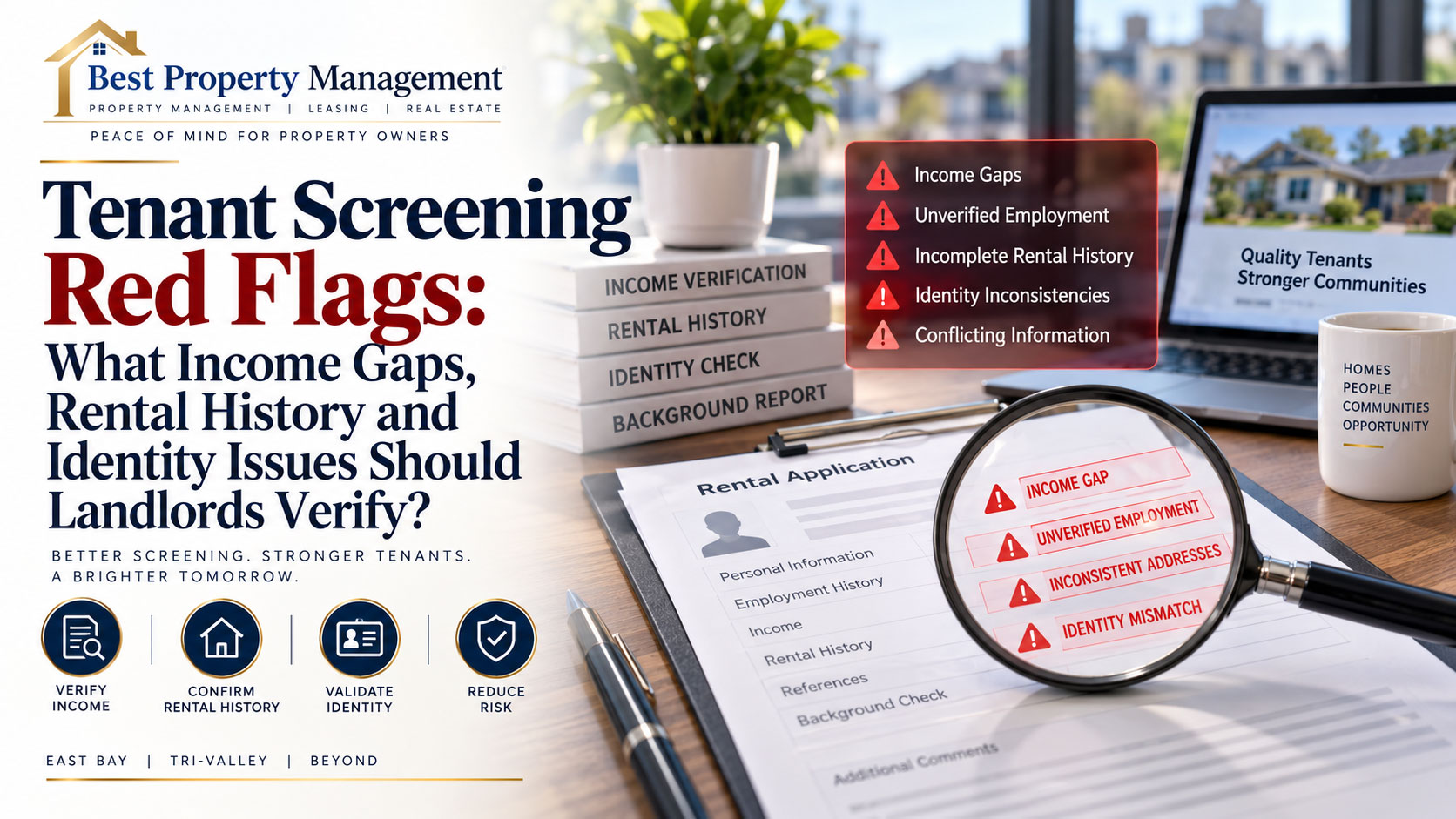
Tenant Screening Red Flags: What Income Gaps, Rental History and Identity Issues Should Landlords Verify?
Not every unusual rental application is fraudulent.
A gap in employment may have a reasonable explanation. A previous address may be missing because an applicant lived with family. Income may fluctuate because the applicant earns commissions, works seasonally or is self-employed.
But inconsistencies can still matter.
For East Bay rental owners, the challenge is knowing which application issues deserve verification without turning screening into guesswork or subjective judgment.
Quick Answer: Tenant screening red flags should be treated as signals to verify, not automatic reasons to reject an applicant. Landlords should pay attention to unexplained income gaps, conflicting employment information, incomplete rental history, identity mismatches, inconsistent addresses and documents that do not align with the application. The strongest process uses written screening criteria, independent verification and consistent follow-up. Owners should evaluate facts tied to lawful rental qualifications rather than relying on intuition about who seems trustworthy.
What Does a Real Tenant Screening Red Flag Look Like?
The phrase “red flag” gets used loosely.
Sometimes it means a legitimate inconsistency.
Other times it simply means something about an applicant feels unfamiliar.
Those are not the same thing.
A useful screening red flag should be objective and verifiable.
Examples might include:
- Income figures that conflict across documents
- Employment dates that do not match the application
- A prior address that cannot be verified
- Identity information that differs across records
- Rental history with unexplained gaps
- A reference that cannot be independently confirmed
- Documents that appear internally inconsistent
- An applicant using information that does not match trusted records
TransUnion has described a growing “trust gap” in rental applications, where applications can look complete and legitimate while relying on unreliable or manipulated information. It specifically identifies income, employment and identity as areas where verification is becoming more important.
The important word is verification.
A mismatch does not automatically mean fraud.
It means the information may need clarification.
That distinction helps owners reduce risk while keeping screening fair.
Best Property’s tenant screening service is built around reviewing income, employment, rental history, credit and identity together rather than making a decision from one isolated signal.
Owner takeaway: A useful red flag is a factual inconsistency that can be checked. A personal impression is not a screening standard.
How Should Landlords Review Income Gaps and Employment Changes?
Income gaps can look concerning, but they do not all mean the same thing.
An applicant may have:
- Changed employers
- Been temporarily unemployed
- Taken family leave
- Returned to school
- Started a business
- Shifted from salary to commission
- Added freelance income
- Recently accepted a better-paying position
The screening question should therefore be:
Does the applicant currently meet the property’s lawful income qualification standard?
Not:
Has the applicant’s work history always been perfectly continuous?
That is an important difference.
For current income, owners should compare:
| Income Question | What to Verify |
|---|---|
| Current employer | Does the employer match the application? |
| Current income | Does verified income meet the written standard? |
| Pay frequency | Do pay periods and deposits make sense? |
| Employment start date | Does it align with the application? |
| Variable income | Is there enough history to evaluate recurring earnings? |
| Multiple income sources | Are they legitimate and appropriately documented? |
A recent employment gap may matter less than whether current qualifying income can be verified.
Likewise, a long employment history should not automatically override inconsistent or unverifiable current income.
TransUnion’s current guidance emphasizes a layered approach in which income verification, identity verification and credit or eviction screening each address different types of risk.
Owners should also avoid changing the standard based on who applied.
For example, requiring extensive documentation from one applicant while accepting minimal documentation from another applicant with similar circumstances creates unnecessary inconsistency.
If you are screening applicants for an East Bay rental, Best Property Management can help verify income, employment, rental history and identity through a structured tenant-placement process.
What Rental History Issues Should Landlords Verify?
Rental history is useful because it can provide context about how an applicant handled a prior tenancy.
But rental-history information should also be verified carefully.
Possible issues include:
- Missing prior addresses
- Inconsistent move-in or move-out dates
- Landlord contact information that cannot be independently confirmed
- A stated landlord who appears to be a friend or relative
- Different prior addresses appearing across the application and screening report
- Unexplained periods with no listed residence
- Rental references that conflict with other records
Again, these issues do not automatically prove misconduct.
An applicant may have lived with family.
They may have owned a home.
They may have been a student.
They may have moved frequently for work.
The landlord’s task is to determine whether the information relevant to the screening criteria can be verified.
The FTC notes that tenant background reports can include rental and eviction history, credit information and other records, and those reports are considered consumer reports under the Fair Credit Reporting Act.
That means third-party information also needs to be handled carefully.
A screening report may contain an address the applicant disputes.
A court record may belong to someone with a similar name.
A prior landlord report may be incomplete.
So the owner should avoid assuming that every database result is automatically correct.
A strong process asks:
Does the rental history make sense when compared with the rest of the application?
Best Property’s tenant background check service incorporates rental history alongside identity, income and employment verification.
Owner takeaway: Rental-history verification is most useful when it confirms a consistent timeline rather than serving as a subjective character judgment.
What Identity Issues Should Landlords Take Seriously?
Identity verification has become more important as rental fraud becomes more sophisticated.
TransUnion notes that synthetic identities can combine real and fabricated information in ways that may pass surface-level checks. Its resident identity-verification tools are designed to evaluate identity risk and digital fraud signals.
For an owner, identity-related inconsistencies might include:
- Name variations that cannot be explained
- Date-of-birth mismatches
- Address history that does not align
- Government identification that does not match the application
- Information that appears tied to multiple identities
- Screening data that does not correspond with the applicant
But identity verification should not turn into assumptions about names, accents, nationality or cultural differences.
A name difference may have a perfectly legitimate explanation.
People marry.
Names change.
Some applicants use shortened names professionally.
Others may have hyphenated or multiple surnames.
The appropriate response is the same as with financial discrepancies:
verify the factual information under a consistent policy.
Not:
make assumptions about the person.
Experian also emphasizes identity and document verification as an important part of modern rental-fraud prevention.
This is another reason professional screening tools can be useful.
They may help confirm identity through trusted data rather than requiring an individual landlord to decide whether an ID “looks right.”
Why Credit or Eviction History Should Not Be Treated as a Simple Red Flag
Credit and eviction records can be relevant to tenant screening.
But they require context.
A credit report may show:
- Late payments
- High balances
- Recent credit inquiries
- Collections
- Limited credit history
An eviction-related record may also appear in a tenant-screening report.
Those facts should not automatically be treated as interchangeable.
The FTC explains that tenant-screening reports are consumer reports under the Fair Credit Reporting Act and that landlords who rely on them in an adverse decision have specific obligations.
HUD also cautions against imprecise or overbroad screening criteria that may exclude applicants without being closely connected to whether they are likely to meet their tenancy obligations.
A current TransUnion study provides an example of why context matters.
Its June 2026 research found that applicants with 15 or more recent credit inquiries within seven days showed significantly higher later charge-off rates than the overall sample. But even that kind of data is a risk indicator, not proof that a particular applicant is fraudulent or will default.
This distinction matters.
Good screening uses data to support a consistent decision process.
Poor screening converts one data point into a personal prediction about an applicant.
How Can Landlords Follow Up Without Creating Fair Housing Problems?
This is where written criteria become essential.
HUD’s tenant-screening guidance makes clear that housing providers have a legitimate interest in selecting tenants who are likely to pay rent and follow lease requirements. But it also warns that overly broad or inconsistent screening practices can create discriminatory results.
Owners should therefore decide before applications arrive how discrepancies will be handled.
For example:
- Which income documents are accepted?
- When is direct verification required?
- What counts as a complete rental-history record?
- How are conflicting addresses handled?
- What identity-verification process is used?
- How much time does an applicant receive to clarify a discrepancy?
- Who makes the approval decision?
- How is the decision documented?
The same process should apply to similarly situated applicants.
A landlord should avoid:
“I trust this applicant, so I will overlook the inconsistency.”
or:
“This applicant makes me nervous, so I want extra proof.”
Those are subjective approaches.
A better rule might be:
“When submitted income documents conflict with the application, independent income verification is required.”
That is objective.
Best Property’s East Bay leasing and tenant placement guide emphasizes written screening criteria, consistent application processing and documented verification.
What Should Landlords Do When Information Does Not Match?
A discrepancy should usually trigger a process, not an accusation.
A practical approach can look like this:
1. Identify the exact inconsistency
Be specific.
For example:
The employment start date on the application differs from the verification record.
That is more useful than:
The application looks suspicious.
2. Determine whether the inconsistency matters to the rental criteria
A minor formatting difference may not matter.
An unverifiable income source may matter significantly.
3. Request clarification consistently
Use the same process and timing that would apply to another applicant in the same situation.
4. Verify the information independently when appropriate
This may involve employment, income, identity or rental-history verification.
5. Evaluate the application against the written standard
The decision should be based on whether the qualification criteria are satisfied.
6. Document the result
Record the factual reason behind the decision.
If a consumer report influences an adverse action, the Fair Credit Reporting Act can require an adverse-action notice. The FTC notes that adverse actions can include denial, requiring a co-signer or imposing different financial terms because of consumer-report information.
This structure makes the screening decision easier to explain.
It also helps separate fraud prevention from subjective judgment.
Tenant screening is becoming more complex as applicant information and fraud techniques evolve. Contact Best Property Management for tenant screening, applicant verification, residential leasing and full-service property management throughout the East Bay and Tri-Valley.
Related Tenant Screening Resources
- Tenant Screening for Rental Property Owners
- Tenant Background Checks
- East Bay Leasing and Tenant Placement Guide
- Residential Leasing Services
Frequently Asked Questions About Tenant Screening Red Flags
What are the biggest red flags on a rental application?
The most useful red flags are objective inconsistencies rather than personal impressions. Examples include income that cannot be verified, employment dates that conflict, unexplained gaps in rental history, identity information that does not match trusted records and documents that contradict other parts of the application. None of these automatically proves fraud. They indicate that additional verification may be appropriate. Landlords should establish the verification process before applications arrive and apply it consistently to applicants who present comparable circumstances.
Is an employment gap a reason to reject a rental applicant?
Not by itself. An employment gap may have many legitimate explanations, including job changes, caregiving, education, illness or a transition into self-employment. The more relevant screening question is whether the applicant currently satisfies the property’s lawful income and qualification requirements. If current income is verifiable and meets the written standard, a past gap may not determine the outcome. Landlords should avoid policies that automatically treat every employment interruption as a negative factor without considering whether it actually relates to the applicant’s ability to meet tenancy obligations.
What should landlords verify in an applicant’s rental history?
Landlords may review prior addresses, tenancy dates, rental-payment history and other lawful rental-history information included in their screening process. The key is to confirm that the timeline is reasonably consistent and that references can be verified. Missing history should not automatically be treated as fraud because applicants may have lived with family, owned a home or had other legitimate housing arrangements. Third-party screening reports can also contain errors, so discrepancies should be investigated consistently rather than automatically accepted as accurate.
What identity issues should concern a landlord during tenant screening?
Identity concerns become relevant when core information cannot be reconciled, such as conflicting names, birth dates, addresses or identification records. Modern fraud techniques can also involve synthetic identities that combine real and fabricated information. However, ordinary name variations or address changes can have legitimate explanations. Landlords should rely on a consistent identity-verification procedure rather than assumptions about an applicant’s name, appearance or background. Professional verification tools can help confirm whether applicant information corresponds with trusted identity data.
Can a landlord reject an applicant because something “doesn’t feel right”?
That is a risky screening approach. Rental decisions should be tied to lawful written qualification criteria and objectively verifiable information rather than intuition. HUD emphasizes that housing providers should use screening practices that are relevant to whether applicants are likely to meet tenancy obligations and apply them in a nondiscriminatory manner. If an application contains a discrepancy, identify the factual issue, follow the established verification process and document whether the applicant ultimately satisfies the qualification standard.
Best Property Management Bay Area Offices
Brentwood Office 200 Sand Creek Rd., Suite D, Brentwood, CA 94513 925-392-2411
Fremont Office 40087 Mission Blvd., Fremont, CA 94539 510-770-0824
Livermore Office 2300 First Street, Suite 236, Livermore, CA 94550 925-292-1785
Tracy Office 672 W. 11th Street, Tracy, CA 95376 1-800-910-1237
This article is provided for general informational purposes only and is not legal, financial, fair housing or tenant-screening compliance advice. Screening requirements, consumer-reporting laws and individual circumstances can vary. Rental property owners should verify current requirements and consult qualified professionals when appropriate.
Blog
Company News
Landlord Resources
Landlords
Legal
Linkedin
Local Market Insights
Maintenance & Repairs
Market
Owners
Property
Property Law & Compliance
Property Management
Rental Property
Tenants
Video
FILTER BY EASTBAY & TRI-VALLEY CITIES
AB 1482
AI Rental Fraud
Antioch Property Management
Applicant Data Security
Applicant Information
Applicant Screening
Applicant Verification
Bank Statement Fraud
Brentwood
Brentwood property management
California Insurance
California Landlord Laws
California Property Management
California Rent Increase
Central Valley Property Management
Concord Property Management
Credit Reports
Danville Property Management
Danville rentals
Desert Hot Springs Property Management
Desert Property Maintenance
Desert Rentals
Document Fraud
Dublin property management
East Bay Landlords
East Bay Lease Renewals
East Bay property management
East Bay Rental Market
East Bay Rental Owners
East Bay Rental Property Maintenance
East Bay Rental Property Management
East Bay rental tips
East Bay Rentals
Eviction Notices
Eviction Support
Fair Housing
Fake Pay Stubs
Fall Leasing
find a property manager
Fremont
Fremont property management
full service property management
Full-Service Property Management
Good Tenants
Hayward Property Management
Hayward rentals
hiring a property manager
HOA Compliance
HOA Rental Management
HOA Rentals
Home Insurance Costs
Identity Verification
Income Verification
Indian Wells Property Management
Inherited Rental Property
Landlord Compliance
Landlord Data Security
Landlord Insurance
Landlord Resources
Landlord Tips
Lease Renewal Strategy
Lease Renewals
Leasing Fees
Leasing Services
Livermore
Livermore property management
Livermore Rentals
Local Development
Local Market Insights
Local Rental Support
Long-Term Rentals
Luxury Rentals
maintenance coordination
Maintenance Response
Management Services
Manteca Property Management
Milpitas Property Management
Mountain House Property Management
New Housing San Ramon
Newark CA Property Management
Oakley Property Management
Online Rent Payments
Owner Onboarding
owner reporting
Palm Desert Property Management
Palm Springs Area Property Management
Palm Springs Property Management
Palm Springs Rentals
Pittsburg CA Property Management
Pleasanton property management
Pleasanton rentals
Preventive Maintenance
Property Inspections
Property Maintenance
Property Management
Property Management Companies
Property Management Fees
Property Management Services
Property Management Transition
Property Manager
Rancho Mirage Property Management
Real Estate
real estate investing
Redfin Rentals
Remote Property Management
Rent Collection
Rent Control
Rent Trends
Rental Application Fraud
Rental Application Privacy
Rental Competition
Rental Fees
Rental Fraud
Rental History
Rental Inspections
rental leasing
Rental Market Analysis
Rental Market Trends
Rental Marketing
Rental Pricing
Rental Property
Rental Property Expenses
Rental Property Maintenance
rental property owners
rental property ROI
Renter Choice
Renter Experience
Repair Coordination
Resident Portal
Residential Leasing
San Lorenzo Property Management
San Ramon Landlords
San Ramon Orchards
San Ramon property management
San Ramon Rental Market
Screening Red Flags
Seasonal Rentals
Security Deposits
Sell or Rent
Silicon Valley Rentals
single family rentals
Single-Family Rentals
Tenant Background Checks
Tenant Communication
Tenant Complaints
Tenant Expectations
Tenant Issues
Tenant Placement
Tenant Protection Act
Tenant Retention
tenant screening
Tenant Screening Data Security
Tenant Screening Fraud
Tenant Screening Red Flags
Tenant Turnover
Tracy Property Management
Tri-Valley
Tri-Valley Housing Market
Tri-Valley property management
Tri-Valley Rentals
Union City Property Management
Vacation Rental Management
Wildfire Risk
Zillow Rentals
 FILTER
 SEARCH BLOG