Property Management Termination Letter: What Should Owners Include Before Giving Notice?
A property management termination letter should identify the agreement and rental property, state the intended termination date, follow the contract’s notice requirements and request an orderly transfer of records, money and access. Read the agreement before sending it. A clear letter does not automatically eliminate fees, resolve a dispute or end every responsibility on the day it is delivered.
The awkward part is often what happens after the letter. Who answers the tenant? Who collects the next rent payment? What happens to the repair already scheduled for Friday? Your notice should begin a controlled closeout, not leave those decisions floating between two companies.
What should you read before writing the termination letter?
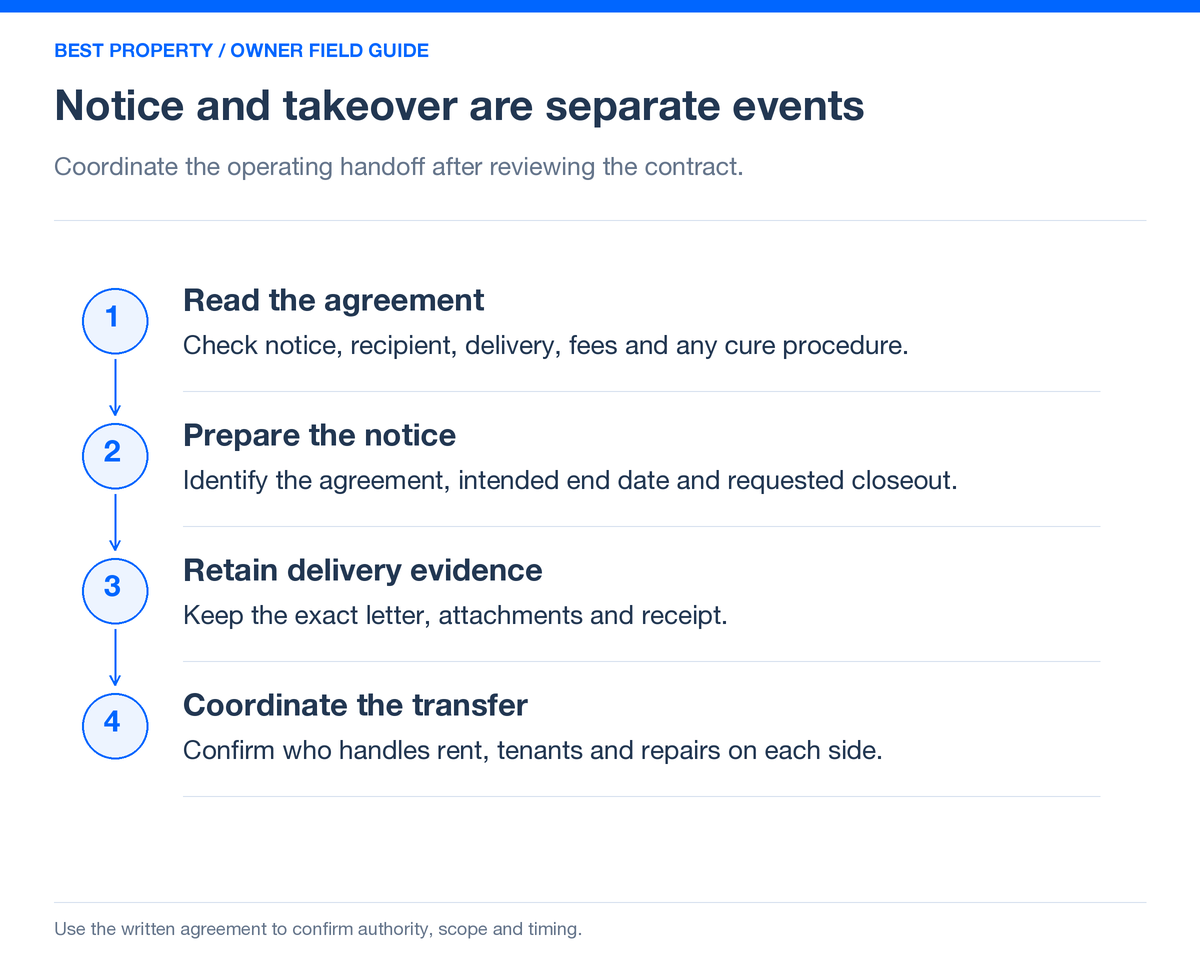
Find the signed management agreement and all amendments. Check the term, renewal provision, notice period, required recipient, delivery method, termination charges and any procedure for correcting a claimed service failure. A remembered conversation is a poor substitute for the actual clause.
Distinguish an ordinary termination from a claimed termination for cause. If you believe a breach permits a different procedure, have the facts and wording reviewed before using that route. The California DRE agency reference distinguishes ending an agency relationship from the potential contractual consequences. The practical lesson is to examine both authority and the agreement, rather than assume dissatisfaction creates a cost-free exit.
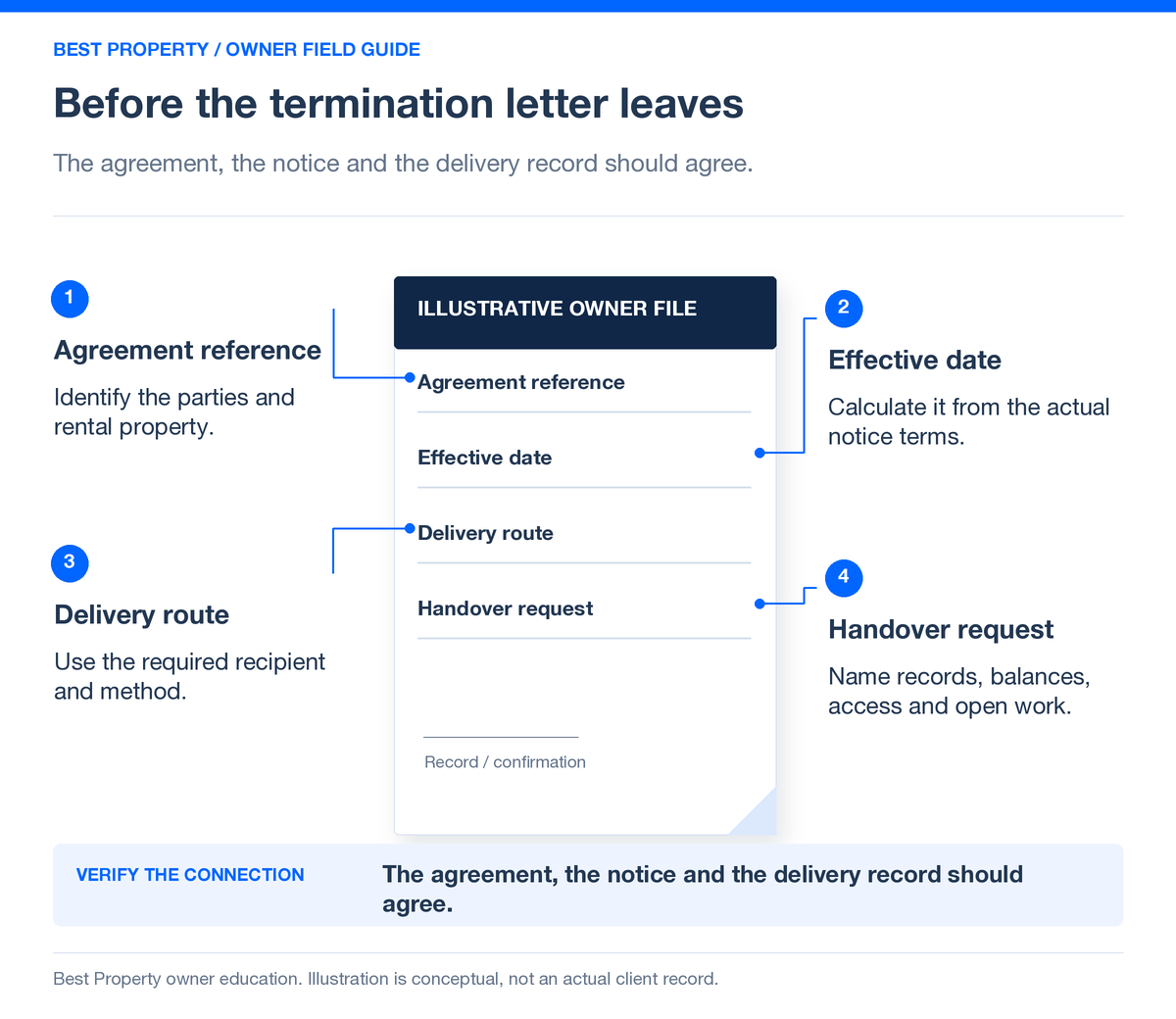
Make a small notice worksheet with the clause, recipient, method and proposed date. If those entries do not agree, resolve the inconsistency before mailing anything. Our management-agreement review gives owners additional questions about scope and termination terms.
What information belongs in the letter itself?
Keep the operative request easy to find. Identify the owner or authorized contracting party, management company, property address and agreement date if available. State that you are providing notice under the relevant termination provision and identify the intended effective date.
Include a reliable contact for coordinating the transition. Ask for written acknowledgment and a schedule for closing statements, funds, records and access. If an incoming manager is already selected, identify that company and describe the authority to receive the necessary material. Do not include sensitive tenant information in an unnecessarily broad email distribution.
| Letter element | Why it matters |
|---|---|
| Agreement and property | Prevents confusion when the owner or company has multiple rentals. |
| Termination provision | Connects the notice to the actual contract. |
| Intended effective date | Identifies the proposed endpoint of management authority. |
| Delivery and acknowledgment | Creates a record of what was sent and received. |
| Closeout requests | Makes the next operational steps visible. |
How do you choose the effective date and delivery method?
Use the agreement’s language to calculate the date and select the required notice method. Check whether the period is measured from sending, receipt or another event, and whether the wording refers to calendar days, business days or a particular billing cycle. Do not substitute a generic internet template for those details.
If email is convenient but the contract calls for another method, convenience does not answer the notice question. Keep the final letter, attachments and delivery evidence together. Where appropriate, ask the recipient to confirm the date they understand management will end.
Avoid casually changing that date in a later conversation. If the parties agree to a different closeout arrangement, document it clearly. An informal “that should be fine” can leave the owner, tenant and incoming manager working from different calendars. Seek advice if the clause or its application remains disputed.
What can an illustrative termination letter say?
The following is a drafting example, not a completed legal notice: “I am providing notice concerning the management agreement for [property], dated [agreement date]. Under [identified provision], the intended termination date is [date]. Please confirm receipt and the closeout schedule, including records, property access, open work and the reconciliation and transfer of funds.”
Add the actual delivery information, authorized sender and coordination contact. Adapt the wording to the agreement. Do not copy a sample statement that asserts a breach, waives a claim or promises payment unless you understand and intend that consequence.
Keep a service complaint separate when that makes the notice clearer. A factual chronology can accompany a disputed issue, but the reader should not have to hunt through three pages of frustration to identify the requested effective date. Documenting an unresponsive manager can help organize that separate record.
Which handover requests should accompany the notice?
Ask for the current lease and amendments, tenant ledger, owner statements, deposit accounting, reserve balance, unpaid invoices, open work orders, inspection records and property access inventory. Request a list of upcoming renewals, appointments and other deadlines. The outgoing company should know what you expect to receive and where it should go.
Do not assume every balance can be finalized before all outstanding transactions are known. Ask how pending rent, unpaid vendor bills, refunds or adjustments will be identified and reconciled. Distinguish a requested closeout schedule from a deadline actually established by the agreement or applicable law.
Our new-manager document checklist helps define the receiving file. For the broader transfer process, use the guide to switching managers without disrupting tenants. A good notice names the requested handoff; a separate checklist verifies that the handoff actually happened.
Who handles tenants and repairs while notice is running?
Identify responsibility for each period: before the effective date, on the date of transfer and afterward. The current manager may still be authorized to collect rent or coordinate work during the notice period. The incoming manager needs a clear start point rather than an assumption that authority begins when the owner signs a new agreement.
Keep tenant instructions practical. Confirm the management contact, payment destination and maintenance process that apply at each stage. Do not ask the tenant to interpret a dispute between companies. Verify new payment details through a known contact before instructions are distributed.
A repair needs the same continuity. If a plumber has an approved appointment, identify which company will coordinate access, receive the invoice and verify completion. Terminating an agreement should not cause an approved job to disappear from both companies’ work lists.
What should you check before considering the termination complete?
Compare the requested handover with what was received. Can the incoming manager open the lease file, identify the tenant balance, access the home and see every unfinished repair? Do the closing and opening financial records explain the same money? Has the tenant received one coherent set of instructions?
Keep an exception list for unresolved records, balances and work. Name the person responsible and the next checkpoint for each item. A letter marked delivered establishes an important event, but it does not prove that all operating responsibilities and financial questions are closed.
If a dispute continues, retain the contract, notice, delivery evidence and chronology. Seek appropriate professional advice about the remedy needed. Repeatedly rewriting the same letter will not necessarily resolve a disagreement about fees, authority or missing funds.
What else do rental owners ask?
Is 30 days always enough notice to terminate a property manager?
No. Read the actual agreement and applicable requirements. Notice periods, renewal provisions and delivery rules can differ. Do not treat a common template period as your contractual answer.
Can I send the termination letter by email?
Check the required method and recipient. Keep evidence of the exact notice sent. If the agreement requires another delivery route, an ordinary email may not resolve the notice requirement.
Should I explain every complaint in the letter?
Keep the termination request clear. A separate factual chronology can document a dispute. Avoid unnecessary accusations or legal conclusions that distract from the effective date and requested closeout.
Can the new manager receive the old manager’s records?
Arrange appropriate authority, secure delivery and a named recipient. Transfer the information needed to operate the rental while protecting tenant and owner data.
Does the letter cancel the tenant’s lease?
A management notice addresses the owner-manager relationship. Do not use it as a substitute for changing or ending a tenancy. Review any separate tenancy action under the applicable requirements.
What if the outgoing manager disputes the date or fee?
Ask for the contract provision and the company’s calculation in writing. Preserve the disagreement and get advice where necessary. Continue coordinating essential property responsibilities while the dispute is addressed.
Related articles for rental property owners
How Do You Switch Property Management Companies Without Disrupting Tenants?
What Documents Should Owners Give a New Property Manager?
Property Manager Not Responding: When Should Rental Owners Start Looking Elsewhere?
What should you discuss with Best Property?
Bring the agreement, current property records and your main unanswered questions. Ask Best Property to explain the service scope, responsibilities and reporting for your rental before choosing an arrangement. Discuss the relevant service, then contact the Best Property team about your property.
Sources and published service information checked November 20, 2026. This is general owner education. Confirm the current agreement and rules for the specific property. Original editorial cover is AI-assisted; illustrations do not depict actual clients or private records.
Blog
Company News
Landlord Resources
Landlords
Legal
Linkedin
Local Market Insights
Maintenance & Repairs
Market
Owners
Property
Property Law & Compliance
Property Management
Rental Property
Tenants
Video
FILTER BY EASTBAY & TRI-VALLEY CITIES
AB 1482
AI Property Management
AI Rental Fraud
Antioch Property Management
Applicant Data Security
Applicant Information
Applicant Screening
Applicant Verification
Bank Statement Fraud
Battery Recalls
Brentwood
Brentwood property management
California Insurance
California Landlord Laws
California Property Management
California Rent Increase
Central Valley Property Management
Concord Property Management
Credit Reports
Danville Property Management
Danville rentals
Desert Hot Springs Property Management
Desert Property Maintenance
Desert Rentals
Document Fraud
Dublin property management
E-Bike Safety
East Bay Landlords
East Bay Lease Renewals
East Bay property management
East Bay Rental Market
East Bay Rental Owners
East Bay Rental Property Maintenance
East Bay Rental Property Management
East Bay rental tips
East Bay Rentals
EV Charging
Eviction Notices
Eviction Support
Fair Housing
Fake Pay Stubs
Fall Leasing
find a property manager
Fremont
Fremont property management
full service property management
Full-Service Property Management
Good Tenants
Hayward Property Management
Hayward rentals
Heat Pump Water Heaters
hiring a property manager
HOA Compliance
HOA Rental Management
HOA Rentals
Home Insurance Costs
Human Oversight
Identity Verification
Income Verification
Indian Wells Property Management
Inherited Rental Property
Landlord Compliance
Landlord Data Security
Landlord Insurance
Landlord Resources
Landlord Tips
Lease Renewal Strategy
Lease Renewals
Leasing Fees
Leasing Services
Livermore
Livermore property management
Livermore Rentals
Local Development
Local Market Insights
Local Rental Support
Long-Term Rentals
Luxury Rentals
maintenance coordination
Maintenance Response
Management Services
Manteca Property Management
Milpitas Property Management
Mountain House Property Management
New Housing San Ramon
Newark CA Property Management
Oakley Property Management
Online Rent Payments
Owner Onboarding
owner reporting
Palm Desert Property Management
Palm Springs Area Property Management
Palm Springs Property Management
Palm Springs Rentals
Pittsburg CA Property Management
Pleasanton property management
Pleasanton rentals
Preventive Maintenance
Property Inspections
Property Maintenance
Property Management
Property Management Companies
Property Management Fees
Property Management Services
Property Management Transition
Property Manager
Rancho Mirage Property Management
Real Estate
real estate investing
Redfin Rentals
Remote Property Management
Rent Collection
Rent Control
Rent Reporting
Rent Trends
Rental Application Fraud
Rental Application Privacy
Rental Competition
Rental Fee Transparency
Rental Fees
Rental Fraud
Rental History
Rental Inspections
Rental Internet
rental leasing
Rental Market Analysis
Rental Market Trends
Rental Marketing
Rental Pricing
Rental Property
Rental Property Expenses
Rental Property Maintenance
rental property owners
rental property ROI
Renter Choice
Renter Experience
Repair Coordination
Resident Portal
Residential Leasing
Roommate Management
San Lorenzo Property Management
San Ramon Landlords
San Ramon Orchards
San Ramon property management
San Ramon Rental Market
Screening Red Flags
Seasonal Rentals
Security Deposits
Sell or Rent
Silicon Valley Rentals
single family rentals
Single-Family Rentals
Tenant Background Checks
Tenant Communication
Tenant Complaints
Tenant Expectations
Tenant Issues
Tenant Placement
Tenant Protection Act
Tenant Retention
tenant screening
Tenant Screening Data Security
Tenant Screening Fraud
Tenant Screening Red Flags
Tenant Turnover
Tracy Property Management
Tri-Valley
Tri-Valley Housing Market
Tri-Valley property management
Tri-Valley Rentals
Union City Property Management
Vacation Rental Management
Wildfire Risk
Winter Rental Safety
Zillow Rentals
 FILTER
 SEARCH BLOG