Property Management Contract: Which Responsibilities Should Owners Get in Writing?
A property management contract should say which tasks the manager performs, which decisions remain with the owner, when spending needs approval and what records confirm the work. It should also explain compensation, reporting, renewal and termination. A long service list is less useful than clear responsibility for each decision and a way to verify completion.
The phrase “full service” can sound reassuring until a repair, renewal or disputed charge raises a question nobody assigned in writing. Read the agreement as an operating plan for your rental. At each stage, ask who acts, who approves and what evidence reaches the owner.
Which responsibilities should be listed in the agreement?
Identify the work you are actually hiring the company to do: leasing, applicant screening, lease preparation, rent collection, reporting, maintenance coordination, inspections and tenant communication. Check where a task starts and ends. A manager may coordinate a contractor without performing the repair or providing an engineering assessment.
List exclusions beside the included work. Insurance-claim coordination, major rehabilitation, legal representation or another unusual assignment may require a separate arrangement. Do not infer inclusion simply because the company offers a related service somewhere on its website.
The full-service management guide provides a service overview, while the San Ramon agreement article adds contract-review questions. Your contract should connect those general ideas to the actual home, tenancy and package you choose.
Who can approve repairs and other spending?
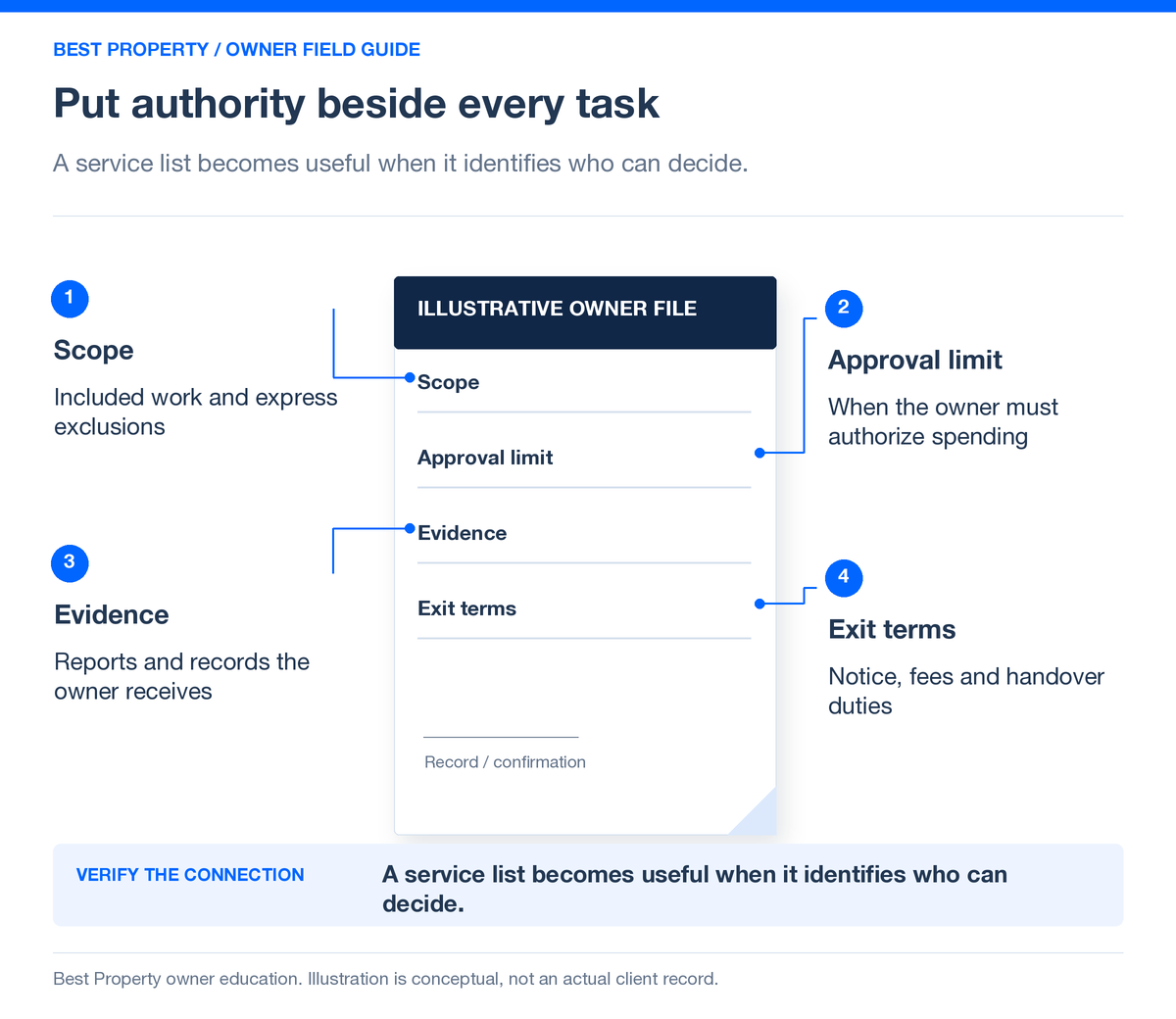
Find the ordinary spending limit and the process for obtaining approval above it. Check whether the limit applies per incident, invoice, job or another defined unit. Splitting one project into several small invoices should not make the underlying approval question disappear.
Ask how urgent work is treated when waiting for an owner could worsen a serious condition. Confirm the emergency contact route, the manager’s authority and how the owner will be informed afterward. A general maintenance clause should not be used to invent an unlimited emergency authorization.
Identify how a change in scope is handled. If an approved repair uncovers a different problem, who contacts the owner, documents the revised estimate and authorizes the additional work? Our maintenance-approval guide helps owners frame that conversation without pretending one dollar limit fits every home.
What decisions should remain with the rental owner?
Spell out the owner’s role in rent strategy, lease terms, larger expenditures, property improvements and the choice of services. An owner who wants to approve each routine step may need a different operating arrangement from one who delegates within written limits.
The agreement should also identify owner obligations. These can include providing accurate property records, maintaining required insurance, supplying funds and responding to requests for decisions. Management cannot work smoothly when necessary approvals or repair money remain unavailable.
Ask what happens if the owner and manager disagree about a proposed action. A defined escalation route is more useful than a broad statement that the owner has “final say.” Some decisions also involve legal duties that cannot be resolved merely by an owner’s preference. Obtain qualified advice when a proposed instruction conflicts with an applicable requirement.
What should the reporting and communication terms explain?
Identify which statements and documents owners receive, where they can access them and how accounting questions are handled. Distinguish a regular reporting schedule from immediate access to every underlying event. Ask what happens when a statement needs correction or an invoice has not yet arrived.
Communication terms should cover the assigned contact, backup route, urgent issues and escalation. A promise to be “responsive” is hard to compare. A written acknowledgment process and update checkpoints are easier to use when a specific repair or question remains open.
Discuss Best Property’s owner financial reporting service against your needs. Confirm the actual package and contact arrangement rather than treating website descriptions as substitutes for the signed contract. Owners should know how to obtain the record behind a charge, not only where to see a summary.
How should fees be connected to the work they cover?
Read the fee schedule together with the service clauses. Identify the calculation base, payment trigger and included work for each charge. A percentage of collected rent differs from a percentage of scheduled rent; a leasing fee differs from monthly management compensation.
Separate manager compensation from property expenses paid to others. A plumbing invoice is not automatically a management fee, and a coordination charge, if applicable, should have its own stated basis. Ask about charges associated with renewals, inspections, vacant periods, major projects and termination without assuming every company charges for each event.
Use the California management-fee guide to compare the overall structure. Then make a property-specific list of the events you expect in the coming year. An agreement is easier to evaluate when you can connect a likely event to the clause and charge that would apply.
Can a responsibility matrix reveal gaps before you sign?
Yes. Write down a few real operating situations and assign the manager’s action, the owner’s decision and the confirming record. Keep any ambiguity visible until the company explains it. The exercise works even when you are comparing contracts with different wording.
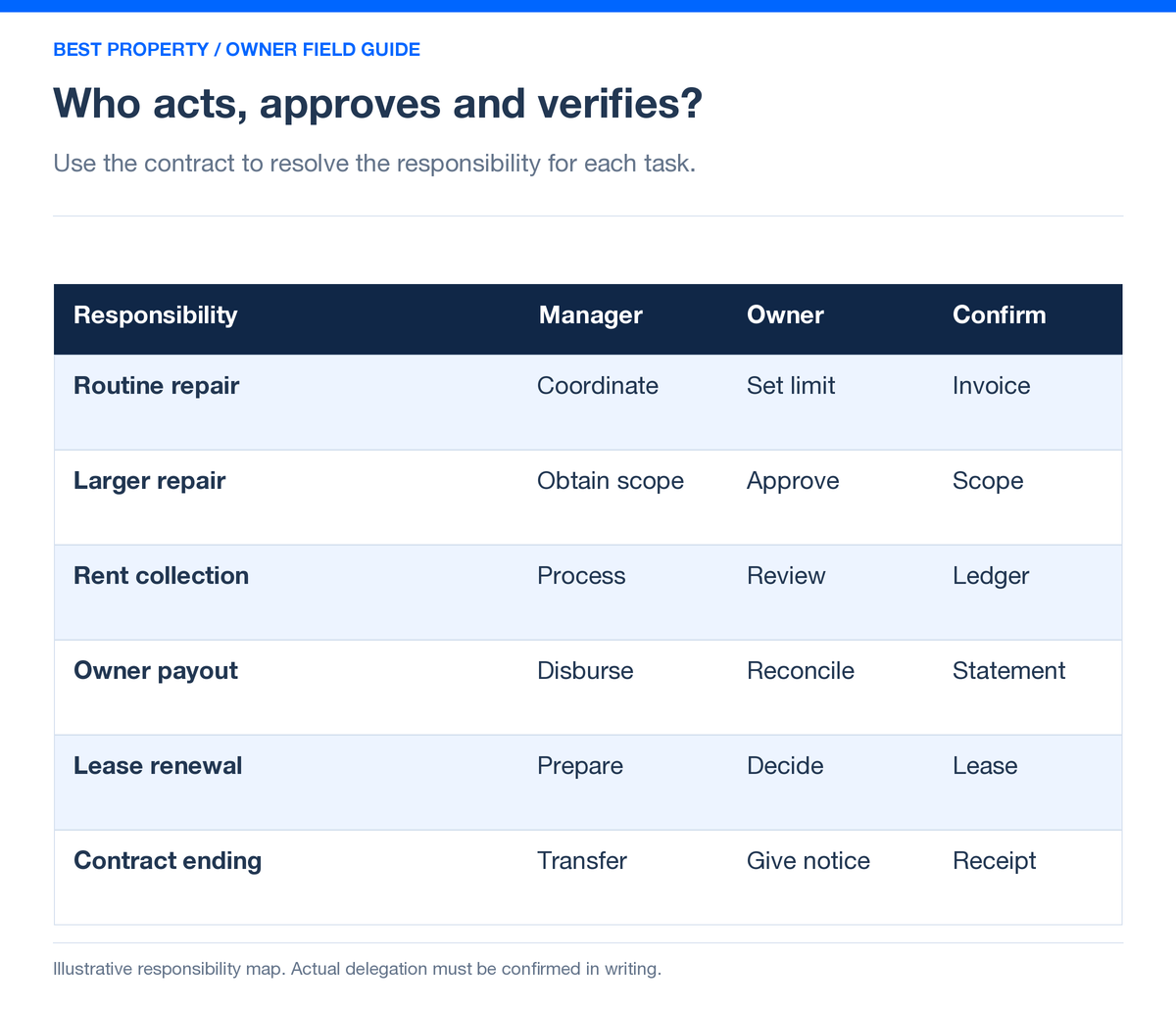
| Situation | Manager action to confirm | Owner role to confirm |
|---|---|---|
| Routine repair | Coordinate within agreed authority | Set limits and review the record. |
| Larger repair | Obtain scope and request approval | Approve the work and funding. |
| Rent collection | Process and report receipts and balances | Review exceptions and statements. |
| Lease renewal | Prepare the review and documents | Decide on proposed lawful terms. |
| Contract ending | Coordinate records and closeout | Give proper notice and name the recipient. |
This is an illustrative review tool, not a claim about the terms in every Best Property agreement. Use the matrix to ask questions and then verify that the contract reflects the answers you intend to rely on.
What should renewal, termination and handover terms cover?
Check the agreement’s duration, automatic renewal language, notice requirements and any charges associated with ending it. Locate the required recipient and delivery method. Understand the difference between an ordinary termination and a disputed claim of breach before choosing a procedure.
Ask how records, balances, keys, tenant communication and open repairs are handled at the end. The contract should support an orderly closeout rather than leaving operational duties unclear. If another manager will take over, identify how the companies will coordinate authority and access to necessary records.
The California DRE agency reference provides background on agency responsibilities and termination issues. Seek advice about an unclear or disputed provision before signing or relying on it. A convenient interpretation is not the same as an agreed one.
What else do rental owners ask?
Does full-service management mean every possible task is included?
No. Review the actual scope, exclusions and separate-charge provisions. Ask specifically about unusual work such as major projects, insurance claims and legal representation.
Should a repair approval limit be in writing?
Yes. Confirm the amount, what it applies to, how approval is requested and the treatment of urgent work. Also identify how a changed scope receives authorization.
Can I keep some vendors or tasks myself?
Discuss that arrangement before signing. Record who coordinates each retained service, how information is shared and who responds if the arrangement fails or the vendor is unavailable.
Is the lowest monthly fee the best contract?
Not necessarily. Compare equivalent services, triggers, reporting, authority and potential event charges. A low headline does not explain which work the owner still has to perform.
What reporting should I ask to see before choosing a manager?
Request a redacted example statement and the process for tracing an entry to a ledger, invoice or approval. Confirm how questions and corrections are handled.
Should I sign if a verbal promise is missing from the agreement?
Ask for the intended commitment to be clarified in the written documents. If the wording or its effect remains unclear, obtain advice before relying on the verbal explanation.
Related articles for rental property owners
What Does Full-Service Property Management Include in the East Bay?
What should you discuss with Best Property?
Bring the agreement, current property records and your main unanswered questions. Ask Best Property to explain the service scope, responsibilities and reporting for your rental before choosing an arrangement. Discuss the relevant service, then contact the Best Property team about your property.
Sources and published service information checked November 20, 2026. This is general owner education. Confirm the current agreement and rules for the specific property. Original editorial cover is AI-assisted; illustrations do not depict actual clients or private records.
Blog
Company News
Landlord Resources
Landlords
Legal
Linkedin
Local Market Insights
Maintenance & Repairs
Market
Owners
Property
Property Law & Compliance
Property Management
Rental Property
Tenants
Video
FILTER BY EASTBAY & TRI-VALLEY CITIES
AB 1482
AI Property Management
AI Rental Fraud
Antioch Property Management
Applicant Data Security
Applicant Information
Applicant Screening
Applicant Verification
Bank Statement Fraud
Battery Recalls
Brentwood
Brentwood property management
California Insurance
California Landlord Laws
California Property Management
California Rent Increase
Central Valley Property Management
Concord Property Management
Credit Reports
Danville Property Management
Danville rentals
Desert Hot Springs Property Management
Desert Property Maintenance
Desert Rentals
Document Fraud
Dublin property management
E-Bike Safety
East Bay Landlords
East Bay Lease Renewals
East Bay property management
East Bay Rental Market
East Bay Rental Owners
East Bay Rental Property Maintenance
East Bay Rental Property Management
East Bay rental tips
East Bay Rentals
EV Charging
Eviction Notices
Eviction Support
Fair Housing
Fake Pay Stubs
Fall Leasing
find a property manager
Fremont
Fremont property management
full service property management
Full-Service Property Management
Good Tenants
Hayward Property Management
Hayward rentals
Heat Pump Water Heaters
hiring a property manager
HOA Compliance
HOA Rental Management
HOA Rentals
Home Insurance Costs
Human Oversight
Identity Verification
Income Verification
Indian Wells Property Management
Inherited Rental Property
Landlord Compliance
Landlord Data Security
Landlord Insurance
Landlord Resources
Landlord Tips
Lease Renewal Strategy
Lease Renewals
Leasing Fees
Leasing Services
Livermore
Livermore property management
Livermore Rentals
Local Development
Local Market Insights
Local Rental Support
Long-Term Rentals
Luxury Rentals
maintenance coordination
Maintenance Response
Management Services
Manteca Property Management
Milpitas Property Management
Mountain House Property Management
New Housing San Ramon
Newark CA Property Management
Oakley Property Management
Online Rent Payments
Owner Onboarding
owner reporting
Palm Desert Property Management
Palm Springs Area Property Management
Palm Springs Property Management
Palm Springs Rentals
Pittsburg CA Property Management
Pleasanton property management
Pleasanton rentals
Preventive Maintenance
Property Inspections
Property Maintenance
Property Management
Property Management Companies
Property Management Fees
Property Management Services
Property Management Transition
Property Manager
Rancho Mirage Property Management
Real Estate
real estate investing
Redfin Rentals
Remote Property Management
Rent Collection
Rent Control
Rent Reporting
Rent Trends
Rental Application Fraud
Rental Application Privacy
Rental Competition
Rental Fee Transparency
Rental Fees
Rental Fraud
Rental History
Rental Inspections
Rental Internet
rental leasing
Rental Market Analysis
Rental Market Trends
Rental Marketing
Rental Pricing
Rental Property
Rental Property Expenses
Rental Property Maintenance
rental property owners
rental property ROI
Renter Choice
Renter Experience
Repair Coordination
Resident Portal
Residential Leasing
Roommate Management
San Lorenzo Property Management
San Ramon Landlords
San Ramon Orchards
San Ramon property management
San Ramon Rental Market
Screening Red Flags
Seasonal Rentals
Security Deposits
Sell or Rent
Silicon Valley Rentals
single family rentals
Single-Family Rentals
Tenant Background Checks
Tenant Communication
Tenant Complaints
Tenant Expectations
Tenant Issues
Tenant Placement
Tenant Protection Act
Tenant Retention
tenant screening
Tenant Screening Data Security
Tenant Screening Fraud
Tenant Screening Red Flags
Tenant Turnover
Tracy Property Management
Tri-Valley
Tri-Valley Housing Market
Tri-Valley property management
Tri-Valley Rentals
Union City Property Management
Vacation Rental Management
Wildfire Risk
Winter Rental Safety
Zillow Rentals
 FILTER
 SEARCH BLOG