Flat-Fee Property Management vs. Percentage Fees: Which Is Better for Your Rental?
Flat-fee property management is not automatically cheaper than percentage pricing. Compare both models using the same rent collected, occupancy, service scope and additional-charge assumptions. A flat fee can be predictable, while a percentage changes with its stated fee base. The better fit depends on the total arrangement and the work your rental needs.
Two proposals can look easy to compare: “$200 a month” versus “8%.” But the first may continue during vacancy, the second may use scheduled rather than collected rent and either may have separate leasing or renewal charges. The label is the beginning of the comparison, not the answer.
What is the difference between a flat fee and a percentage fee?
A flat monthly fee is a stated amount for the services and period described in the agreement. Check whether the amount changes by property type, unit count, service package or occupancy. “Flat” does not mean every property expense and special service is included.
A percentage fee applies a stated rate to a defined base. Ask whether that base is collected rent, rent due, scheduled rent or another amount. Also check minimum charges and how credits, concessions, returned payments or partial months affect the calculation.
Treat both as pricing mechanisms rather than measures of service quality. A manager using either model can provide a clear scope and good reporting, or leave important responsibilities vague. Use the California management-fee guide to identify the underlying categories before calculating totals.
How can you make an annual comparison that is fair?
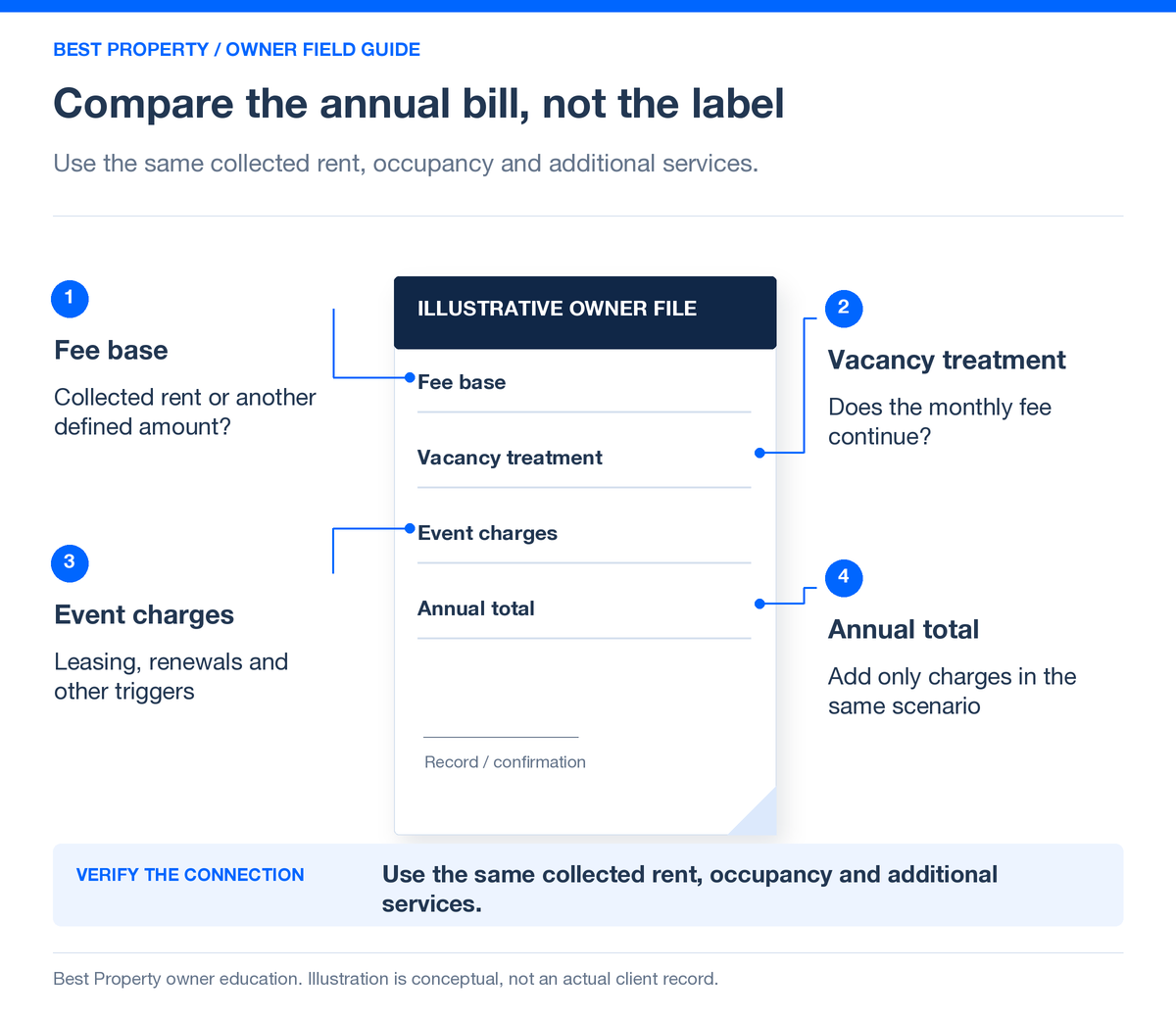
Choose one property scenario and hold its assumptions constant. State the monthly rent, number of collected months, whether a new tenancy occurs and which additional services are required. Calculate both quotes against that same scenario rather than giving the preferred quote the more favorable assumptions.
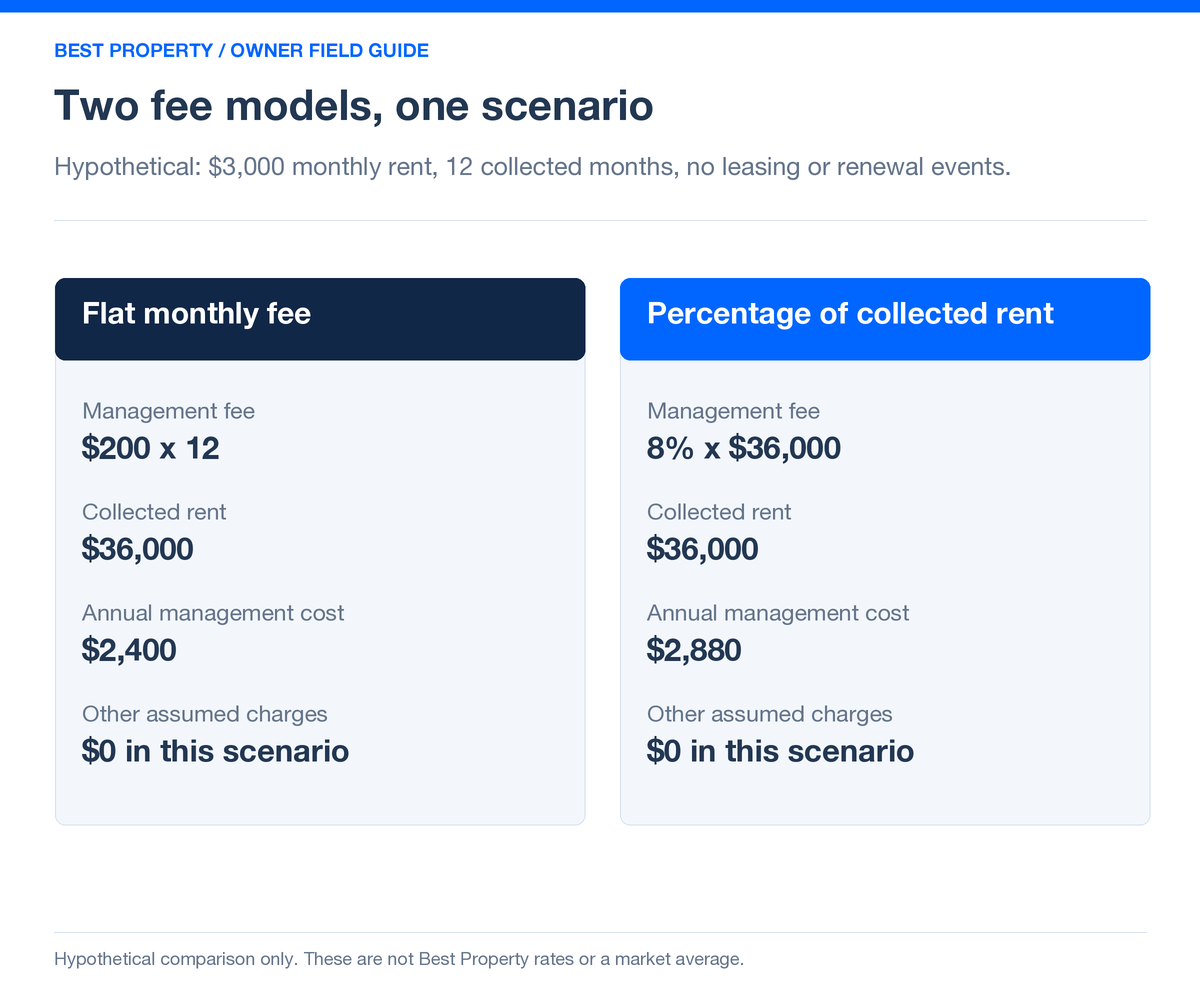
For an illustrative occupied rental with $3,000 monthly rent and 12 fully collected months, annual collected rent is $36,000. A $200 monthly management fee totals $2,400. An 8% fee on collected rent totals $2,880. The $480 difference is meaningful only for the defined management scope and assumptions.
| Illustrative assumption | Flat-fee model | Percentage model |
|---|---|---|
| Monthly rent | $3,000 | $3,000 |
| Collected months | 12 | 12 |
| Annual collected rent | $36,000 | $36,000 |
| Management calculation | $200 x 12 | 8% x $36,000 |
| Annual management fee | $2,400 | $2,880 |
| Other charges in this scenario | $0 assumed | $0 assumed |
These figures are hypothetical, not Best Property rates, a market average or a quote. Replace every assumption with the actual proposals and property circumstances before making a decision.
What changes when the property has a vacant month?
Read each proposal’s vacancy terms. If the hypothetical flat fee continues for all 12 months but only 11 months of $3,000 rent are collected, it still totals $2,400. At 8% of $33,000 collected rent, the hypothetical percentage charge would be $2,640. That changes the difference to $240 before any other event charges.
If the flat-fee contract instead pauses during vacancy, that calculation changes again. If the percentage contract uses scheduled rent or has a minimum, the example above does not describe it. The point is to expose the rule, not to declare one model the winner from an incomplete description.
Vacancy also creates property and leasing costs outside the monthly management calculation. Repairs, utilities, marketing or placement work need their own assumptions. Our Tracy rental-budget guide explains why manager compensation and operating costs belong in separate parts of the budget.
Which additional charges should be compared separately?
Ask about the events that may trigger charges under each proposal: tenant placement, lease renewal, inspections, major-project coordination, onboarding, account closing or another defined service. Do not assume a charge exists simply because it is possible, and do not assume it is absent because it is not mentioned in a short sales summary.
For each applicable item, record the trigger, amount or calculation, included work and whether it has already been counted elsewhere. A leasing charge should not be multiplied into every year if your scenario assumes no tenant turnover. Likewise, an expected renewal should not be ignored when one quote prices it separately.
The Fremont fee-inclusion article and Brentwood quote-comparison guide offer useful questions about scope. Use them to build an event list that fits this property, rather than adding every imaginable fee to inflate one quote.
Does percentage pricing create a stronger incentive to raise rent?
A percentage tied to collected rent changes when that base changes, but that fact does not establish how well a company prices or manages a home. Ask about the actual rent-review process, comparable properties, owner approval and compliance review. Do not infer good judgment from the fee formula alone.
At the hypothetical 8% rate, an additional $100 collected in a month changes the management fee by $8. That arithmetic does not tell you whether a rent change is appropriate, lawful or likely to improve the owner’s overall result. Vacancy, turnover and service quality also matter.
Similarly, predictable flat pricing does not prove the manager will underperform or ignore rent reviews. Ask both candidates for their process and evidence. A useful comparison evaluates decisions and follow-through alongside the fee, without inventing a behavioral guarantee for either pricing model.
What should you compare besides the annual price?
Identify the work you would still perform under each arrangement. Who responds to tenants, coordinates repairs, reviews applicants, handles statements and follows up on unpaid rent? A cheaper package can require more owner involvement, which may be acceptable if that is the arrangement you want.
Ask how the manager documents repairs and explains charges. Request a redacted statement and an example of an open-work update. Compare access to information, escalation and approval rules. These details are harder to reduce to a single number but directly affect the owner’s experience.
Discuss the actual scope through Best Property’s full-time management information. Confirm the proposal for your rental rather than applying the hypothetical figures in this article to the company’s services.
How should you record the final decision?
Keep a one-page comparison with the scenario, fee calculations, event charges, exclusions and responsibilities. Mark unknowns as unknowns and ask for clarification. Do not replace a missing answer with an optimistic zero.
Run at least the scenario you expect and a plausible alternative, such as a continuing tenant versus a turnover. Use the same change for both proposals. You are testing how the agreements behave, not forecasting a guaranteed rental outcome.
Choose the arrangement whose written scope, operating process and total cost fit your needs. The useful result is a decision you can explain from the actual documents, rather than a preference for a pricing label that conceals important assumptions.
What else do rental owners ask?
Is flat-fee management always cheaper for a higher-rent home?
Not always. Compare the actual flat amount, percentage base, minimums, scope and additional charges. A broad rule cannot replace the proposals for your property.
Should I compare a percentage with scheduled or collected rent?
Use the base stated in that agreement. Ask for clarification if the quote is ambiguous. Scheduled rent and money actually collected can produce different fees.
Does a flat fee usually stop during vacancy?
Do not assume so. Check the written vacancy and billing provisions. Your annual comparison should use the rule in the proposal you are evaluating.
Are the example prices Best Property’s rates?
No. They are hypothetical figures used to show the calculation. Obtain a current property-specific proposal and verify its scope and fee triggers.
Should every possible leasing fee be counted each year?
Count an event only when it occurs in the scenario. Compare both models using the same continuing-tenancy or turnover assumptions and avoid double counting.
What if one proposal leaves an extra charge unspecified?
Mark it as an open question. Ask for the trigger and calculation in writing before treating the quote as complete or using zero in the total.
Related articles for rental property owners
Fremont Property Management Fees: What Is Included and What Costs Extra?
Brentwood Property Management Fees: How Do You Compare Quotes Beyond the Monthly Rate?
Tracy Property Management Fees: What Should You Budget Beyond the Monthly Fee?
What should you discuss with Best Property?
Bring the agreement, current property records and your main unanswered questions. Ask Best Property to explain the service scope, responsibilities and reporting for your rental before choosing an arrangement. Discuss the relevant service, then contact the Best Property team about your property.
Sources and published service information checked November 20, 2026. This is general owner education. Confirm the current agreement and rules for the specific property. Original editorial cover is AI-assisted; illustrations do not depict actual clients or private records.
Blog
Company News
Landlord Resources
Landlords
Legal
Linkedin
Local Market Insights
Maintenance & Repairs
Market
Owners
Property
Property Law & Compliance
Property Management
Rental Property
Tenants
Video
FILTER BY EASTBAY & TRI-VALLEY CITIES
AB 1482
AI Property Management
AI Rental Fraud
Antioch Property Management
Applicant Data Security
Applicant Information
Applicant Screening
Applicant Verification
Bank Statement Fraud
Battery Recalls
Brentwood
Brentwood property management
California Insurance
California Landlord Laws
California Property Management
California Rent Increase
Central Valley Property Management
Concord Property Management
Credit Reports
Danville Property Management
Danville rentals
Desert Hot Springs Property Management
Desert Property Maintenance
Desert Rentals
Document Fraud
Dublin property management
E-Bike Safety
East Bay Landlords
East Bay Lease Renewals
East Bay property management
East Bay Rental Market
East Bay Rental Owners
East Bay Rental Property Maintenance
East Bay Rental Property Management
East Bay rental tips
East Bay Rentals
EV Charging
Eviction Notices
Eviction Support
Fair Housing
Fake Pay Stubs
Fall Leasing
find a property manager
Fremont
Fremont property management
full service property management
Full-Service Property Management
Good Tenants
Hayward Property Management
Hayward rentals
Heat Pump Water Heaters
hiring a property manager
HOA Compliance
HOA Rental Management
HOA Rentals
Home Insurance Costs
Human Oversight
Identity Verification
Income Verification
Indian Wells Property Management
Inherited Rental Property
Landlord Compliance
Landlord Data Security
Landlord Insurance
Landlord Resources
Landlord Tips
Lease Renewal Strategy
Lease Renewals
Leasing Fees
Leasing Services
Livermore
Livermore property management
Livermore Rentals
Local Development
Local Market Insights
Local Rental Support
Long-Term Rentals
Luxury Rentals
maintenance coordination
Maintenance Response
Management Services
Manteca Property Management
Milpitas Property Management
Mountain House Property Management
New Housing San Ramon
Newark CA Property Management
Oakley Property Management
Online Rent Payments
Owner Onboarding
owner reporting
Palm Desert Property Management
Palm Springs Area Property Management
Palm Springs Property Management
Palm Springs Rentals
Pittsburg CA Property Management
Pleasanton property management
Pleasanton rentals
Preventive Maintenance
Property Inspections
Property Maintenance
Property Management
Property Management Companies
Property Management Fees
Property Management Services
Property Management Transition
Property Manager
Rancho Mirage Property Management
Real Estate
real estate investing
Redfin Rentals
Remote Property Management
Rent Collection
Rent Control
Rent Reporting
Rent Trends
Rental Application Fraud
Rental Application Privacy
Rental Competition
Rental Fee Transparency
Rental Fees
Rental Fraud
Rental History
Rental Inspections
Rental Internet
rental leasing
Rental Market Analysis
Rental Market Trends
Rental Marketing
Rental Pricing
Rental Property
Rental Property Expenses
Rental Property Maintenance
rental property owners
rental property ROI
Renter Choice
Renter Experience
Repair Coordination
Resident Portal
Residential Leasing
Roommate Management
San Lorenzo Property Management
San Ramon Landlords
San Ramon Orchards
San Ramon property management
San Ramon Rental Market
Screening Red Flags
Seasonal Rentals
Security Deposits
Sell or Rent
Silicon Valley Rentals
single family rentals
Single-Family Rentals
Tenant Background Checks
Tenant Communication
Tenant Complaints
Tenant Expectations
Tenant Issues
Tenant Placement
Tenant Protection Act
Tenant Retention
tenant screening
Tenant Screening Data Security
Tenant Screening Fraud
Tenant Screening Red Flags
Tenant Turnover
Tracy Property Management
Tri-Valley
Tri-Valley Housing Market
Tri-Valley property management
Tri-Valley Rentals
Union City Property Management
Vacation Rental Management
Wildfire Risk
Winter Rental Safety
Zillow Rentals
 FILTER
 SEARCH BLOG