Castro Valley Property Management: What Should a Quote Include for a Single-Family Rental Home?
A Castro Valley property management quote for a single-family rental should spell out recurring management, leasing, property-specific maintenance, spending authority, reporting and the cost of ending service. Give each company the same property details and ask it to price the same occupied and turnover scenarios. That lets you compare the scope behind the fee.
Imagine two quotes for a three-bedroom house. One gives a monthly rate and a placement fee. The other asks who maintains the yard, whether the garage is part of the lease and what to do when a tenant reports water near the rear steps. The second quote is already doing something the first still needs to do: defining the home it will manage.
What should a Castro Valley manager know before quoting?
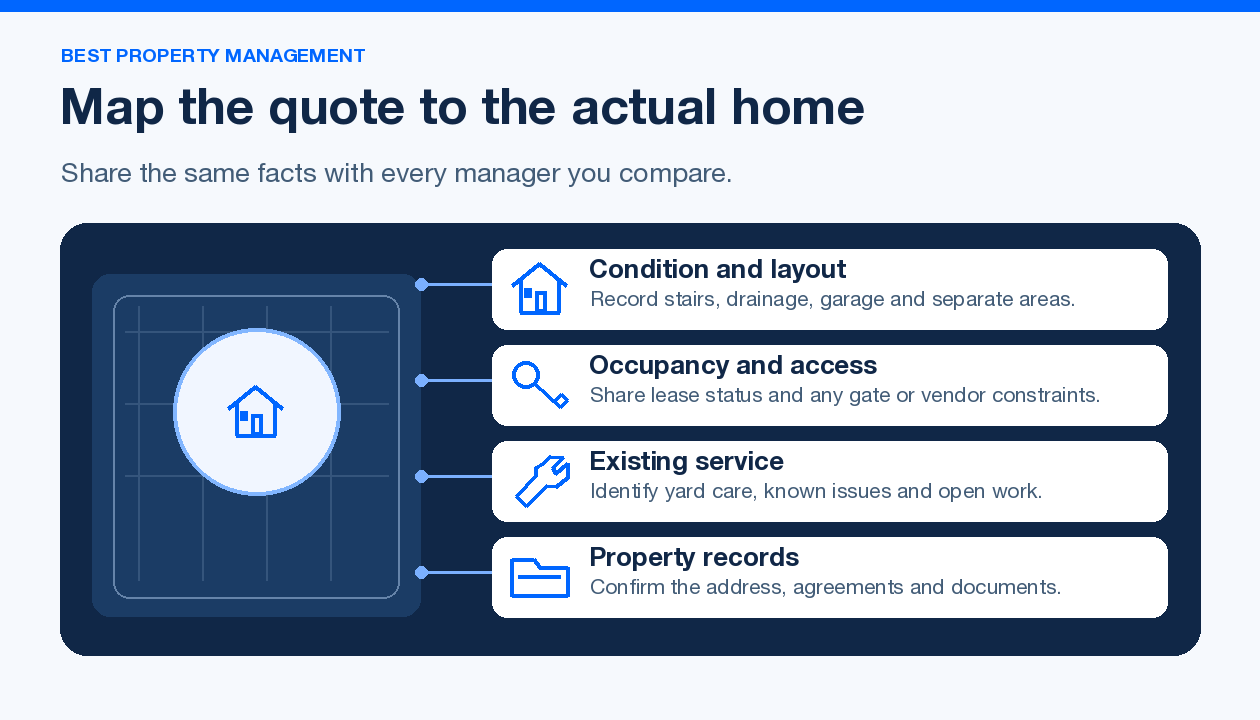
Describe the address, occupancy, lease dates, condition and features that require upkeep. Disclose open work and recurring services. For a detached house, that might mean irrigation, trees, exterior stairs, a detached garage or a slope that affects access. Describe the features you actually have. There is no reason to price a hillside maintenance scenario for a home on a level lot.
Confirm the property’s jurisdiction and the rules applicable to the address. Castro Valley is an unincorporated community, and a postal city or ZIP code alone does not settle every question about public agencies and property requirements. Start with Alameda County’s community development resources when checking jurisdiction, and ask the manager to explain how it confirms local requirements.
Send each firm the same property profile and any documents it needs through an appropriate channel. A quote for a vacant, rent-ready home can differ from a quote for an occupied home with unresolved maintenance or incomplete lease records.
Which services should the monthly quote cover?
Ask about rent collection, tenant communication, repair coordination, notices within the agreed scope, monthly statements and owner access to records. Confirm the contact for ordinary questions and what happens when something cannot wait. A rate without a description of these tasks is hard to compare.
Identify services that apply only at certain events. Does the quote include evaluating a renewal, arranging an extra visit or closing the account? If an item is optional or separately priced, ask for the trigger, amount and resulting work. Our California property management fee guide can help identify terms to review.
Request one redacted example of a routine report. Ask how a manager would connect a repair expense in that report to a work order and invoice. A usable reporting package can save time every month, particularly if you manage the home from out of town.
How should the quote handle landscaping, access and repairs?
Ask who coordinates recurring vendor work and who pays the invoice. If the current lease assigns yard work or another duty to the tenant, confirm how the manager will review that language and handle exceptions. A quote should account for what is already in place and any proposed change.
For property access, identify gates, garages, stairs and any separate occupied area. Discuss how keys and access instructions are handled securely. If a feature is shared or subject to an association rule, clarify who can authorize work and how the manager will communicate with the relevant party. Our guide to owner and HOA responsibilities illustrates why scope boundaries matter even when the property type differs.
Discuss any known condition without presenting it as a diagnosis. A recurring damp patch or drainage concern may need a qualified evaluation. Ask whether the manager arranges that evaluation and how the owner will see the findings. The rental maintenance guide helps organize the questions without assuming the house needs every possible service.
What belongs in a side-by-side comparison?
Ask each company to describe a continuing-tenancy year and a turnover year using the same assumptions. For an occupied rental, include continuing management, the anticipated renewal process and known routine services. For turnover, add the agreed marketing, preparation and move-in tasks. The examples should distinguish the company’s compensation from money paid to vendors or other third parties.
| Quote area | Common question | Evidence to request |
|---|---|---|
| Monthly work | Who handles rent, tenant contact and reporting? | Written scope and a sample statement. |
| Leasing or turnover | What work starts when a tenant leaves? | Rent-ready, marketing and placement responsibilities. |
| Property features | Who coordinates yard or special-access work? | Property-specific scope and vendor arrangement. |
| Repair approval | What can proceed and who approves the rest? | Written approval and emergency terms. |
| Inspections | When are reports supplied and what is included? | Redacted report and any additional visit charge. |
| Transition | What happens to open work and records when service ends? | Notice, closing accounting and handover process. |
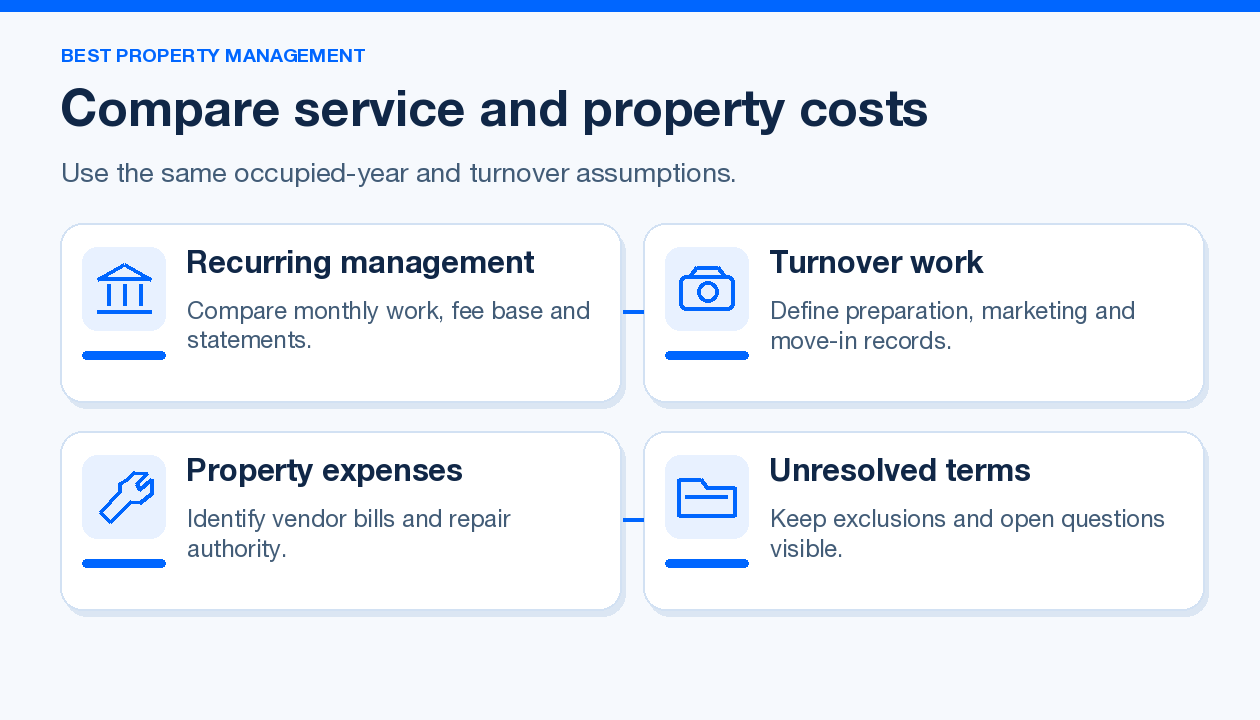
Use the table to record the answers as each firm provides them. If a quote omits a service, ask whether the owner would arrange it, the manager would provide it for a separate charge or the service is unnecessary for the home.
Who should approve repair work and larger expenses?
Ask which nonurgent expenses the manager may authorize and when an owner decision is required. Confirm how the manager groups work within a project, what information it sends before approval and how it handles a situation that cannot wait. A dollar threshold is only one part of the decision.
For example, imagine a contractor proposes a diagnostic visit followed by separately quoted work. Ask whether both steps require authorization, what the diagnostic report will contain and who verifies completion. That conversation is more revealing than asking a manager to promise it will always obtain several bids.
Set up a clear contact route for owner decisions. The manager should be able to tell which reply counts as authorization and where that record will be kept. Our repair approval and vendor-cost guide offers questions to adapt to your agreement.
How should an occupied home change the quote?
Request an onboarding scope for the existing tenancy. The incoming firm should know which documents and balances must be reviewed, who communicates with the tenant and when new rent or maintenance instructions take effect. If you are switching managers, ask who coordinates with the outgoing firm and how outstanding items are recorded.
Do the same for a vacant home. Ask who confirms readiness, prepares and approves the asking rent, arranges photography and completes the move-in documentation. An accurate quote for each stage lets you compare the relevant work without paying attention to charges unlikely to occur in your scenario.
Ask who will handle an open repair or unresolved owner statement during onboarding. A clear answer should name the responsible party and the expected next update. That applies whether you are hiring your first manager or moving from an existing provider.
What should you bring to a consultation?
Bring a short property profile, the occupancy and lease status, current service arrangements and a list of the responsibilities you want help with. If you already have quotes, bring the written scope and questions about the differences. Request a property-specific proposal so the agreement reflects your home and your expected involvement.
Ask the prospective manager to explain what the owner will see after onboarding. For example, when will the first report arrive, how can you request an invoice and who handles a repair approval? You can then compare each company’s work and reporting as well as the price.
What else do rental owners ask?
Can two Castro Valley quotes with different monthly rates include different work?
Yes. Compare the service scope, leasing and renewal work, property expenses, approvals and event charges under the same assumptions.
Does a single-family rental need a separate landscaping plan?
Discuss who performs and pays for routine work and how the lease addresses it. The right plan depends on the home’s features and the existing arrangements.
Should I share the lease before getting a final occupied-property quote?
A current lease and related records help a manager understand what it will take over. Use a secure method and clarify which records are needed for the quote.
Are inspections automatically included?
Ask which inspections or visits are included, how they are documented and when extra work is billed. Compare sample reports where possible.
How can I compare quotes when one leaves areas blank?
Ask for a written clarification and mark the item as unresolved until you receive it. A blank price should not be evaluated as zero.
What if a repair is already open when management begins?
Identify its status, authorization, vendor and expected follow-up. Ask which party will own the next step and how that responsibility will be documented.
Related articles for rental property owners
Fremont Condo Property Management: Who Handles Tenant Repairs and HOA Responsibilities?
What should you discuss with Best Property?
Bring the address, occupancy status and details of any recurring work or special access. Ask for a written quote that reflects how your Castro Valley house is actually operated. See the Castro Valley property management page. Review Best Property’s property management services service or contact the Best Property team.
Editorial cover is AI-assisted and illustrative. Check the agreement and the rules that apply to your property.
Blog
Company News
Landlord Resources
Landlords
Legal
Linkedin
Local Market Insights
Maintenance & Repairs
Market
Owners
Property
Property Law & Compliance
Property Management
Rental Property
Tenants
Video
FILTER BY EASTBAY & TRI-VALLEY CITIES
AB 1482
AI Property Management
AI Rental Fraud
Antioch Property Management
Applicant Data Security
Applicant Information
Applicant Screening
Applicant Verification
Bank Statement Fraud
Battery Recalls
Brentwood
Brentwood property management
California Insurance
California Landlord Laws
California Property Management
California Rent Increase
Central Valley Property Management
Concord Property Management
Credit Reports
Danville Property Management
Danville rentals
Desert Hot Springs Property Management
Desert Property Maintenance
Desert Rentals
Document Fraud
Dublin property management
E-Bike Safety
East Bay Landlords
East Bay Lease Renewals
East Bay property management
East Bay Rental Market
East Bay Rental Owners
East Bay Rental Property Maintenance
East Bay Rental Property Management
East Bay rental tips
East Bay Rentals
EV Charging
Eviction Notices
Eviction Support
Fair Housing
Fake Pay Stubs
Fall Leasing
find a property manager
Fremont
Fremont property management
full service property management
Full-Service Property Management
Good Tenants
Hayward Property Management
Hayward rentals
Heat Pump Water Heaters
hiring a property manager
HOA Compliance
HOA Rental Management
HOA Rentals
Home Insurance Costs
Human Oversight
Identity Verification
Income Verification
Indian Wells Property Management
Inherited Rental Property
Landlord Compliance
Landlord Data Security
Landlord Insurance
Landlord Resources
Landlord Tips
Lease Renewal Strategy
Lease Renewals
Leasing Fees
Leasing Services
Livermore
Livermore property management
Livermore Rentals
Local Development
Local Market Insights
Local Rental Support
Long-Term Rentals
Luxury Rentals
maintenance coordination
Maintenance Response
Management Services
Manteca Property Management
Milpitas Property Management
Mountain House Property Management
New Housing San Ramon
Newark CA Property Management
Oakley Property Management
Online Rent Payments
Owner Onboarding
owner reporting
Palm Desert Property Management
Palm Springs Area Property Management
Palm Springs Property Management
Palm Springs Rentals
Pittsburg CA Property Management
Pleasanton property management
Pleasanton rentals
Preventive Maintenance
Property Inspections
Property Maintenance
Property Management
Property Management Companies
Property Management Fees
Property Management Services
Property Management Transition
Property Manager
Rancho Mirage Property Management
Real Estate
real estate investing
Redfin Rentals
Remote Property Management
Rent Collection
Rent Control
Rent Reporting
Rent Trends
Rental Application Fraud
Rental Application Privacy
Rental Competition
Rental Fee Transparency
Rental Fees
Rental Fraud
Rental History
Rental Inspections
Rental Internet
rental leasing
Rental Market Analysis
Rental Market Trends
Rental Marketing
Rental Pricing
Rental Property
Rental Property Expenses
Rental Property Maintenance
rental property owners
rental property ROI
Renter Choice
Renter Experience
Repair Coordination
Resident Portal
Residential Leasing
Roommate Management
San Lorenzo Property Management
San Ramon Landlords
San Ramon Orchards
San Ramon property management
San Ramon Rental Market
Screening Red Flags
Seasonal Rentals
Security Deposits
Sell or Rent
Silicon Valley Rentals
single family rentals
Single-Family Rentals
Tenant Background Checks
Tenant Communication
Tenant Complaints
Tenant Expectations
Tenant Issues
Tenant Placement
Tenant Protection Act
Tenant Retention
tenant screening
Tenant Screening Data Security
Tenant Screening Fraud
Tenant Screening Red Flags
Tenant Turnover
Tracy Property Management
Tri-Valley
Tri-Valley Housing Market
Tri-Valley property management
Tri-Valley Rentals
Union City Property Management
Vacation Rental Management
Wildfire Risk
Winter Rental Safety
Zillow Rentals
 FILTER
 SEARCH BLOG