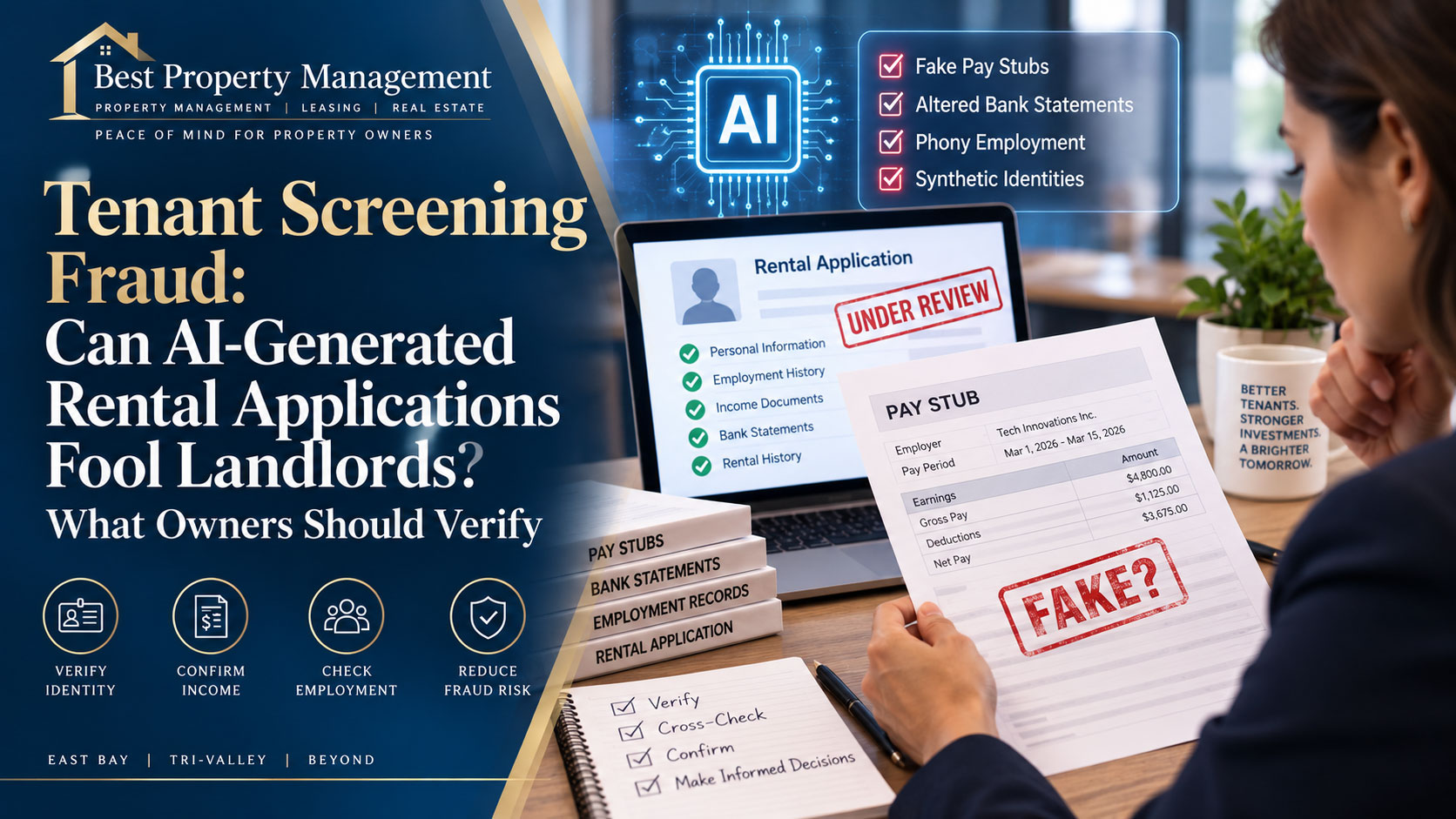
Tenant Screening Fraud: Can AI-Generated Rental Applications Fool Landlords? What Owners Should Verify
Rental application fraud is entering a new phase.
A landlord may receive a polished application, professional-looking pay stubs, convincing bank statements and employment information that appears completely legitimate. Yet some of that information can now be altered or generated with tools that require far less technical skill than they did just a few years ago.
For East Bay rental property owners, the challenge is no longer simply spotting an obviously fake document.
It is determining whether the information behind the application is real, consistent and independently verifiable.
Quick Answer: Yes, AI-assisted tools can make fraudulent rental applications harder to identify visually. They can help create convincing income documents, employment records and other application materials, while synthetic identity techniques can make an applicant appear legitimate during surface-level review. But landlords should not assume every unusual application involves AI or fraud. A stronger tenant-screening process verifies identity, income, employment and rental history through consistent procedures and independent sources when appropriate. Technology can support screening, but approval and denial decisions still need to be accurate, documented and compliant with fair housing and consumer-reporting requirements.
How Is AI Changing Rental Application Fraud?
Artificial intelligence did not invent rental fraud.
Applicants have falsified income, employment and identity information for years.
What AI changes is the speed, accessibility and credibility of some fraudulent materials.
TransUnion described this problem in its June 2026 analysis of rental applications as a growing “trust gap.” Applications can appear complete and satisfy traditional screening criteria while relying on manipulated or AI-generated income documents or synthetic identity information.
That distinction matters.
Traditional screening was largely designed around a basic assumption:
The information being evaluated is authentic.
Credit history may be checked.
Prior rental records may be reviewed.
Income may be compared with the property’s qualification standard.
But if the identity or financial documentation being submitted is unreliable, even a well-designed screening process can begin with bad data.
Current fraud risks can include:
- AI-assisted or manipulated pay stubs
- Altered bank statements
- Fabricated employment documents
- Synthetic identities
- False employer or landlord contact information
- Applications containing a mixture of real and fabricated data
- Coordinated applications using overlapping identities or documents
TransUnion notes that income and employment verification are particularly exposed because those details are fundamental to leasing decisions and increasingly easy to manipulate.
Experian likewise describes manual verification of applicant information and fraudulent documents as an increasing challenge for landlords and property managers.
But owners should keep the problem in perspective.
Current industry research supports the conclusion that AI is making some fraud more sophisticated. It does not establish that every fraudulent rental application is AI-generated or that most applicants are committing fraud.
The correct response is better verification, not greater suspicion of everyone who applies.
Owner takeaway: AI makes document appearance less trustworthy as a screening signal. It does not change the need to evaluate every applicant under the same lawful standards.
What Parts of an AI-Generated Rental Application Can Look Real?
The difficulty with modern document fraud is that it may not look fraudulent.
AI-assisted tools can potentially help produce information that is internally polished enough to survive a quick review.
Consider a pay stub.
A convincing fake might contain:
- A recognizable employer name
- Appropriate payroll terminology
- Plausible gross income
- Standard deductions
- Year-to-date earnings
- A professional payroll layout
The same can happen with a bank statement or employment document.
That means questions such as:
“Does the font look right?”
or
“Does this PDF look professionally generated?”
are becoming less useful.
The more valuable questions involve cross-checking information.
| Application Information | What Owners Should Verify |
|---|---|
| Identity | Does the identity consistently match trusted records? |
| Employment | Can the employer and current employment be independently confirmed? |
| Income | Does reported income align across reliable sources? |
| Pay records | Do pay periods and year-to-date figures make sense? |
| Bank activity | Do recurring deposits reasonably support stated income? |
| Rental history | Can prior tenancy information be validated? |
| Application details | Are names, dates and addresses consistent throughout? |
A well-designed fake document may still fail when compared with independent information.
For example, an applicant might submit a pay stub reporting $7,500 per month.
The document itself looks perfect.
But the employer cannot be verified, the applicant’s job dates conflict with the application or independent income information shows something different.
Those discrepancies matter more than whether a logo is slightly misaligned.
Best Property Management’s tenant screening service approaches tenant qualification as a broader review rather than relying on a single applicant-provided document.
Concerned about increasingly sophisticated rental applications? Best Property Management can help East Bay owners manage identity, income, employment and rental-history verification within a consistent tenant-screening and leasing process.
Why Identity Verification Is Becoming Just as Important as Income Verification
Income fraud gets a great deal of attention because fake pay stubs are easy to understand.
Identity risk can be more complicated.
A synthetic identity may combine legitimate and fabricated personal information into what appears to be a real individual.
TransUnion identifies synthetic identities and altered identity information as part of the evolving fraud environment and provides identity-verification tools specifically designed to evaluate identity risk.
For rental owners, that means verifying income without establishing that the applicant is genuinely the person represented in the application can leave an important gap.
Modern screening can therefore involve several layers:
Confirm the applicant’s identity
The name, identifying information and documentation should correspond consistently.
Review device or digital risk when appropriate
Some professional screening systems can evaluate whether a digital application displays fraud-risk signals.
Verify income independently
Income information should be confirmed rather than accepted solely because the documents look convincing.
Verify employment
The employer should exist and the applicant’s employment should align with the application.
Compare the complete application
Address history, employment dates, rental history and other records should tell a coherent story.
TransUnion’s June 2026 rental-fraud research also reinforces that useful fraud signals may appear outside the documents themselves. In one analysis, applicants with unusually high volumes of recent credit inquiries showed substantially higher later charge-off rates than the overall sample. That does not mean credit inquiries prove fraud, but it illustrates why modern screening increasingly uses multiple signals instead of one document.
This is especially relevant for individual landlords.
A property owner reviewing documents manually may simply not have access to the same data relationships available through professional screening systems.
The point is not that technology should make the decision.
It can help establish whether the underlying information deserves additional verification.
Can AI Help Landlords Detect AI-Generated Fraud?
Potentially, yes.
But this creates an important distinction.
There are really two different uses of AI in the tenant-screening conversation:
AI used to create or enhance fraudulent application information
and
AI or automated tools used to help detect inconsistencies and evaluate applications.
Verification technology may help identify document manipulation, identity inconsistencies or other fraud-risk indicators that a human reviewer could miss.
That can make screening faster and more accurate.
However, owners should resist the idea that software produces unquestionable answers.
No screening tool is infallible.
A legitimate application can contain unusual information.
An applicant may have:
- Changed jobs recently
- Received a bonus
- Become self-employed
- Started earning commission
- Deposited income into multiple accounts
- Used several legitimate income sources
- Experienced a recent address change
Those circumstances can produce inconsistencies without fraud.
This is why an alert should generally mean:
“Verify this information.”
Not:
“This applicant is fraudulent.”
Third-party screening information can also contain errors.
In July 2026, the Federal Trade Commission announced a $2.25 million settlement involving RentGrow, alleging failures to use reasonable procedures to ensure the accuracy of certain tenant-screening reports.
That case is a useful reminder for landlords.
Applicant-created information can be inaccurate.
Screening-company information can also be inaccurate.
A defensible screening process needs a way to handle both.
Owner takeaway: Use technology to identify information that needs verification, not to replace judgment, documentation or consistent screening criteria.
Why Fair Housing Still Matters When AI Is Involved
Fraud prevention does not operate separately from fair housing.
HUD has specifically addressed artificial intelligence and tenant screening, making clear that the Fair Housing Act applies when machine learning, algorithms or other AI systems influence housing decisions.
That applies to both housing providers and tenant-screening companies.
The concern is not simply whether an algorithm intentionally discriminates.
An automated screening practice can also create problems if it has an unjustified discriminatory effect or uses criteria that are not adequately connected to whether an applicant is likely to meet tenancy obligations.
This creates a practical lesson for landlords.
Do not build fraud detection around personal impressions.
For example:
Weak approach: “This applicant’s documents look suspicious, so I am going to require much more proof.”
Stronger approach: “Our written screening policy requires independent verification when specified information cannot be confirmed or documents contain defined inconsistencies.”
The second approach focuses on a process.
Landlords should ideally establish before applications arrive:
- Financial qualification standards
- Accepted income documentation
- Identity-verification procedures
- When independent verification is required
- How discrepancies are resolved
- How rental history is evaluated
- How applications are documented
- How third-party screening information is reviewed
Best Property’s East Bay leasing and tenant placement guide emphasizes the value of written screening criteria, documented application procedures and consistent applicant communication.
This becomes more important, not less important, as technology becomes involved.
A sophisticated fraud-detection system should not produce a process that the landlord cannot explain.
What Should East Bay Rental Owners Verify in 2026?
The solution to AI-enhanced rental fraud is not to become an AI expert.
It is to strengthen the verification workflow.
A practical process might look like this:
1. Verify identity
Confirm that the person applying can be reliably matched with the identity used throughout the application.
2. Compare documents for consistency
Review employment names, dates, income, addresses and other information across the complete file.
3. Verify income
Do not rely exclusively on the appearance of a pay stub.
Where appropriate, use lawful independent income or employment verification.
4. Confirm employment
Verify employment using a reliable method rather than relying solely on applicant-provided contact information.
5. Review rental history
Prior landlord and address information should be evaluated consistently.
6. Use reputable screening information
Credit and other permissible consumer-report information can provide additional context.
7. Investigate inconsistencies without assuming fraud
Give legitimate applicants a consistent opportunity to clarify information.
8. Document the decision
A landlord should be able to identify which established rental qualification was or was not satisfied.
If a consumer report contributes to an adverse decision, Fair Credit Reporting Act requirements may apply. The FTC explains that tenant-screening reports are consumer reports and that landlords using them must follow applicable FCRA procedures, including adverse-action requirements in relevant circumstances.
That is a much stronger process than trying to determine whether a document “looks AI-generated.”
The purpose is not to prove how a questionable document was created.
The purpose is to determine whether the applicant’s qualifying information can be verified.
Rental application fraud is becoming more sophisticated, but tenant screening should remain consistent, documented and fair. Contact Best Property Management for tenant screening, applicant verification, leasing and full-service property management throughout the East Bay and Tri-Valley.
Related Tenant Screening Resources
- Tenant Screening for Rental Property Owners
- Tenant Background Checks
- East Bay Leasing and Tenant Placement Guide
- Residential Leasing Services
Frequently Asked Questions About AI Rental Application Fraud
Can AI create fake pay stubs for rental applications?
Generative AI and modern document tools can make false or altered financial documents easier to produce and more convincing to a casual reviewer. TransUnion specifically identifies manipulated or AI-generated income documentation as an emerging rental-fraud concern. That does not mean a professional-looking pay stub should automatically be considered fraudulent. Landlords should compare the document with other application information and independently verify income or employment when required by their screening policy. The goal is to verify the underlying information, not determine which software may have created the document.
Can AI-generated rental applications pass a normal tenant screening check?
Potentially, especially if the screening process assumes that submitted identity and income information is genuine. Traditional credit, eviction or background checks may evaluate an applicant correctly while still beginning with unreliable identity or financial information. That is why modern screening increasingly includes identity and income verification in addition to conventional background information. A successful credit check alone does not prove that every document submitted with the application is accurate. Owners should evaluate multiple independent signals and follow the same verification process for applicants in comparable circumstances.
How can landlords tell whether a rental application was created with AI?
In many cases, they cannot reliably determine that from appearance alone, and they do not necessarily need to. AI-generated documents can look professional, while legitimate documents can sometimes have unusual formatting. The better question is whether the information can be independently verified. Compare identity details, employer information, income, dates, addresses and rental history across reliable sources. If an inconsistency appears, follow the property’s established verification procedure. Screening should focus on factual accuracy rather than trying to prove whether a particular AI tool was involved.
Should landlords use AI to screen rental applicants?
Automated tools can help with identity verification, document analysis and fraud-risk detection, but they should support rather than replace a transparent screening process. HUD states that the Fair Housing Act applies when AI and machine-learning systems are used in tenant screening. Owners should understand what criteria influence screening decisions, use information relevant to tenancy obligations and ensure applicants are treated consistently. A software recommendation should not become an unexplained automatic approval or denial without appropriate review.
What should a landlord do if an application appears fraudulent?
Avoid immediately accusing the applicant. Instead, identify the specific information that cannot be verified or that conflicts with established screening requirements. Follow the same discrepancy-resolution procedure that would apply to another applicant, request appropriate clarification or verification and document the outcome. If the applicant ultimately cannot satisfy the property’s lawful written criteria, a decision may follow based on that failure rather than speculation about fraud. When consumer-report information influences an adverse decision, applicable FCRA requirements should also be followed. Property-specific legal questions should be reviewed with qualified counsel.
Best Property Management Bay Area Offices
Brentwood 200 Sand Creek Rd., Suite D, Brentwood, CA 94513 925-392-2411 ronventura@bestproperty4u.com Brentwood Office
Fremont 40069 Mission Blvd., Fremont, CA 94539 510-770-0824 dustinventura@bestproperty4u.com Fremont Office Information
Livermore 1985 First Street, Suite 209, Livermore, CA 94550 925-292-1785 robertventura@bestproperty4u.com Livermore Office Information
Tracy 672 West 11th Street, Suite 208, Tracy, CA 95376 209-340-2500 brendanreese@bestproperty4u.com Tracy Office Information
This article is provided for general informational purposes only and is not legal, financial, fair housing, privacy or tenant-screening compliance advice. Rental fraud techniques, screening technology, consumer-reporting requirements and individual circumstances can change. Rental property owners should verify current requirements and consult qualified professionals when appropriate.
Blog
Company News
Landlord Resources
Landlords
Legal
Linkedin
Local Market Insights
Maintenance & Repairs
Market
Owners
Property
Property Law & Compliance
Property Management
Rental Property
Tenants
Video
FILTER BY EASTBAY & TRI-VALLEY CITIES
AB 1482
AI Rental Fraud
Antioch Property Management
Applicant Data Security
Applicant Information
Applicant Screening
Applicant Verification
Bank Statement Fraud
Brentwood
Brentwood property management
California Insurance
California Landlord Laws
California Property Management
California Rent Increase
Central Valley Property Management
Concord Property Management
Credit Reports
Danville Property Management
Danville rentals
Desert Hot Springs Property Management
Desert Property Maintenance
Desert Rentals
Document Fraud
Dublin property management
East Bay Landlords
East Bay Lease Renewals
East Bay property management
East Bay Rental Market
East Bay Rental Owners
East Bay Rental Property Maintenance
East Bay Rental Property Management
East Bay rental tips
East Bay Rentals
Eviction Notices
Eviction Support
Fair Housing
Fake Pay Stubs
Fall Leasing
find a property manager
Fremont
Fremont property management
full service property management
Full-Service Property Management
Good Tenants
Hayward Property Management
Hayward rentals
hiring a property manager
HOA Compliance
HOA Rental Management
HOA Rentals
Home Insurance Costs
Identity Verification
Income Verification
Indian Wells Property Management
Inherited Rental Property
Landlord Compliance
Landlord Data Security
Landlord Insurance
Landlord Resources
Landlord Tips
Lease Renewal Strategy
Lease Renewals
Leasing Fees
Leasing Services
Livermore
Livermore property management
Livermore Rentals
Local Development
Local Market Insights
Local Rental Support
Long-Term Rentals
Luxury Rentals
maintenance coordination
Maintenance Response
Management Services
Manteca Property Management
Milpitas Property Management
Mountain House Property Management
New Housing San Ramon
Newark CA Property Management
Oakley Property Management
Online Rent Payments
Owner Onboarding
owner reporting
Palm Desert Property Management
Palm Springs Area Property Management
Palm Springs Property Management
Palm Springs Rentals
Pittsburg CA Property Management
Pleasanton property management
Pleasanton rentals
Preventive Maintenance
Property Inspections
Property Maintenance
Property Management
Property Management Companies
Property Management Fees
Property Management Services
Property Management Transition
Property Manager
Rancho Mirage Property Management
Real Estate
real estate investing
Redfin Rentals
Remote Property Management
Rent Collection
Rent Control
Rent Trends
Rental Application Fraud
Rental Application Privacy
Rental Competition
Rental Fees
Rental Fraud
Rental History
Rental Inspections
rental leasing
Rental Market Analysis
Rental Market Trends
Rental Marketing
Rental Pricing
Rental Property
Rental Property Expenses
Rental Property Maintenance
rental property owners
rental property ROI
Renter Choice
Renter Experience
Repair Coordination
Resident Portal
Residential Leasing
San Lorenzo Property Management
San Ramon Landlords
San Ramon Orchards
San Ramon property management
San Ramon Rental Market
Screening Red Flags
Seasonal Rentals
Security Deposits
Sell or Rent
Silicon Valley Rentals
single family rentals
Single-Family Rentals
Tenant Background Checks
Tenant Communication
Tenant Complaints
Tenant Expectations
Tenant Issues
Tenant Placement
Tenant Protection Act
Tenant Retention
tenant screening
Tenant Screening Data Security
Tenant Screening Fraud
Tenant Screening Red Flags
Tenant Turnover
Tracy Property Management
Tri-Valley
Tri-Valley Housing Market
Tri-Valley property management
Tri-Valley Rentals
Union City Property Management
Vacation Rental Management
Wildfire Risk
Zillow Rentals
 FILTER
 SEARCH BLOG