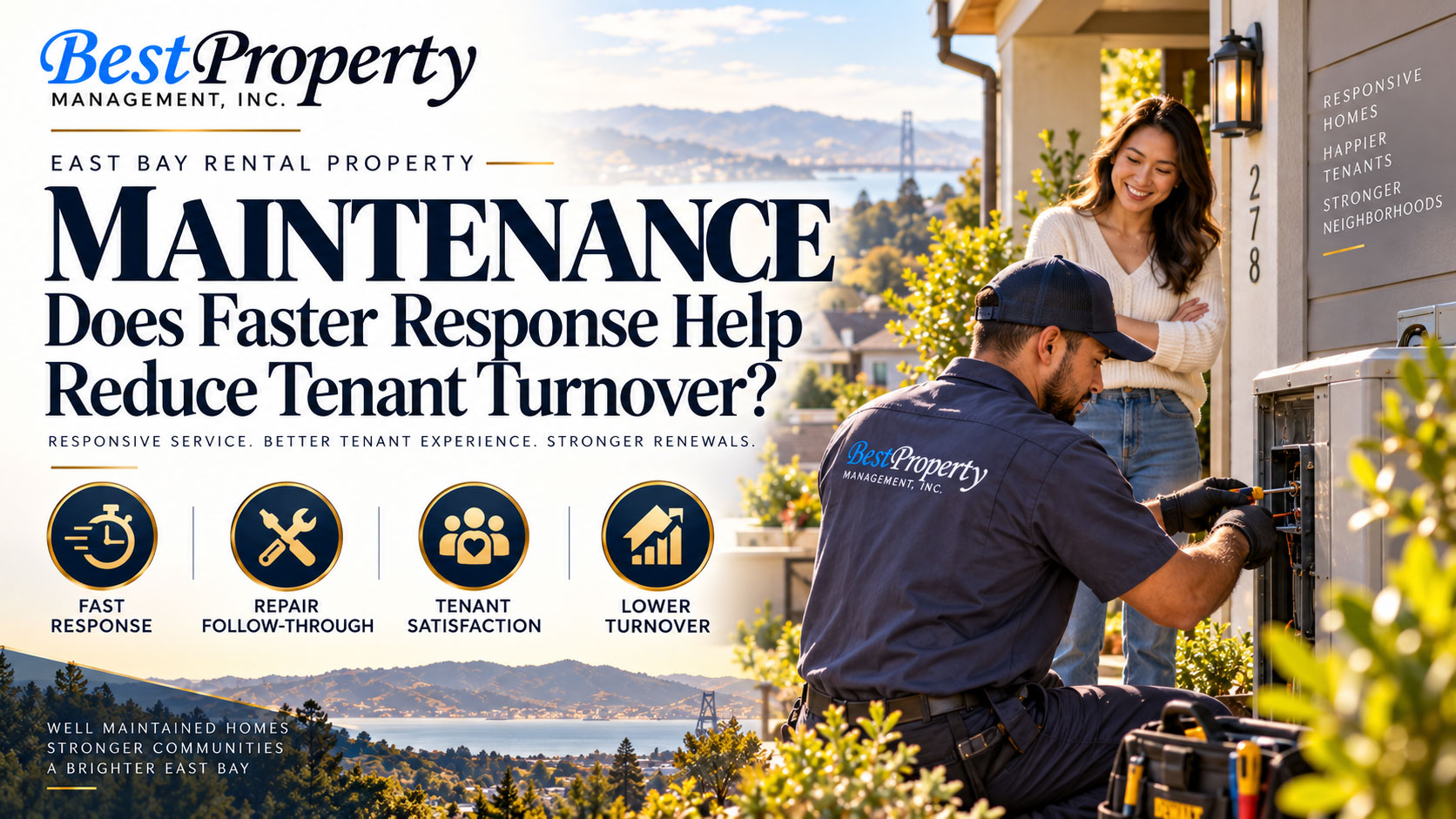
East Bay Rental Property Maintenance: Does Faster Response Help Reduce Tenant Turnover?
A maintenance request may look like a small operational task.
To a tenant, however, it can become one of the most important moments in the entire rental experience.
A broken appliance, leaking faucet, HVAC problem or electrical concern immediately tests whether the property is being managed professionally. The tenant notices how quickly someone responds, whether they receive updates and how long the repair actually takes.
For East Bay rental property owners, that matters because current renter research shows a strong connection between maintenance satisfaction, communication and lease-renewal intentions.
Quick Answer: Faster maintenance response can help reduce avoidable tenant turnover, but speed alone is not enough. Renters also care about follow-through, communication and knowing what is happening with their repair. Buildium’s 2026 renter research found that tenants satisfied with maintenance were 57% more likely to plan to renew their lease, while AppFolio found that 56% of maintenance-satisfied renters planned to renew or stay compared with only 31% of dissatisfied renters. For owners, the goal should be a reliable maintenance process that acknowledges requests quickly, prioritizes emergencies, keeps tenants informed and completes repairs efficiently.
Why Maintenance Has Such a Big Effect on Tenant Retention
Maintenance is different from many other parts of property management because it directly affects how a tenant experiences the home.
A tenant may rarely think about lease administration or owner reporting.
They immediately notice when:
- The air conditioner stops working
- A plumbing fixture leaks
- An appliance fails
- A lock does not function properly
- An electrical problem develops
- A roof or window begins allowing water inside
Buildium’s 2026 Renters’ Survey identifies maintenance as the number-one driver of renter satisfaction.
Its survey of 1,500 renters found:
- 24% said maintenance was the most stressful part of renting
- 25% were dissatisfied with maintenance completion
- 39% said better maintenance follow-through would improve their rental experience
- Renters satisfied with maintenance were 57% more likely to plan to renew
- Maintenance-satisfied renters were 48% more likely to say their rental represented good value
AppFolio’s 2026 research found a similar relationship.
Among renters satisfied with maintenance, 56% planned to renew or stay, compared with only 31% of renters dissatisfied with maintenance. AppFolio also found that 79% of satisfied renters said maintenance issues were resolved within a few days or less, while 53% of dissatisfied renters reported waiting weeks or longer.
These are national renter surveys rather than East Bay-only studies.
But the underlying lesson is highly relevant for owners in Fremont, Livermore, Pleasanton, Dublin, San Ramon, Danville, Brentwood and surrounding communities:
maintenance performance affects how tenants judge the entire rental experience.
That does not mean every repair must be completed immediately.
What matters is whether the process feels organized, responsive and predictable.
Owner takeaway: Tenants may accept that some repairs take time. They are much less likely to accept silence, repeated follow-ups and unresolved maintenance requests.
Does Faster Maintenance Response Really Reduce Turnover?
The research shows a strong relationship between maintenance satisfaction and renewal intentions.
But owners should be careful with the word cause.
A fast response alone cannot guarantee that a tenant stays.
Renters move because of:
- Job changes
- Home purchases
- Family changes
- Need for additional space
- Commute changes
- Rent affordability
- Neighborhood preferences
- Better housing options
What maintenance can influence is avoidable turnover.
Suppose a good tenant has lived in a property for three years.
They pay reliably and otherwise like the home.
Over the final year of the lease, however:
- Several maintenance requests require repeated follow-up
- Nobody acknowledges messages promptly
- Repairs take longer than expected
- The tenant receives little information about vendor schedules
By renewal time, the tenant may not evaluate the next rent increase in isolation.
They evaluate the rent plus the service experience.
Buildium found that renters satisfied with maintenance were more likely to perceive their rental as offering good value. That is important because 32% of renters planning to move said they were doing so for lower rent or better value.
In other words, maintenance can affect how a tenant feels about what they receive for the rent they pay.
A responsive maintenance system can reinforce:
“This home is worth staying in.”
Poor maintenance can create the opposite impression.
If maintenance requests are becoming difficult to track or coordinate, Best Property Management can help East Bay owners manage tenant requests, vendor scheduling, owner approvals and repair follow-through through a more organized property-management process.
What Does “Fast Maintenance Response” Actually Mean?
Fast response does not always mean fast completion.
That distinction is important.
A property manager may receive a maintenance request at 9 a.m. and respond at 9:15 a.m.
The repair itself might take two days because a technician is unavailable or a replacement part needs to be ordered.
From the tenant’s perspective, those two situations feel very different from submitting a request and hearing nothing for two days.
A strong process usually has several stages:
| Maintenance Stage | What the Tenant Needs |
|---|---|
| Request submitted | Confirmation it was received |
| Triage | Understanding of urgency |
| Vendor assigned | Confirmation that action is underway |
| Appointment scheduled | Clear timing or access instructions |
| Repair delayed | Explanation and updated expectations |
| Repair completed | Confirmation and follow-up |
Buildium found that 84% of renters expect a response from their property manager within 24 hours, while 61% expect a response the same day or faster.
That does not mean an owner must personally solve every request within 24 hours.
It means the tenant increasingly expects the management system to acknowledge the issue quickly.
Communication is especially important when the repair cannot happen immediately.
A simple message such as:
“We received your request. The vendor has been contacted and we expect to confirm the appointment this afternoon.”
can dramatically change the experience.
The tenant now knows:
- Someone received the request
- Someone is responsible
- The issue is moving forward
- Another update is coming
Best Property’s East Bay maintenance approach connects repair requests with vendor coordination and owner communication rather than treating each issue as an isolated phone call. East Bay Rental Property Maintenance Guide
How Communication Changes the Maintenance Experience
Maintenance and communication are tightly connected.
Buildium found renters satisfied with communication were 58% more likely to plan to renew their lease.
AppFolio’s 2026 data found that 55% of renters satisfied with communication planned to renew or stay, compared with 38% of renters dissatisfied with communication.
That means an owner can have competent vendors and still create a poor tenant experience if communication breaks down.
Consider two identical HVAC repairs.
Property A
The tenant submits a request.
The manager responds immediately.
A technician is scheduled for the following morning.
The tenant receives confirmation.
The technician determines a part is needed.
The manager tells the tenant the repair will take another day.
Property B
The tenant submits the same request.
Nobody responds.
The tenant sends another message.
They call the owner.
Eventually a vendor appears, but the tenant does not know when the repair will be completed.
The technical repair may take the same amount of time.
The tenant experience is completely different.
This is why maintenance systems should track more than the final completion date.
Owners should care about:
- Initial response time
- Emergency triage
- Vendor assignment
- Time to appointment
- Time to completion
- Tenant updates
- Repeated follow-up
- Open maintenance backlog
Professional property management can centralize those steps so a repair does not depend on one person remembering a text message.
Best Property Full-Service Management
Owner takeaway: The tenant does not experience maintenance as a work order. They experience the communication, waiting and uncertainty surrounding the work order.
Could Better Maintenance Also Protect the Property?
Tenant retention is only one reason maintenance responsiveness matters.
Fast reporting and organized repair coordination can also help prevent a small problem from becoming expensive.
Consider:
Slow plumbing leak: A minor repair can become flooring, cabinet or drywall damage.
Roof leak: Delayed response can increase interior water damage.
HVAC issue: Early diagnosis may prevent a larger system failure.
Irrigation problem: A small leak can create significant water waste or landscape damage.
Electrical issue: Prompt evaluation may identify a safety problem before it worsens.
That creates alignment between tenant and owner interests.
The tenant wants the issue fixed because it affects daily life.
The owner wants it addressed because unresolved maintenance can damage the asset.
Buildium’s 2026 property-management industry research also found that 56% of rental owners said maintenance support was the primary reason they hired a property manager, making it the owners’ top reported source of stress.
East Bay properties can create their own maintenance complexities.
A San Ramon or Dublin townhome may require HOA coordination.
A Livermore or Brentwood single-family home may involve irrigation, exterior areas and HVAC systems.
Older Fremont properties may require more frequent plumbing or electrical attention.
The specific repair categories differ.
The importance of an organized maintenance system does not.
How Should East Bay Owners Improve Maintenance Response?
Owners do not necessarily need to repair everything faster themselves.
They need a process that moves faster and communicates better.
A practical system can include:
Make it easy for tenants to report problems
A resident portal or defined maintenance channel creates better documentation than scattered text messages.
Acknowledge requests quickly
Even when the solution is not yet known.
Separate emergency from routine maintenance
A water leak should not enter the same workflow as a loose cabinet handle.
Use dependable vendors
Vendor availability is one of the biggest determinants of repair speed.
Communicate delays
If a part is backordered or approval is needed, tell the tenant.
Track unresolved work orders
Repeated follow-up should not be required to keep a request alive.
Review maintenance before renewal
An owner should know whether unresolved issues exist before asking a tenant to sign another lease.
Look for repeated property problems
Multiple service calls involving the same system may justify preventive repair or replacement.
Buildium specifically recommends tracking maintenance requests by age, status and backlog, along with sending updates throughout the maintenance lifecycle.
The goal is not perfection.
It is consistency.
A tenant should know what happens after they report a problem.
Want to reduce maintenance stress while improving the tenant experience? Contact Best Property Management for East Bay rental property maintenance coordination, tenant communication and full-service property management.
Related East Bay Rental Property Resources
- East Bay Rental Property Maintenance Guide
- Full-Service Property Management in the East Bay
- Best Guide to East Bay Property Management
- Best Property Contact and Local Offices
Frequently Asked Questions About Rental Property Maintenance and Tenant Turnover
Does faster maintenance response really make tenants more likely to renew?
Current renter research shows a strong relationship between maintenance satisfaction and lease-renewal intentions. Buildium found maintenance-satisfied renters were 57% more likely to plan to renew. AppFolio reported that 56% of renters satisfied with maintenance planned to renew or stay compared with 31% of dissatisfied renters. Those findings do not mean fast repairs guarantee renewal because tenants move for many other reasons. They do show that maintenance is one of the resident-experience factors property owners and managers can directly influence.
How quickly should a landlord respond to a maintenance request?
The appropriate repair time depends on the issue and applicable legal requirements, but acknowledgement should usually happen much sooner than final completion. Buildium’s 2026 survey found 84% of renters expected a property-manager response within 24 hours and 61% expected a response the same day or faster. Emergencies and habitability concerns may require substantially faster action. For routine issues, tenants should still receive confirmation that the request was received, information about next steps and updates when scheduling or parts create delays.
What maintenance problems cause the most tenant frustration?
The specific repair varies by property, but the larger frustration often comes from the process surrounding it. Buildium found maintenance was renters’ top source of stress and 39% said better follow-through on maintenance requests would improve their experience. Long delays, unclear timelines and repeated follow-up can be particularly frustrating. A well-run system should distinguish urgent problems from routine requests, communicate status and document completion. Owners should also pay attention to recurring issues because repeated repairs involving the same system can gradually reduce tenant confidence in the property.
Can better maintenance reduce rental vacancy costs?
Potentially. Better maintenance can help support tenant satisfaction and retention, which may reduce avoidable turnover. Every prevented turnover can mean avoiding some combination of vacancy, cleaning, repairs, marketing, showings, applicant screening and lease preparation. However, no maintenance program can guarantee a tenant will stay. Renters relocate for many reasons beyond property management. The stronger business case is that responsive maintenance protects both sides of the rental relationship: it helps preserve the property while removing one common reason a good tenant may become dissatisfied and consider moving.
Should landlords use an online maintenance portal?
An online portal can make maintenance easier to organize because tenants can submit requests, attach photos and potentially track progress. AppFolio’s 2026 report found maintenance satisfaction was higher among renters with portal access than among those without it. But software alone does not create good service. A portal that collects requests without fast acknowledgement or follow-through may simply digitize a poor process. The most useful system combines convenient online reporting with human oversight, reliable vendors, clear communication and documented completion.
Best Property Management Bay Area Offices
Brentwood 200 Sand Creek Rd., Suite D, Brentwood, CA 94513 925-392-2411 ronventura@bestproperty4u.com Brentwood Office
Fremont 40069 Mission Blvd., Fremont, CA 94539 510-770-0824 dustinventura@bestproperty4u.com Fremont Office
Livermore 1985 First Street, Suite 209, Livermore, CA 94550 925-292-1785 robertventura@bestproperty4u.com Livermore Office
Tracy 672 West 11th Street, Suite 208, Tracy, CA 95376 209-340-2500 brendanreese@bestproperty4u.com Tracy Office
This article is provided for general informational purposes only and is not legal, financial or property-management compliance advice. Maintenance obligations, repair timelines, habitability requirements and rental-property circumstances vary by jurisdiction and property. Rental property owners should verify current requirements and consult qualified professionals when appropriate.
Blog
Company News
Landlord Resources
Landlords
Legal
Linkedin
Local Market Insights
Maintenance & Repairs
Market
Owners
Property
Property Law & Compliance
Property Management
Rental Property
Tenants
Video
FILTER BY EASTBAY & TRI-VALLEY CITIES
AB 1482
AI Rental Fraud
Antioch Property Management
Applicant Data Security
Applicant Information
Applicant Screening
Applicant Verification
Bank Statement Fraud
Brentwood
Brentwood property management
California Insurance
California Landlord Laws
California Property Management
California Rent Increase
Central Valley Property Management
Concord Property Management
Credit Reports
Danville Property Management
Danville rentals
Desert Hot Springs Property Management
Desert Property Maintenance
Desert Rentals
Document Fraud
Dublin property management
East Bay Landlords
East Bay Lease Renewals
East Bay property management
East Bay Rental Market
East Bay Rental Owners
East Bay Rental Property Maintenance
East Bay Rental Property Management
East Bay rental tips
East Bay Rentals
Eviction Notices
Eviction Support
Fair Housing
Fake Pay Stubs
Fall Leasing
find a property manager
Fremont
Fremont property management
full service property management
Full-Service Property Management
Good Tenants
Hayward Property Management
Hayward rentals
hiring a property manager
HOA Compliance
HOA Rental Management
HOA Rentals
Home Insurance Costs
Identity Verification
Income Verification
Indian Wells Property Management
Inherited Rental Property
Landlord Compliance
Landlord Data Security
Landlord Insurance
Landlord Resources
Landlord Tips
Lease Renewal Strategy
Lease Renewals
Leasing Fees
Leasing Services
Livermore
Livermore property management
Livermore Rentals
Local Development
Local Market Insights
Local Rental Support
Long-Term Rentals
Luxury Rentals
maintenance coordination
Maintenance Response
Management Services
Manteca Property Management
Milpitas Property Management
Mountain House Property Management
New Housing San Ramon
Newark CA Property Management
Oakley Property Management
Online Rent Payments
Owner Onboarding
owner reporting
Palm Desert Property Management
Palm Springs Area Property Management
Palm Springs Property Management
Palm Springs Rentals
Pittsburg CA Property Management
Pleasanton property management
Pleasanton rentals
Preventive Maintenance
Property Inspections
Property Maintenance
Property Management
Property Management Companies
Property Management Fees
Property Management Services
Property Management Transition
Property Manager
Rancho Mirage Property Management
Real Estate
real estate investing
Redfin Rentals
Remote Property Management
Rent Collection
Rent Control
Rent Trends
Rental Application Fraud
Rental Application Privacy
Rental Competition
Rental Fees
Rental Fraud
Rental History
Rental Inspections
rental leasing
Rental Market Analysis
Rental Market Trends
Rental Marketing
Rental Pricing
Rental Property
Rental Property Expenses
Rental Property Maintenance
rental property owners
rental property ROI
Renter Choice
Renter Experience
Repair Coordination
Resident Portal
Residential Leasing
San Lorenzo Property Management
San Ramon Landlords
San Ramon Orchards
San Ramon property management
San Ramon Rental Market
Screening Red Flags
Seasonal Rentals
Security Deposits
Sell or Rent
Silicon Valley Rentals
single family rentals
Single-Family Rentals
Tenant Background Checks
Tenant Communication
Tenant Complaints
Tenant Expectations
Tenant Issues
Tenant Placement
Tenant Protection Act
Tenant Retention
tenant screening
Tenant Screening Data Security
Tenant Screening Fraud
Tenant Screening Red Flags
Tenant Turnover
Tracy Property Management
Tri-Valley
Tri-Valley Housing Market
Tri-Valley property management
Tri-Valley Rentals
Union City Property Management
Vacation Rental Management
Wildfire Risk
Zillow Rentals
 FILTER
 SEARCH BLOG