Fremont Lease Preparation: What Should Owners Review Before a New Tenant Signs?
A lease is the operating document for a Fremont rental, not simply the final page of an application process. Before a new tenant signs, the owner needs confidence that the document identifies the right property, matches the approved terms and assigns responsibilities clearly. A copied lease with old details can create confusion before the tenancy begins.
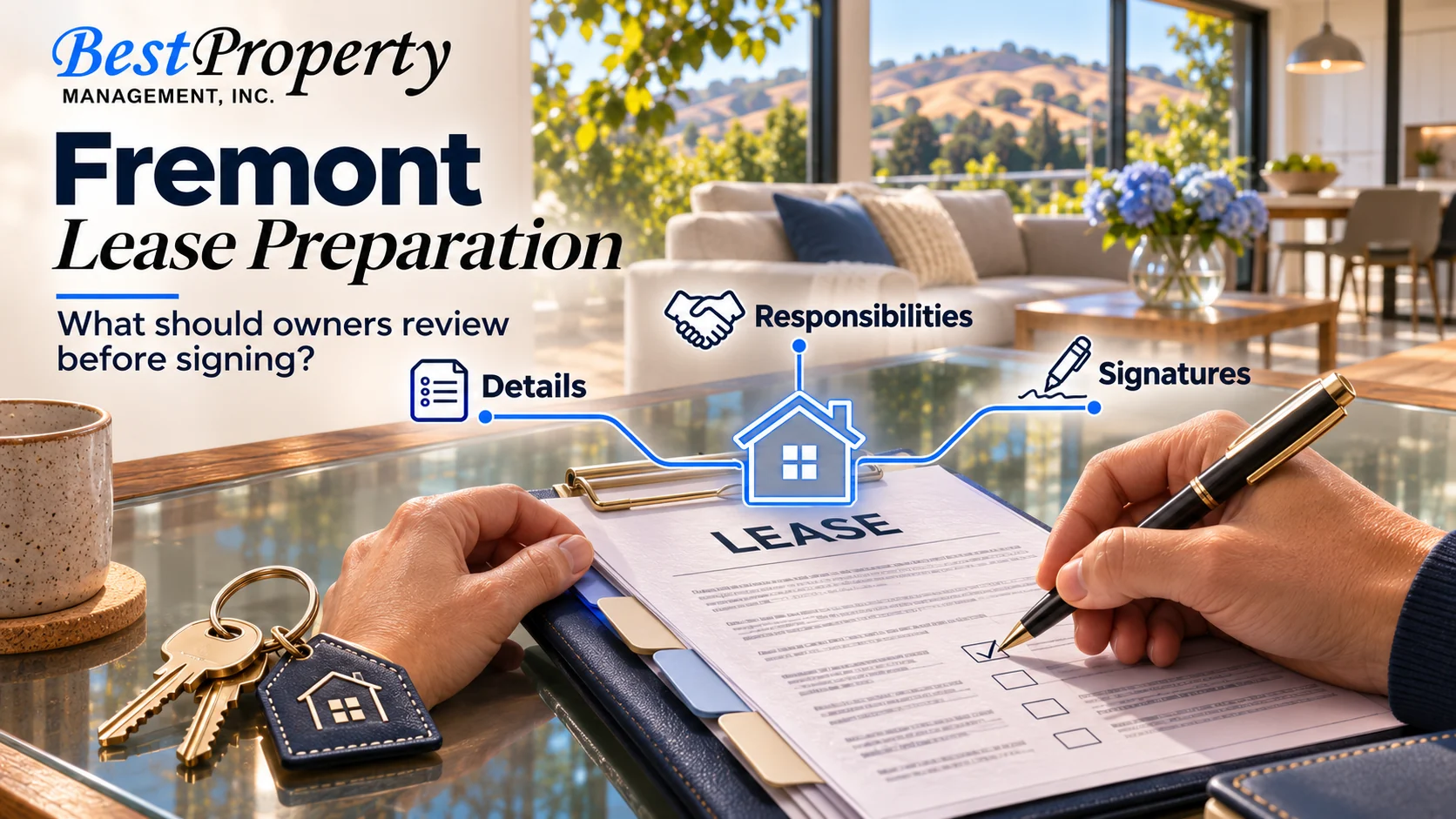
Before signing, review the parties, property description, tenancy dates, payment terms, maintenance reporting, applicable attachments and document consistency. Confirm that proposed terms receive current property-specific review. This is an owner review workflow, not a substitute lease form or a legal opinion about which provisions your property requires.
Which Basic Details Should Owners Check First?
Begin with the names, property address and the intended tenancy details. Compare the lease with the approved application information and the owner’s agreed instructions. A small mismatch can create practical problems when payment instructions, access records or later communications use different information.
Review dates as a sequence. The signing date, tenancy start and planned key handoff may serve different purposes. Ask the manager how those events are coordinated and what must be complete before possession changes hands. Do not assume that a signature alone means the home is ready.
Our Fremont property management guide explains how lease preparation fits within ongoing service. The lease review should connect to the manager’s actual handoff process, not operate as a separate administrative task.
How Should Payment Terms and Instructions Be Reviewed?
Confirm that the written payment terms match the approved arrangement and applicable requirements. Identify the amount, timing and accepted payment process described in the documents. If the manager handles collection, the tenant should receive consistent instructions from the responsible party.
| Review area | Owner question | Consistency check |
|---|---|---|
| Parties and property | Does this identify the intended tenancy? | Lease, application and file agree |
| Dates and access | What happens before keys are released? | Readiness and handoff sequence agree |
| Payments | Are the approved terms recorded correctly? | Lease and payment instructions agree |
| Attachments | Which documents apply to this property? | Complete, current review and signatures |
Ask how changes are documented if a term is revised during preparation. Untracked edits can leave different versions circulating. Our rent collection guide provides context for the payment records that follow signing.
What Should the Lease Say About Maintenance Communication?
The tenant needs to know where to report a repair and how to describe an urgent concern. The owner needs to understand which responsibilities remain theirs and what the manager handles. A service agreement between owner and manager should be consistent with the tenant-facing communication process.
Avoid treating a maintenance clause as permission to shift obligations that cannot lawfully be shifted. The California Attorney General's tenant resources are an official starting point for housing-condition responsibilities. Obtain appropriate review of a provision rather than assuming a template makes it enforceable.
For the operating process, ask how a request becomes a work order and who communicates the next step. Our East Bay maintenance guide explains why those records matter. Clear instructions reduce avoidable confusion but do not replace the duty to respond appropriately.
Which Property-Specific Attachments Need Attention?
Ask the preparer to identify the documents applicable to the home and tenancy. Association information, access instructions, disclosures or other attachments may require attention depending on the circumstances. Do not use a universal checklist as proof that every required document has been identified.
For a Fremont condo, the owner should provide the current association documents relevant to rental operations. Ask how approved rules and practical instructions are communicated without inserting unsupported statements into the lease. The manager may need additional information before the packet is complete.
Fremont also has a city Rent Review Program. Confirm current local requirements and how the tenancy file should address them. A statewide template should not be assumed to cover every local responsibility without review.
How Do You Prevent Version and Signature Problems?
Use one clearly identified final packet. If the owner requests a change, record what changed and have the appropriate person review it before signing. A revised payment term or attachment should not appear in one person’s copy while another person signs the earlier version.
Confirm how signatures, required acknowledgments and copies are handled. The owner should be able to access the completed documents afterward. If electronic signing is used, ask how the final record is stored and how the tenant receives the completed packet.
An illustrative problem is an owner approving one tenancy start date while a draft retains another. The solution is not a verbal assurance that everyone understands. Correct the document before execution and keep the final signed version identifiable.
What Should Be Complete Before the Key Handoff?
Connect the lease file to move-in readiness. Confirm that the agreed documents are complete, payment requirements are handled appropriately, condition documentation is prepared and unresolved work has an assigned follow-up. Each step needs an owner rather than a general assumption that leasing has finished.
Our leasing and tenant placement guide describes the broader handoff. The East Bay screening guide covers the earlier applicant review. Keep those stages connected while recognizing that an approved application and a fully prepared tenancy are different milestones.
Discuss Best Property Management’s lease preparation service for your rental. Owner takeaway: Review the document’s accuracy, its consistency with other records and the property-specific requirements before signatures make a correction more complicated.
Frequently Asked Questions About Fremont Lease Preparation
Can I reuse the lease from my previous tenant?
Do not assume it remains appropriate. Dates, parties, property details and applicable requirements need review. A prior document can contain terms or attachments that do not fit the next tenancy. Ask the responsible preparer to confirm the current packet rather than changing only the tenant’s name.
Should the owner review the lease even if a manager prepares it?
Yes, review the business details and confirm your instructions are reflected accurately. The manager or qualified adviser should address property-specific legal requirements within their scope. Owner review helps catch mismatches, but it does not turn an unfamiliar provision into a lawful one simply because the owner approved it.
What if a tenant asks to change a clause?
Route the request to the responsible preparer and obtain appropriate review before agreeing. Record the final decision and keep all copies consistent. Avoid an informal side promise that conflicts with the written packet. Some proposed changes may require legal guidance or may not be appropriate for the property.
Are association rules automatically part of the lease?
Do not assume they are included or accurately communicated without checking. Provide current relevant documents and ask how the applicable information is handled in the tenancy packet. Separate practical instructions from legal provisions and confirm the process for updates or questions during the tenancy.
Does Fremont require attention beyond a statewide template?
Owners should check current local requirements, including the city’s Rent Review Program, alongside applicable state law. The right packet depends on the property and tenancy. Ask who is responsible for that review and avoid assuming a generic form automatically addresses all local obligations.
What should I do if I find a wrong date after signing?
Contact the responsible manager or qualified adviser promptly and ask how to correct the record appropriately. Do not quietly edit the signed copy or assume a text message resolves the discrepancy. Preserve the original and keep an understandable record of any approved correction.
Where should the signed lease be stored?
Use a secure, organized tenancy file with controlled access and a clearly identified final version. The owner should know how to retrieve it and related attachments. Avoid scattering signed documents across personal inboxes or sharing sensitive applicant information unnecessarily with people who do not need it.
How can the Fremont team help me prepare for the next lease?
Bring the current property information, occupancy plans, relevant association records and any unusual circumstances. Ask what information is missing and who reviews the final packet. The office contact page can connect you with the team for a property-specific discussion.
Related Articles
Fremont property management services explains the management responsibilities around lease preparation.
California landlord rules provides broader compliance context.
Leasing and tenant placement covers the process from approval to move-in.
East Bay tenant screening explains the applicant review that precedes lease preparation.
Blog
Company News
Landlord Resources
Landlords
Legal
Linkedin
Local Market Insights
Maintenance & Repairs
Market
Owners
Property
Property Law & Compliance
Property Management
Rental Property
Tenants
Video
FILTER BY EASTBAY & TRI-VALLEY CITIES
AB 1482
AI Property Management
AI Rental Fraud
Antioch Property Management
Applicant Data Security
Applicant Information
Applicant Screening
Applicant Verification
Bank Statement Fraud
Brentwood
Brentwood property management
California Insurance
California Landlord Laws
California Property Management
California Rent Increase
Central Valley Property Management
Concord Property Management
Credit Reports
Danville Property Management
Danville rentals
Desert Hot Springs Property Management
Desert Property Maintenance
Desert Rentals
Document Fraud
Dublin property management
East Bay Landlords
East Bay Lease Renewals
East Bay property management
East Bay Rental Market
East Bay Rental Owners
East Bay Rental Property Maintenance
East Bay Rental Property Management
East Bay rental tips
East Bay Rentals
EV Charging
Eviction Notices
Eviction Support
Fair Housing
Fake Pay Stubs
Fall Leasing
find a property manager
Fremont
Fremont property management
full service property management
Full-Service Property Management
Good Tenants
Hayward Property Management
Hayward rentals
hiring a property manager
HOA Compliance
HOA Rental Management
HOA Rentals
Home Insurance Costs
Human Oversight
Identity Verification
Income Verification
Indian Wells Property Management
Inherited Rental Property
Landlord Compliance
Landlord Data Security
Landlord Insurance
Landlord Resources
Landlord Tips
Lease Renewal Strategy
Lease Renewals
Leasing Fees
Leasing Services
Livermore
Livermore property management
Livermore Rentals
Local Development
Local Market Insights
Local Rental Support
Long-Term Rentals
Luxury Rentals
maintenance coordination
Maintenance Response
Management Services
Manteca Property Management
Milpitas Property Management
Mountain House Property Management
New Housing San Ramon
Newark CA Property Management
Oakley Property Management
Online Rent Payments
Owner Onboarding
owner reporting
Palm Desert Property Management
Palm Springs Area Property Management
Palm Springs Property Management
Palm Springs Rentals
Pittsburg CA Property Management
Pleasanton property management
Pleasanton rentals
Preventive Maintenance
Property Inspections
Property Maintenance
Property Management
Property Management Companies
Property Management Fees
Property Management Services
Property Management Transition
Property Manager
Rancho Mirage Property Management
Real Estate
real estate investing
Redfin Rentals
Remote Property Management
Rent Collection
Rent Control
Rent Trends
Rental Application Fraud
Rental Application Privacy
Rental Competition
Rental Fees
Rental Fraud
Rental History
Rental Inspections
Rental Internet
rental leasing
Rental Market Analysis
Rental Market Trends
Rental Marketing
Rental Pricing
Rental Property
Rental Property Expenses
Rental Property Maintenance
rental property owners
rental property ROI
Renter Choice
Renter Experience
Repair Coordination
Resident Portal
Residential Leasing
Roommate Management
San Lorenzo Property Management
San Ramon Landlords
San Ramon Orchards
San Ramon property management
San Ramon Rental Market
Screening Red Flags
Seasonal Rentals
Security Deposits
Sell or Rent
Silicon Valley Rentals
single family rentals
Single-Family Rentals
Tenant Background Checks
Tenant Communication
Tenant Complaints
Tenant Expectations
Tenant Issues
Tenant Placement
Tenant Protection Act
Tenant Retention
tenant screening
Tenant Screening Data Security
Tenant Screening Fraud
Tenant Screening Red Flags
Tenant Turnover
Tracy Property Management
Tri-Valley
Tri-Valley Housing Market
Tri-Valley property management
Tri-Valley Rentals
Union City Property Management
Vacation Rental Management
Wildfire Risk
Winter Rental Safety
Zillow Rentals
 FILTER
 SEARCH BLOG