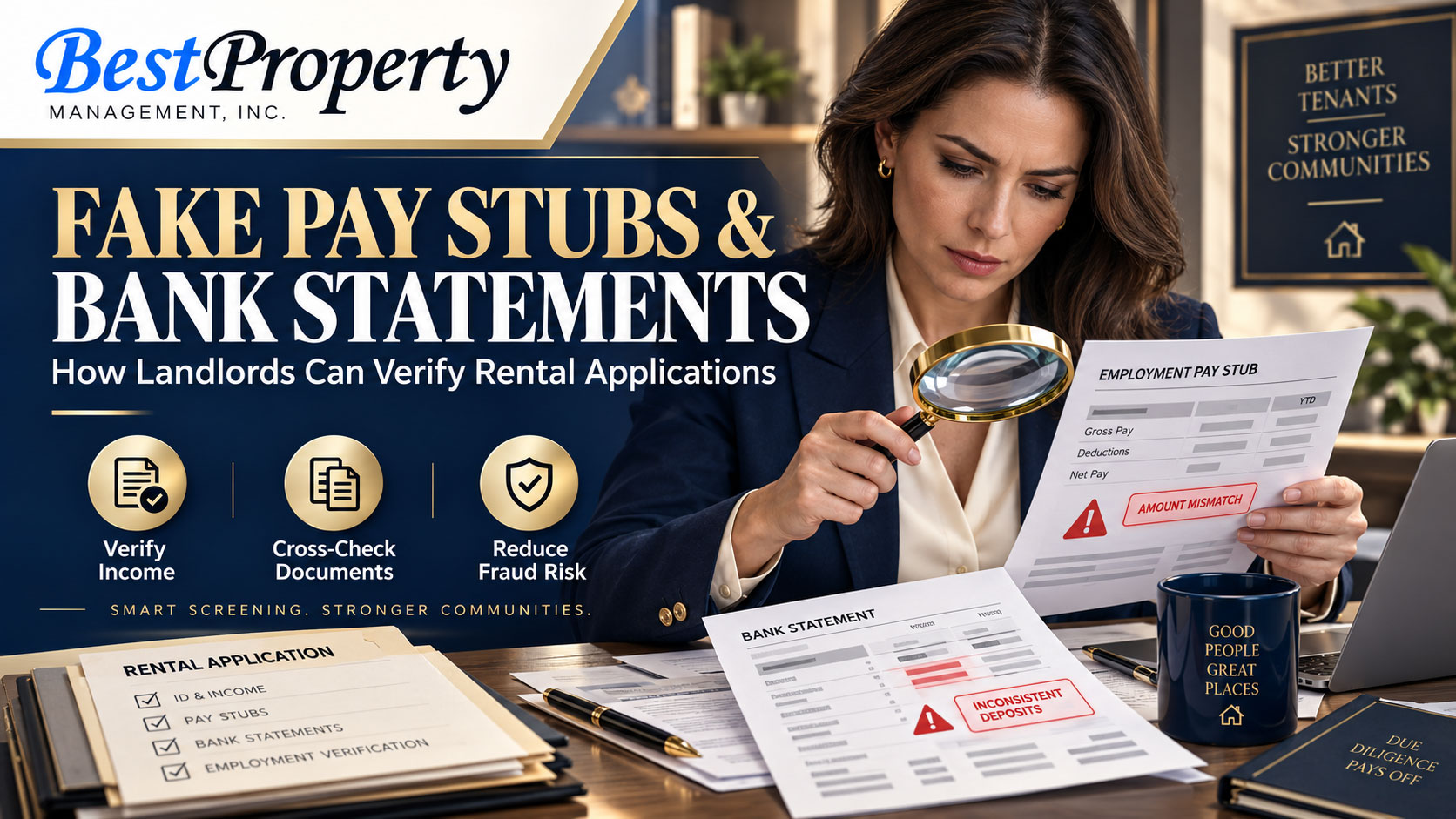
Tenant Screening: How Can Landlords Spot Fake Pay Stubs and Bank Statements in Rental Applications?
Rental application fraud is becoming much harder to detect by eye.
A few years ago, a fake pay stub might have obvious formatting problems or numbers that did not add up. Today, AI tools, editable templates and inexpensive document software can produce pay stubs, bank statements and employment records that look polished enough to pass a quick review.
For East Bay rental property owners, that means screening should rely less on visual judgment and more on consistent verification across multiple sources.
Quick Answer: Landlords should not try to identify fake pay stubs or bank statements from appearance alone. A stronger process is to compare income, employer information, deposits, dates, balances and application details for consistency, then independently verify income or employment where appropriate. Documents that look professional can still contain false information. Owners should also apply the same verification process to every applicant and avoid subjective screening practices that could create fair housing problems.
Why Fake Financial Documents Are Getting Harder to Spot
Rental fraud is becoming more sophisticated because the tools used to create fake documents are becoming more sophisticated too.
Experian says landlords and property managers increasingly face difficulty manually verifying applicant information and detecting fraudulent documents. Its rental-fraud materials specifically highlight fake pay stubs, identity manipulation and document verification as growing concerns.
TransUnion has also been tracking rental-application fraud more closely. In June 2026, the company reported that certain fraud-risk indicators were strongly associated with later charge-offs, reinforcing the importance of looking beyond a single document or credit score when evaluating an application.
The central problem is simple:
A clean-looking PDF is not proof that the information is real.
A fake pay stub can include:
- A real company name
- A professional payroll layout
- Correct-looking tax categories
- Plausible gross and net income
- Consistent fonts and spacing
- A realistic pay period
A fake bank statement can look equally convincing.
That is why screening should focus less on “Does this document look fake?” and more on:
“Does this information make sense when compared with everything else we know?”
Best Property’s tenant screening service is built around that broader verification approach rather than relying on a single uploaded document.
Owner takeaway: Document appearance is becoming less useful as a fraud test. Cross-verification is becoming more important.
What Should Landlords Check on a Pay Stub?
A pay stub can still provide useful information, but it should be reviewed as part of a larger application.
Look for internal consistency.
| Pay Stub Check | What to Compare |
|---|---|
| Employer name | Does it match the application? |
| Pay period | Does the timing make sense? |
| Gross income | Does it align with stated monthly or annual income? |
| Year-to-date income | Is it consistent with the pay frequency and date? |
| Deductions | Do they look plausible for the stated employment? |
| Employee name | Does it match the applicant identity? |
| Address | Is it consistent with other records where applicable? |
One of the most useful checks is the relationship between current earnings and year-to-date earnings.
For example, if an applicant says they are paid every two weeks, the year-to-date total should generally make sense for the number of pay periods that have occurred.
A mismatch does not automatically prove fraud.
There may be bonuses, commissions, unpaid leave, recent employment changes or other explanations.
But it can justify further verification.
The same principle applies to hourly wages.
If the stub shows an hourly rate and hours worked, the gross pay should make mathematical sense.
Owners should also compare the pay stub with the employment information on the application.
If the employer name, job title or employment dates do not match, that is a factual discrepancy worth resolving.
The key is to verify the discrepancy consistently rather than making assumptions about the applicant.
If you are screening applicants for an East Bay rental, Best Property Management can help manage income verification, employment review, rental history and tenant placement using consistent screening procedures.
What Should Landlords Look for on Bank Statements?
Bank statements can help confirm that income is actually reaching an applicant’s account.
But again, the goal is not to become a forensic accountant.
The goal is to look for consistency.
Useful questions include:
- Do payroll deposits appear at expected intervals?
- Does the employer or payment source make sense?
- Do deposit amounts roughly correspond with the submitted income?
- Are there unexplained gaps?
- Does the account holder name match the applicant?
- Do beginning and ending balances make sense?
- Are page numbers and statement periods consistent?
Owners should be particularly careful about relying on a single screenshot.
Screenshots can omit context.
A full statement period may show whether deposits occur consistently and whether the information aligns with the applicant’s claimed employment.
However, landlords should collect only the financial information reasonably necessary for the screening process and handle applicant data securely.
That is especially important because rental applications can include extremely sensitive information.
FTC guidance reminds consumers that tenant screening commonly involves names, Social Security numbers, prior addresses, work history, income history and credit information.
Landlords should therefore avoid creating unnecessary copies of financial records or storing applicant information longer or less securely than needed.
What Are the Most Useful Signs of Possible Document Manipulation?
There are some warning signs that can justify additional verification.
But they should be treated as inconsistencies, not automatic proof of fraud.
Possible issues include:
- Employer information that does not match the application
- Year-to-date income that does not make mathematical sense
- Deposit dates that do not match payroll frequency
- Income figures that vary dramatically between documents without explanation
- Missing pages
- Inconsistent account holder names
- Strange statement periods
- Different addresses across documents
- Employment dates that conflict with claimed income history
- Multiple applications containing unusually similar document formats or patterns
The strongest warning sign is often not visual.
It is a contradiction between independent pieces of information.
For example:
An applicant reports monthly income of $8,000.
The pay stub appears to support that.
But the bank statement shows deposits averaging $3,500.
That does not necessarily mean fraud, because some income may go to another account or the applicant may have multiple income sources.
But the mismatch should be resolved before making a decision.
This is a better screening approach than rejecting an application because a font looks unusual.
Why Independent Verification Matters More Than Document Inspection
The strongest way to reduce document fraud is to stop treating uploaded documents as the only evidence.
Where appropriate, landlords or property managers can independently verify:
- Employment
- Income
- Identity
- Rental history
- Consumer-report information
That might include direct employer verification, trusted third-party income verification or other lawful verification methods.
Experian specifically promotes identity authentication and document verification because manual review alone is increasingly difficult.
TransUnion likewise emphasizes identity validation and cross-checking fraud signals as part of modern screening.
This is also where automation can help.
A verification platform may be able to detect patterns a human reviewer would miss.
But automation should not become a black box.
HUD’s tenant-screening guidance makes clear that housing providers remain responsible for fair and nondiscriminatory screening even when third-party companies or AI tools are used.
Technology can help answer:
“Is this information consistent?”
It should not replace the owner’s responsibility to apply lawful criteria fairly.
Owner takeaway: The goal is not to become better at spotting fake PDFs. The goal is to build a screening process that does not depend on trusting PDFs in the first place.
How Can Landlords Verify Fraud Without Creating Fair Housing Risk?
This is one of the most important parts of the process.
Fraud prevention should be systematic.
Not personal.
A landlord should not verify one applicant aggressively because they “seem suspicious” while accepting another applicant’s documents without question.
A better approach is to establish the verification standard before applications arrive.
For example:
- All applicants provide the same categories of income documentation
- All applicants must satisfy the same income standard
- Employment verification follows the same process
- Rental history is checked consistently
- Missing or conflicting information is handled under the same policy
- Applicants are given the same opportunity to provide required clarification
HUD emphasizes that housing providers have a legitimate interest in determining whether an applicant is likely to pay rent and comply with a lease, but overly broad or inconsistent screening criteria can create discriminatory effects.
Fair housing rules still apply when fraud-detection technology is used.
The process should therefore focus on verifiable financial qualifications and documented inconsistencies rather than protected characteristics, stereotypes or subjective impressions.
Best Property’s East Bay leasing and tenant placement guide explains why applicant screening should sit within a standardized leasing workflow instead of being handled informally.
What If a Third-Party Screening Report Contains Incorrect Information?
Landlords should remember that applicant-supplied documents are not the only information that can be wrong.
Tenant-screening reports can contain mistakes too.
In July 2026, the Federal Trade Commission announced a $2.25 million settlement with RentGrow involving allegations that the company failed to maintain reasonable procedures to assure the accuracy of information in certain tenant-screening reports.
The Fair Credit Reporting Act governs many consumer reports used in tenant screening.
If a landlord takes adverse action because of information in a consumer report, FCRA requirements can include notifying the applicant about the reporting company involved.
This is an important balance.
Owners need to protect themselves from fraudulent applicants.
But applicants also need protection from inaccurate screening information.
A professional screening workflow accounts for both possibilities.
A Better 2026 Screening Workflow for East Bay Rental Owners
The most practical approach can be summarized in seven steps.
1. Establish written criteria before accepting applications
Define income, credit, rental-history and documentation requirements before seeing who applies.
2. Require a complete application
Know exactly what information is required before review begins.
3. Verify identity
Confirm that the applicant and submitted identity information match.
4. Review documents for consistency
Compare pay stubs, bank statements and application data.
5. Independently verify key information
Do not make major approval decisions based solely on applicant-created documents.
6. Investigate discrepancies consistently
Give applicants a standardized way to clarify legitimate inconsistencies.
7. Document the decision
Record which established qualification standard the applicant did or did not satisfy.
That process is considerably more defensible than trying to “catch” fraudulent documents based on appearance.
Rental application fraud is getting more sophisticated. Contact Best Property Management for tenant screening, applicant verification, tenant placement and full-service property management across the East Bay and Tri-Valley.
Related Tenant Screening Resources
- Tenant Screening for Rental Property Owners
- Tenant Background Checks
- East Bay Leasing and Tenant Placement Guide
- Tenant Placement Services
Frequently Asked Questions About Fake Pay Stubs and Bank Statements
How can a landlord tell if a pay stub is fake?
There is no single visual clue that reliably identifies a fake pay stub. Modern document tools can reproduce professional payroll layouts very convincingly. Landlords should instead compare the employer, pay period, gross income, deductions and year-to-date totals with the rental application and other supporting information. Mathematical inconsistencies or conflicting employment details can justify further verification. The strongest approach is independent income or employment verification rather than relying solely on the submitted pay stub. The same verification procedure should be applied consistently to applicants who are evaluated under the same rental criteria.
Can landlords verify employment directly with an employer?
In many situations, employment can be independently verified as part of a lawful tenant-screening process, but owners should use an appropriate and consistent procedure and collect only information relevant to rental qualification. Some employers may provide limited information or use third-party verification services. Applicants may also have self-employment, contract income or multiple employers, requiring different documentation. The important principle is that the screening standard should not change arbitrarily from applicant to applicant. Property-specific questions about authorization, privacy or local screening requirements should be reviewed with qualified legal counsel.
Are bank statements enough to prove an applicant’s income?
Bank statements can help confirm recurring deposits, but they should generally not be treated as the only evidence of income. Deposits may include transfers, gifts, reimbursements, investment proceeds or other money that is not recurring employment income. Conversely, some legitimate income may be deposited into another account. Owners should compare bank activity with the applicant’s stated income source and other documentation. A consistent combination of income documentation and independent verification provides a stronger picture than either a pay stub or bank statement alone.
What should a landlord do if a pay stub and bank statement do not match?
A mismatch should usually trigger clarification rather than an automatic accusation of fraud. There may be legitimate reasons, such as split direct deposits, bonuses, multiple accounts, commissions or recent changes in employment. The owner or property manager should follow the same discrepancy-resolution process used for other applicants and request appropriate supporting information. If required income ultimately cannot be verified under the written screening criteria, the application may fail that standard. Decisions should be based on documented facts and established qualifications, not assumptions about why the discrepancy occurred.
Can AI detect fake rental application documents?
AI-assisted and automated verification tools can help identify inconsistencies, validate identities and flag potentially manipulated documents, but they should not be treated as infallible. HUD has emphasized that fair housing obligations still apply when artificial intelligence or algorithmic screening tools are used. Landlords should understand what information a screening system evaluates and maintain a transparent, consistent decision process. Technology is most useful when it supports verification rather than becoming an unexplained automatic approval or denial system.
Best Property Management Bay Area Offices
Brentwood Office 200 Sand Creek Rd., Suite D, Brentwood, CA 94513 925-392-2411
Fremont Office 40087 Mission Blvd., Fremont, CA 94539 510-770-0824
Livermore Office 2300 First Street, Suite 236, Livermore, CA 94550 925-292-1785
Tracy Office 672 W. 11th Street, Tracy, CA 95376 1-800-910-1237
This article is provided for general informational purposes only and is not legal, financial, fair housing or tenant-screening compliance advice. Screening requirements, privacy rules, consumer-reporting laws and individual circumstances can vary. Rental property owners should verify current requirements and consult qualified professionals when appropriate.
Blog
Company News
Landlord Resources
Landlords
Legal
Linkedin
Local Market Insights
Maintenance & Repairs
Market
Owners
Property
Property Law & Compliance
Property Management
Rental Property
Tenants
Video
FILTER BY EASTBAY & TRI-VALLEY CITIES
AB 1482
AI Rental Fraud
Antioch Property Management
Applicant Data Security
Applicant Information
Applicant Screening
Applicant Verification
Bank Statement Fraud
Brentwood
Brentwood property management
California Insurance
California Landlord Laws
California Property Management
California Rent Increase
Central Valley Property Management
Concord Property Management
Credit Reports
Danville Property Management
Danville rentals
Desert Hot Springs Property Management
Desert Property Maintenance
Desert Rentals
Document Fraud
Dublin property management
East Bay Landlords
East Bay Lease Renewals
East Bay property management
East Bay Rental Market
East Bay Rental Owners
East Bay Rental Property Maintenance
East Bay Rental Property Management
East Bay rental tips
East Bay Rentals
Eviction Notices
Eviction Support
Fair Housing
Fake Pay Stubs
Fall Leasing
find a property manager
Fremont
Fremont property management
full service property management
Full-Service Property Management
Good Tenants
Hayward Property Management
Hayward rentals
hiring a property manager
HOA Compliance
HOA Rental Management
HOA Rentals
Home Insurance Costs
Identity Verification
Income Verification
Indian Wells Property Management
Inherited Rental Property
Landlord Compliance
Landlord Data Security
Landlord Insurance
Landlord Resources
Landlord Tips
Lease Renewal Strategy
Lease Renewals
Leasing Fees
Leasing Services
Livermore
Livermore property management
Livermore Rentals
Local Development
Local Market Insights
Local Rental Support
Long-Term Rentals
Luxury Rentals
maintenance coordination
Maintenance Response
Management Services
Manteca Property Management
Milpitas Property Management
Mountain House Property Management
New Housing San Ramon
Newark CA Property Management
Oakley Property Management
Online Rent Payments
Owner Onboarding
owner reporting
Palm Desert Property Management
Palm Springs Area Property Management
Palm Springs Property Management
Palm Springs Rentals
Pittsburg CA Property Management
Pleasanton property management
Pleasanton rentals
Preventive Maintenance
Property Inspections
Property Maintenance
Property Management
Property Management Companies
Property Management Fees
Property Management Services
Property Management Transition
Property Manager
Rancho Mirage Property Management
Real Estate
real estate investing
Redfin Rentals
Remote Property Management
Rent Collection
Rent Control
Rent Trends
Rental Application Fraud
Rental Application Privacy
Rental Competition
Rental Fees
Rental Fraud
Rental History
Rental Inspections
rental leasing
Rental Market Analysis
Rental Market Trends
Rental Marketing
Rental Pricing
Rental Property
Rental Property Expenses
Rental Property Maintenance
rental property owners
rental property ROI
Renter Choice
Renter Experience
Repair Coordination
Resident Portal
Residential Leasing
San Lorenzo Property Management
San Ramon Landlords
San Ramon Orchards
San Ramon property management
San Ramon Rental Market
Screening Red Flags
Seasonal Rentals
Security Deposits
Sell or Rent
Silicon Valley Rentals
single family rentals
Single-Family Rentals
Tenant Background Checks
Tenant Communication
Tenant Complaints
Tenant Expectations
Tenant Issues
Tenant Placement
Tenant Protection Act
Tenant Retention
tenant screening
Tenant Screening Data Security
Tenant Screening Fraud
Tenant Screening Red Flags
Tenant Turnover
Tracy Property Management
Tri-Valley
Tri-Valley Housing Market
Tri-Valley property management
Tri-Valley Rentals
Union City Property Management
Vacation Rental Management
Wildfire Risk
Zillow Rentals
 FILTER
 SEARCH BLOG