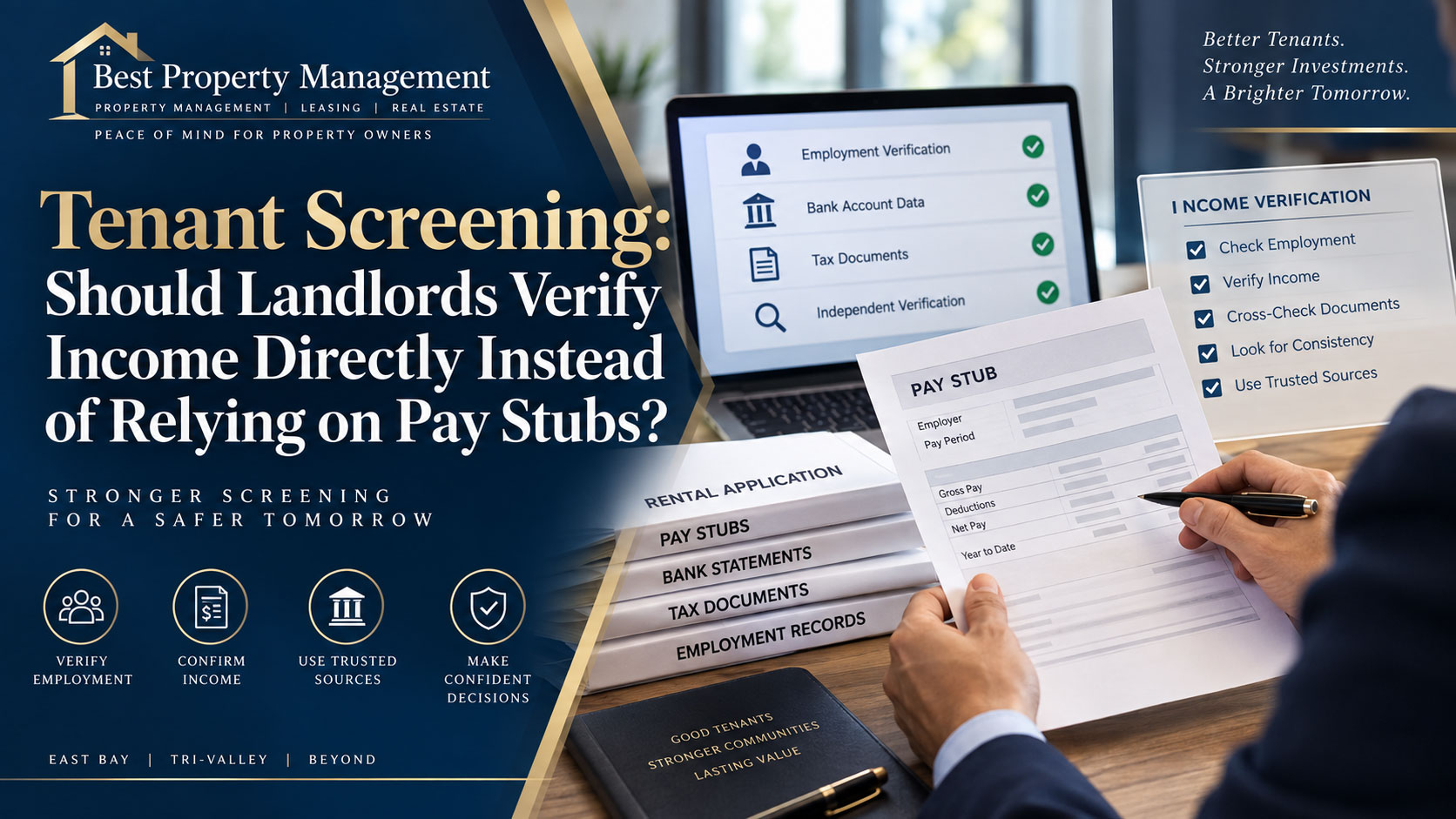
Tenant Screening: Should Landlords Verify Income Directly Instead of Relying on Pay Stubs?
For years, pay stubs have been one of the most common ways landlords confirm whether a rental applicant earns enough income to qualify.
The problem is that a pay stub is ultimately a document provided by the applicant.
In 2026, sophisticated editing software, templates and AI-assisted tools can make altered or fabricated income documents difficult to distinguish from legitimate ones. That does not make pay stubs useless. It does mean East Bay rental owners should think more carefully about when applicant-provided documents are enough and when income should be verified from an independent source.
Quick Answer: Landlords do not necessarily need to stop accepting pay stubs, but relying on pay stubs alone is becoming less reliable. A stronger tenant-screening process can compare applicant-provided documents with independent employment, payroll or consumer-permissioned financial data when appropriate. The objective is not to investigate applicants unnecessarily. It is to verify that the income used to make a rental decision is accurate, relevant and evaluated under the same screening standards for everyone.
Why Pay Stubs Alone Are Becoming Less Reliable for Tenant Screening
A legitimate pay stub can provide useful information.
It may show:
- Employer name
- Gross earnings
- Net earnings
- Pay frequency
- Deductions
- Year-to-date income
But the document itself does not independently prove that the information is accurate.
Experian has specifically identified manipulated pay stubs and other income documents as a growing rental-screening concern. The company notes that modern fraud tools have made manual document review increasingly vulnerable to sophisticated forgeries.
That creates an important distinction.
Proof of income is not always the same as verification of income.
A submitted pay stub is evidence provided by the applicant.
Independent verification attempts to confirm the underlying information through another reliable source.
For example, an owner might receive two recent pay stubs showing $7,000 in monthly earnings. Those documents can support the application, but a more robust process might also confirm that the applicant currently works for the stated employer or use a lawful verification service that accesses payroll or bank-verified income information with the applicant’s authorization.
That does not mean every applicant should automatically undergo multiple levels of verification.
The process should be proportionate, documented and consistent.
Best Property’s tenant screening service combines income review with employment, identity, rental history and other screening information rather than treating one document as the entire qualification decision.
Owner takeaway: Pay stubs can remain useful, but they are strongest when they support a verification process rather than replace one.
What Does Direct Income Verification Actually Mean?
“Direct verification” can refer to several different methods.
It does not necessarily mean calling an applicant’s employer personally.
Depending on the screening process and the applicant’s type of income, verification could include:
| Verification Method | What It Can Help Confirm |
|---|---|
| Employer verification | Employment status, sometimes compensation information |
| Payroll verification | Wage, salary, employment and pay-frequency information |
| Bank-verified income data | Recurring deposits and income patterns |
| Tax documents | Historical income, especially for self-employed applicants |
| Applicant-provided pay stubs | Current reported wages and deductions |
| Third-party verification service | Independent income or employment information |
Experian describes employment and income verification as a process used by landlords and other businesses to confirm information such as wages, employment status, pay frequency and employment duration. It also notes that pay stubs and bank statements remain useful forms of documentation.
Newer technology adds another option.
Some applicant-verification systems allow renters to authorize access to payroll or financial-account information so income can be confirmed from source data instead of relying entirely on uploaded PDFs. Plaid, for example, describes rental-screening tools that can use bank-verified payroll and deposit information with applicant permission.
For owners, the important issue is not which technology sounds newest.
It is whether the method provides relevant, reliable information while fitting the property’s established screening process.
Screening a new tenant for an East Bay rental? Best Property Management can help manage income verification, applicant screening, rental-history review and tenant placement through a consistent leasing process.
When Is Direct Income Verification More Useful Than Pay Stubs?
Direct verification becomes especially useful when the application depends heavily on information that is difficult to confirm from documents alone.
One example is conflicting information.
Suppose an applicant reports $8,000 in monthly income, but the submitted documentation contains different employer names or year-to-date totals that do not align with the stated employment period.
That does not prove fraud.
The applicant may have:
- Changed employers
- Received a bonus
- Been promoted
- Worked overtime
- Split direct deposits between accounts
- Earned legitimate income from multiple sources
The appropriate response is usually verification, not accusation.
Direct verification can also be useful when documents are incomplete or when the applicant’s income structure is less conventional.
For example:
Newly employed applicants
A renter may have started a new position recently and therefore have only one pay stub.
An employment verification or offer documentation may provide additional context.
Commission or bonus-based employees
Monthly pay may fluctuate considerably.
Reviewing only one pay period could understate or overstate recurring income.
Self-employed applicants
Traditional pay stubs may not exist.
Tax returns, bank deposits or other lawful financial documentation may provide a more realistic picture.
Multiple income sources
An applicant may combine employment income with freelance work, investment income or another lawful source.
A screening system should be able to evaluate relevant income without assuming that everyone earns money through the same payroll structure.
HUD’s rental-screening guidance specifically cautions housing providers to consider relevant income and financial resources rather than designing criteria that work only for the most common applicant profile.
The goal is not to make screening harder for applicants whose income looks different.
It is to make verification more accurate.
Is Bank-Verified or Payroll-Verified Income Better?
Not necessarily in every situation.
Different verification methods answer different questions.
Payroll data may be particularly useful for confirming salary, wages, employment status and pay frequency.
Bank data may help demonstrate that recurring income is actually being deposited.
Tax documents may provide a broader historical picture for self-employed applicants.
Pay stubs can still provide useful recent detail.
The strongest approach may therefore be a layered process, rather than deciding that one source is always superior.
Experian has described modern tenant screening as moving toward layered income verification. Its approach combines observed data, research verification and document analysis rather than treating a single method as sufficient for every applicant.
This matters because direct data can have limitations too.
An employment database may not contain every employer.
A bank account may not receive all of an applicant’s income.
A new employee may have little payroll history.
A self-employed applicant may have legitimate income that does not appear as a regular paycheck.
So owners should avoid replacing one rigid screening rule with another.
Owner takeaway: Better income verification means using the most relevant evidence for the applicant’s actual income structure while keeping the qualification standard consistent.
How Can Landlords Verify Income Without Creating Fair Housing Problems?
This is where process matters as much as technology.
Income verification should be based on written screening criteria, not on personal instinct about which applicant seems trustworthy.
For example, an owner should avoid:
“This applicant seems fine, so I’ll accept the pay stub.”
while telling another applicant:
“I don’t trust these documents. I want bank access too.”
A stronger system establishes the verification rules before reviewing applicants.
That might include policies such as:
- All applicants must demonstrate qualifying income
- Accepted documentation types are defined in advance
- Independent verification is used under defined circumstances
- Conflicting information receives the same follow-up process
- Different lawful income types are considered appropriately
- Screening decisions are documented consistently
HUD’s guidance recommends using screening criteria that are relevant to whether an applicant is likely to meet tenancy obligations. It also emphasizes accurate records and fair treatment when automated screening technology is involved.
Fair housing obligations do not disappear because a property manager uses software.
The housing provider remains responsible for how the screening process operates.
Best Property’s East Bay leasing and tenant placement guide explains why tenant screening should be integrated into a documented application and leasing workflow rather than handled informally from applicant to applicant.
What About Privacy When Applicants Connect Payroll or Bank Data?
Direct verification can reduce fraud risk, but it introduces another important responsibility:
Applicant data must be handled carefully.
Financial and employment information is sensitive.
Owners should avoid collecting more information than is reasonably necessary for the rental decision.
A verification process should also make clear what information is being requested and how it is being used.
Many modern verification tools are structured around consumer-permissioned access, meaning the applicant authorizes the connection to their financial or payroll information.
That can be preferable to asking a renter to email unprotected bank statements or sensitive documents.
But owners should still understand what their screening vendor collects, stores and reports.
If the verification is performed by a consumer reporting agency and the resulting report influences a rental decision, Fair Credit Reporting Act obligations may apply.
The FTC explains that landlords using consumer reports for tenant decisions must have a permissible purpose. If information in a consumer report contributes to an adverse action, such as denying the application or requiring different terms, the applicant must receive an adverse-action notice containing specific information about the reporting agency and their dispute rights.
The FTC’s July 2026 RentGrow enforcement action is another reminder that screening information itself can contain errors. The company agreed to pay $2.25 million to settle allegations involving accuracy procedures under the FCRA.
That means landlords need protection from fraudulent information, but applicants also need protection from inaccurate screening data.
A good process accounts for both.
Should East Bay Landlords Stop Accepting Pay Stubs?
No.
That would go too far.
Pay stubs remain a practical and widely used form of income documentation.
The better question is:
Should a pay stub be the only thing standing between an applicant’s stated income and the approval decision?
Increasingly, the answer may be no.
A modern screening process can use pay stubs as one layer while relying on independent verification where appropriate.
For example:
Step 1: Applicant states income and employment information.
Step 2: Applicant provides accepted supporting documentation.
Step 3: The information is checked for consistency.
Step 4: Employment or income is independently verified according to the established screening procedure.
Step 5: Any discrepancy is handled under the same process used for other applicants.
Step 6: The applicant is evaluated against the predetermined rental criteria.
That workflow is stronger than accepting documents blindly.
It is also stronger than treating every unusual document as proof of fraud.
The purpose of income verification is ultimately straightforward:
Determine whether the applicant meets the property’s lawful financial qualification requirements using accurate and consistent information.
As rental application fraud becomes more sophisticated, a consistent verification process matters more than ever. Contact Best Property Management for tenant screening, applicant verification, tenant placement and full-service property management throughout the East Bay and Tri-Valley.
Related Tenant Screening Resources
- Tenant Screening for Rental Property Owners
- Tenant Background Checks
- East Bay Leasing and Tenant Placement Guide
- Tenant Placement Services
Frequently Asked Questions About Tenant Income Verification
Is a pay stub enough to verify a tenant’s income?
A pay stub can provide useful evidence of earnings, but it does not independently prove that every detail on the document is accurate. Modern document tools can make altered pay stubs difficult to identify visually. Landlords can strengthen screening by comparing submitted documents with the application and using independent employment, payroll or income verification when appropriate. The screening policy should define which documentation is accepted and when additional verification is required. Most importantly, landlords should apply the same process consistently rather than deciding applicant by applicant who receives additional scrutiny.
Can landlords contact an applicant’s employer to verify income?
Employment verification may be part of a lawful rental-screening process, but employers may have their own policies about what information they disclose. Some employers confirm only job status or employment dates, while others use specialized verification services. Applicant authorization may also be required depending on the method used. Landlords should establish a consistent procedure and avoid informal calls that produce different levels of information for different applicants. Third-party verification services can provide another approach when direct employer verification is unavailable. Property-specific legal and privacy questions should be reviewed with qualified counsel.
Is bank account verification better than asking for bank statements?
Consumer-permissioned bank verification can reduce reliance on PDFs that may be incomplete or altered, and it can help confirm recurring deposit patterns. However, it is not automatically the best method for every applicant. Some renters receive income into several accounts or have legitimate income that does not appear as a regular payroll deposit. Bank data should therefore be evaluated in context rather than treated as the only acceptable form of proof. Owners should also understand what financial information a verification service accesses and collect only information relevant to the rental qualification decision.
How should landlords verify income for self-employed tenants?
Self-employed applicants often do not receive traditional pay stubs, so a screening policy should allow appropriate alternatives. Depending on the circumstances, those may include tax returns, bank records, business-income documentation or other verifiable financial information. The objective should remain the same as it is for a salaried applicant: determine whether the applicant meets the property’s established financial qualification criteria. Screening rules should not unnecessarily disadvantage applicants simply because their lawful income comes from self-employment. The documentation requirements should be clearly defined and applied consistently to applicants in comparable situations.
Does using an income verification service eliminate rental fraud?
No screening tool can eliminate fraud entirely. Direct income or employment verification can reduce reliance on applicant-created documents and make certain types of manipulation harder, but data may still be incomplete or inaccurate. Landlords should continue to evaluate identity, income, employment, rental history and other lawful screening factors together. If a third-party consumer report influences an adverse rental decision, Fair Credit Reporting Act requirements may apply. Technology should strengthen a consistent screening process, not become an unexplained automatic approval or denial system.
Best Property Management Bay Area Offices
Brentwood Office 200 Sand Creek Rd., Suite D, Brentwood, CA 94513 925-392-2411 ronventura@bestproperty4u.com
Fremont Office 40069 Mission Blvd., Fremont, CA 94539 510-770-0824 dustinventura@bestproperty4u.com
Livermore Office 1985 First Street, Suite 209, Livermore, CA 94550 925-292-1785 robertventura@bestproperty4u.com
Tracy Office 672 West 11th Street, Suite 208, Tracy, CA 95376 209-340-2500 brendanreese@bestproperty4u.com
This article is provided for general informational purposes only and is not legal, financial, fair housing, privacy or tenant-screening compliance advice. Screening requirements, consumer-reporting laws and individual circumstances can vary. Rental property owners should verify current requirements and consult qualified professionals when appropriate.
Blog
Company News
Landlord Resources
Landlords
Legal
Linkedin
Local Market Insights
Maintenance & Repairs
Market
Owners
Property
Property Law & Compliance
Property Management
Rental Property
Tenants
Video
FILTER BY EASTBAY & TRI-VALLEY CITIES
AB 1482
AI Rental Fraud
Antioch Property Management
Applicant Data Security
Applicant Information
Applicant Screening
Applicant Verification
Bank Statement Fraud
Brentwood
Brentwood property management
California Insurance
California Landlord Laws
California Property Management
California Rent Increase
Central Valley Property Management
Concord Property Management
Credit Reports
Danville Property Management
Danville rentals
Desert Hot Springs Property Management
Desert Property Maintenance
Desert Rentals
Document Fraud
Dublin property management
East Bay Landlords
East Bay Lease Renewals
East Bay property management
East Bay Rental Market
East Bay Rental Owners
East Bay Rental Property Maintenance
East Bay Rental Property Management
East Bay rental tips
East Bay Rentals
Eviction Notices
Eviction Support
Fair Housing
Fake Pay Stubs
Fall Leasing
find a property manager
Fremont
Fremont property management
full service property management
Full-Service Property Management
Good Tenants
Hayward Property Management
Hayward rentals
hiring a property manager
HOA Compliance
HOA Rental Management
HOA Rentals
Home Insurance Costs
Identity Verification
Income Verification
Indian Wells Property Management
Inherited Rental Property
Landlord Compliance
Landlord Data Security
Landlord Insurance
Landlord Resources
Landlord Tips
Lease Renewal Strategy
Lease Renewals
Leasing Fees
Leasing Services
Livermore
Livermore property management
Livermore Rentals
Local Development
Local Market Insights
Local Rental Support
Long-Term Rentals
Luxury Rentals
maintenance coordination
Maintenance Response
Management Services
Manteca Property Management
Milpitas Property Management
Mountain House Property Management
New Housing San Ramon
Newark CA Property Management
Oakley Property Management
Online Rent Payments
Owner Onboarding
owner reporting
Palm Desert Property Management
Palm Springs Area Property Management
Palm Springs Property Management
Palm Springs Rentals
Pittsburg CA Property Management
Pleasanton property management
Pleasanton rentals
Preventive Maintenance
Property Inspections
Property Maintenance
Property Management
Property Management Companies
Property Management Fees
Property Management Services
Property Management Transition
Property Manager
Rancho Mirage Property Management
Real Estate
real estate investing
Redfin Rentals
Remote Property Management
Rent Collection
Rent Control
Rent Trends
Rental Application Fraud
Rental Application Privacy
Rental Competition
Rental Fees
Rental Fraud
Rental History
Rental Inspections
rental leasing
Rental Market Analysis
Rental Market Trends
Rental Marketing
Rental Pricing
Rental Property
Rental Property Expenses
Rental Property Maintenance
rental property owners
rental property ROI
Renter Choice
Renter Experience
Repair Coordination
Resident Portal
Residential Leasing
San Lorenzo Property Management
San Ramon Landlords
San Ramon Orchards
San Ramon property management
San Ramon Rental Market
Screening Red Flags
Seasonal Rentals
Security Deposits
Sell or Rent
Silicon Valley Rentals
single family rentals
Single-Family Rentals
Tenant Background Checks
Tenant Communication
Tenant Complaints
Tenant Expectations
Tenant Issues
Tenant Placement
Tenant Protection Act
Tenant Retention
tenant screening
Tenant Screening Data Security
Tenant Screening Fraud
Tenant Screening Red Flags
Tenant Turnover
Tracy Property Management
Tri-Valley
Tri-Valley Housing Market
Tri-Valley property management
Tri-Valley Rentals
Union City Property Management
Vacation Rental Management
Wildfire Risk
Zillow Rentals
 FILTER
 SEARCH BLOG