Tracy Rental Property Maintenance: How Should You Set Repair Approval Limits?
Repair approval limits for a Tracy rental should clarify decisions before the first estimate arrives. A dollar amount alone does not explain what the manager can authorize, which expenses are grouped together or how an urgent condition is handled. The owner needs a policy that connects scope, authority and reporting.
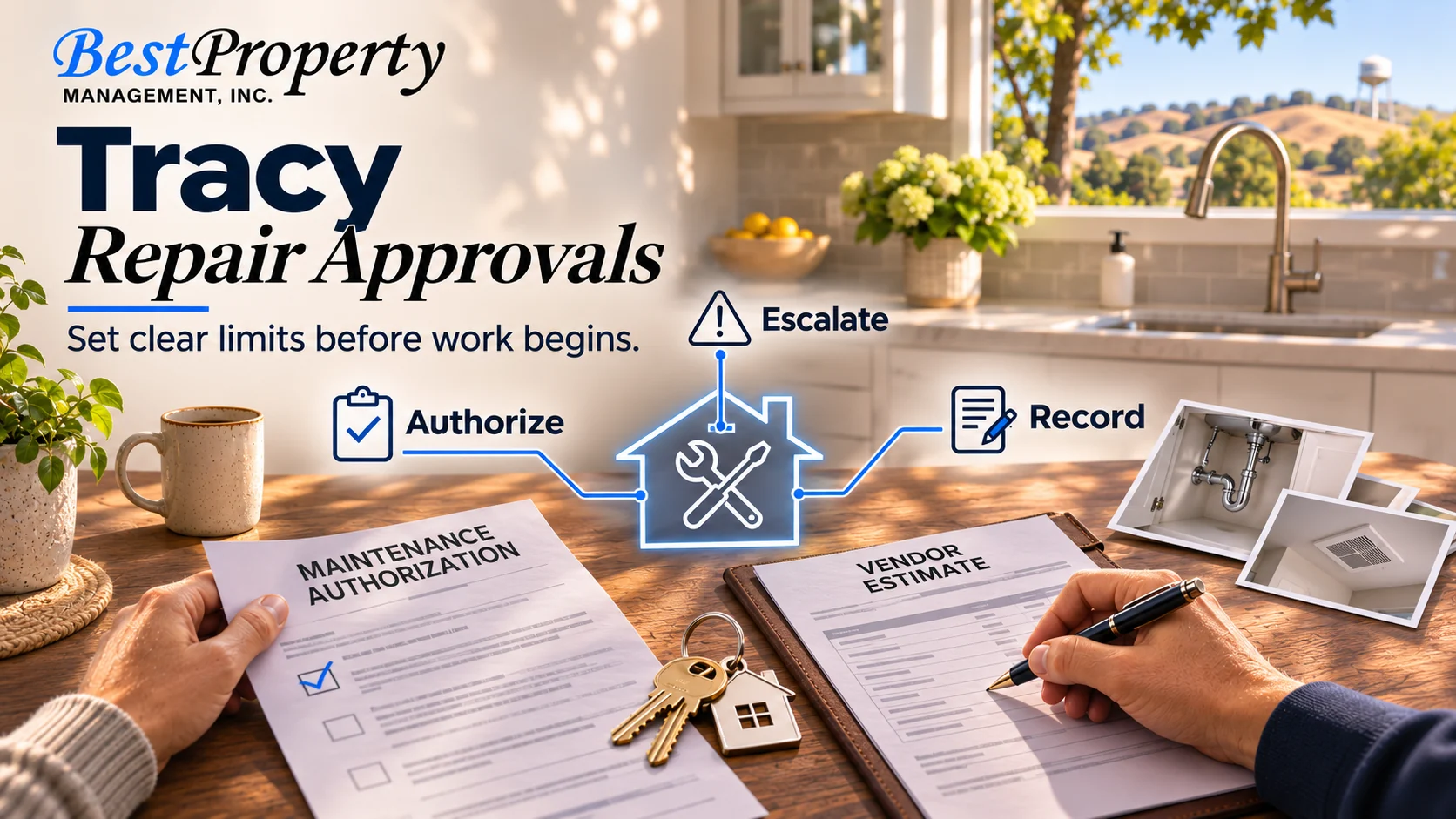
Set repair approval limits in the written management arrangement, including the scope of routine authority, situations requiring owner approval and the process for urgent exceptions. Confirm how estimates, reserve funds and completion records are handled. Do not invent a universal threshold or assume that a reserve balance gives unlimited authority to spend it.
What Should an Approval Limit Actually Define?
An approval policy should explain the decisions the manager can make and the circumstances that require owner input. Ask whether the limit applies to a defined work order, related scope or another clearly described unit. Avoid an informal understanding that larger work will “probably” be discussed.
The policy also needs a communication process. What information accompanies an approval request? Who follows up if the owner does not respond? What happens when findings change after work begins? A usable limit answers those questions alongside the amount.
Our Tracy property management guide places approval authority within the overall agreement. The Central Valley management guide provides wider context for owners comparing operating support.
Which Information Should Accompany a Repair Estimate?
Ask for the reported issue, relevant findings, proposed work and decision needed. Identify whether the estimate includes diagnosis, labor, materials and other relevant tasks. A total without scope leaves the owner approving a number rather than a defined job.
| Policy area | Clarify this | Record to keep |
|---|---|---|
| Routine authority | What work can proceed under the agreement? | Written management terms |
| Owner approval | What information supports the decision? | Estimate and recorded authorization |
| Changed scope | Who reviews newly identified work? | Revised findings and approval |
| Urgent exception | How is immediate action handled and reported? | Incident and follow-up record |
The East Bay maintenance guide explains why scope and history matter. If the issue is recurring, include prior work so the owner does not evaluate another estimate as though it were the first request.
How Should Urgent Conditions Be Handled?
The agreement should explain how the manager evaluates and responds to conditions requiring immediate attention. An owner approval limit should not be treated as a reason to ignore the property’s obligations or leave a serious issue without an appropriate response.
Ask how the owner is notified, what actions can be taken and what records follow. The details should fit the property and applicable requirements. Do not assume every company defines an emergency in the same way or has identical authority.
The California Attorney General's tenant resources provide an official starting point for housing-condition responsibilities. Obtain qualified advice for a property-specific legal issue. This article explains an authorization workflow, not a rule that overrides those responsibilities.
How Do Reserves and Available Funds Affect Approvals?
Separate authority from funding. A reserve may make owner money available for agreed uses, but the agreement still determines who can authorize the work. Likewise, an approved estimate does not establish that sufficient funds are immediately available.
Ask how a needed contribution is requested and how a paid invoice appears on the owner statement. The owner should be able to reconcile funds held, charges incurred and money distributed. Our rent collection and reporting guide explains the accounting trail.
An illustrative Tracy decision might involve a repair within the proposed approval scope but an insufficient reserve balance. The manager should explain both the authorization and funding question. Combining them into one vague request makes the decision harder to understand.
What Happens When the Scope Changes During Work?
New findings should be communicated through the agreed process. A vendor may discover that the original scope does not address the issue. The manager should identify what changed, what additional work is proposed and what authority applies before treating the extension as routine.
Avoid dividing related work into smaller descriptions simply to bypass an approval boundary. The purpose of the policy is informed oversight. Ask how related tasks and revised estimates are tracked so the owner can understand the complete scope.
Our maintenance approval article for rental owners offers a related question framework. Apply your own agreement and property circumstances rather than borrowing another owner’s monetary limit as a rule.
How Should Completed Work Be Reported and Reviewed?
Connect the final invoice to the approved scope and the original issue. Identify any difference and explain remaining follow-up. A completion update should let the owner understand what was done without comparing an unexplained invoice with an old text message.
Review the policy when the property’s needs or the owner’s availability changes. The goal is not to request approval for every minor action or give unlimited discretion. It is a workable division of responsibility supported by clear records.
Discuss Best Property Management’s property maintenance services for your rental. Owner takeaway: A good repair approval policy defines the work, the decision authority, the funding process and the evidence of completion.
Frequently Asked Questions About Tracy Repair Approval Limits
Is there a standard approval amount for every rental?
No universal amount fits every property and management arrangement. Discuss the home’s needs, owner availability and the company’s supported process. The agreed limit and exceptions should be documented. Do not rely on an amount mentioned in a general article or another owner’s contract.
Does a maintenance reserve authorize the manager to spend it?
Funding and authority are separate questions. The agreement should explain when funds can be used and which work requires approval. Ask how reserve use is reported and replenished. A visible balance should not be interpreted as unlimited permission to order repairs.
What if an estimate exceeds my approval limit?
The manager should follow the agreed process for presenting the scope and requesting a decision, subject to appropriate handling of urgent conditions. Review what the estimate includes and what remains uncertain. Record the authorization rather than leaving the decision in an ambiguous conversation.
Can a vendor add work without another review?
That depends on the applicable authority and circumstances. Ask how changed findings and revised scopes are handled in your agreement. The owner should understand what changed and why. A new issue should not automatically disappear into the original approval if it exceeds the authorized scope.
Should related repairs be split into separate small approvals?
Use a process that makes the complete related scope understandable. Dividing work merely to avoid an approval boundary undermines oversight. Ask how the manager groups related tasks and records revisions so you can evaluate the actual project rather than isolated fragments.
What if I am unavailable during an urgent issue?
Agree on coverage and escalation before it happens. Provide a reliable contact arrangement and understand the manager’s authority under the contract. Urgent conditions may require appropriate action, but the owner should still receive a clear account of the issue, response and follow-up.
How do I verify the final repair charge?
Compare the invoice with the approved scope and completion record. Ask about differences and locate the supporting work history. The owner statement should connect the charge to the repair without requiring you to reconstruct the sequence from unrelated messages.
How can I set up the policy with the Tracy team?
Bring the current agreement, repair history and your preferences for involvement. Discuss routine authority, exceptions, estimates, reserves and reporting together. Use the office contact page to confirm a written process appropriate for your rental.
Related Articles
Tracy property management services explains authority within the full agreement.
Rental maintenance planning covers work history and repair decisions.
Maintenance approval questions offers a related owner-oversight framework.
Rent collection and owner reporting explains the records behind expense payments.
Blog
Company News
Landlord Resources
Landlords
Legal
Linkedin
Local Market Insights
Maintenance & Repairs
Market
Owners
Property
Property Law & Compliance
Property Management
Rental Property
Tenants
Video
FILTER BY EASTBAY & TRI-VALLEY CITIES
AB 1482
AI Property Management
AI Rental Fraud
Antioch Property Management
Applicant Data Security
Applicant Information
Applicant Screening
Applicant Verification
Bank Statement Fraud
Brentwood
Brentwood property management
California Insurance
California Landlord Laws
California Property Management
California Rent Increase
Central Valley Property Management
Concord Property Management
Credit Reports
Danville Property Management
Danville rentals
Desert Hot Springs Property Management
Desert Property Maintenance
Desert Rentals
Document Fraud
Dublin property management
East Bay Landlords
East Bay Lease Renewals
East Bay property management
East Bay Rental Market
East Bay Rental Owners
East Bay Rental Property Maintenance
East Bay Rental Property Management
East Bay rental tips
East Bay Rentals
EV Charging
Eviction Notices
Eviction Support
Fair Housing
Fake Pay Stubs
Fall Leasing
find a property manager
Fremont
Fremont property management
full service property management
Full-Service Property Management
Good Tenants
Hayward Property Management
Hayward rentals
hiring a property manager
HOA Compliance
HOA Rental Management
HOA Rentals
Home Insurance Costs
Human Oversight
Identity Verification
Income Verification
Indian Wells Property Management
Inherited Rental Property
Landlord Compliance
Landlord Data Security
Landlord Insurance
Landlord Resources
Landlord Tips
Lease Renewal Strategy
Lease Renewals
Leasing Fees
Leasing Services
Livermore
Livermore property management
Livermore Rentals
Local Development
Local Market Insights
Local Rental Support
Long-Term Rentals
Luxury Rentals
maintenance coordination
Maintenance Response
Management Services
Manteca Property Management
Milpitas Property Management
Mountain House Property Management
New Housing San Ramon
Newark CA Property Management
Oakley Property Management
Online Rent Payments
Owner Onboarding
owner reporting
Palm Desert Property Management
Palm Springs Area Property Management
Palm Springs Property Management
Palm Springs Rentals
Pittsburg CA Property Management
Pleasanton property management
Pleasanton rentals
Preventive Maintenance
Property Inspections
Property Maintenance
Property Management
Property Management Companies
Property Management Fees
Property Management Services
Property Management Transition
Property Manager
Rancho Mirage Property Management
Real Estate
real estate investing
Redfin Rentals
Remote Property Management
Rent Collection
Rent Control
Rent Trends
Rental Application Fraud
Rental Application Privacy
Rental Competition
Rental Fees
Rental Fraud
Rental History
Rental Inspections
Rental Internet
rental leasing
Rental Market Analysis
Rental Market Trends
Rental Marketing
Rental Pricing
Rental Property
Rental Property Expenses
Rental Property Maintenance
rental property owners
rental property ROI
Renter Choice
Renter Experience
Repair Coordination
Resident Portal
Residential Leasing
Roommate Management
San Lorenzo Property Management
San Ramon Landlords
San Ramon Orchards
San Ramon property management
San Ramon Rental Market
Screening Red Flags
Seasonal Rentals
Security Deposits
Sell or Rent
Silicon Valley Rentals
single family rentals
Single-Family Rentals
Tenant Background Checks
Tenant Communication
Tenant Complaints
Tenant Expectations
Tenant Issues
Tenant Placement
Tenant Protection Act
Tenant Retention
tenant screening
Tenant Screening Data Security
Tenant Screening Fraud
Tenant Screening Red Flags
Tenant Turnover
Tracy Property Management
Tri-Valley
Tri-Valley Housing Market
Tri-Valley property management
Tri-Valley Rentals
Union City Property Management
Vacation Rental Management
Wildfire Risk
Winter Rental Safety
Zillow Rentals
 FILTER
 SEARCH BLOG