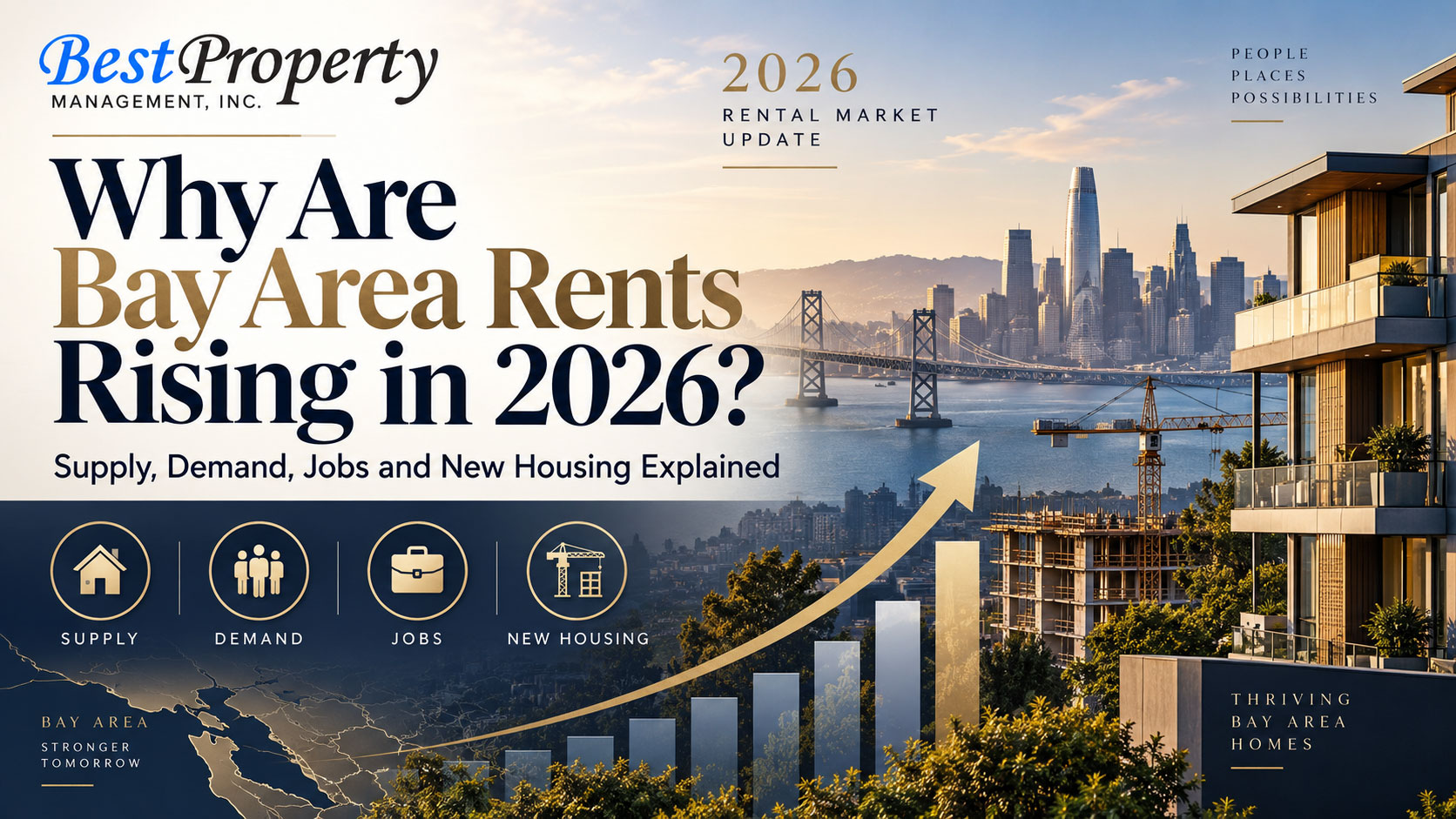
Why Are Bay Area Rents Rising in 2026? Supply, Demand, Jobs and New Housing Explained
Bay Area rents are climbing again in 2026, but the reason is more complicated than simply “more people want apartments.”
The region is experiencing several forces at the same time: renter demand has strengthened, relatively little new apartment inventory is being completed, vacancy has tightened and certain parts of the Bay Area economy are attracting high-income workers again.
For East Bay and Tri-Valley rental property owners, those trends matter. But they do not mean every home in Fremont, Livermore, Pleasanton, Dublin, San Ramon, Danville or Brentwood should automatically be priced higher.
Quick Answer: Bay Area rents are rising in 2026 because renter demand has strengthened faster than new housing supply in several parts of the region. Recent multifamily data shows falling vacancy, strong apartment absorption and sharply reduced new deliveries. San Francisco and San Jose have experienced particularly strong rent growth, while the East Bay has also accelerated. Employment and AI-related economic activity are contributing to demand, but job growth is uneven across the region. Owners should use these regional trends as market context, then price individual rentals using current local competition, property condition and actual tenant demand.
How Much Are Bay Area Rents Actually Rising in 2026?
The Bay Area has become one of the strongest rental markets in the country this year.
According to CBRE’s Q2 2026 Bay Area multifamily report, Bay Area rents increased 7.7% year over year during the second quarter. The San Francisco and Peninsula submarket led the region at 11.4% annual growth, while Bay Area multifamily vacancy fell to just 2.8%.
More recent Apartments.com and CoStar data shows the momentum continuing.
In August:
- San Francisco: +11.9% year over year
- San Jose: +7.7%
- East Bay: +5.1%
Nationally, rent growth has been much more restrained.
The East Bay’s acceleration is especially notable. CoStar reported that East Bay apartment rents were up about 4.0% year over year in July, with average asking rent around $2,570 per month, before annual growth strengthened further in August.
That does not mean every East Bay home appreciated by 5.1% in rental value.
These figures measure broad multifamily markets. A four-bedroom single-family rental in Pleasanton does not compete directly with a downtown Oakland apartment, nor does a Dublin townhouse necessarily follow the same pricing pattern as a rental in Brentwood.
The data tells owners that the broader market has strengthened.
It does not replace a property-specific rental market analysis.
| 2026 Market Indicator | What It Suggests |
|---|---|
| Bay Area rent growth +7.7% in Q2 | Regional rental pricing has strengthened |
| Bay Area vacancy 2.8% | Available apartment supply has tightened |
| East Bay rent growth +5.1% in August | East Bay momentum has accelerated |
| New deliveries remain low | Less new competition is entering the market |
| Employment trends are mixed | Demand is not equally strong everywhere |
Owner takeaway: Rising Bay Area rents are real, but the regional number should be treated as a market signal rather than a percentage to automatically apply to an individual rental.
Why Supply and Demand Are Pushing Rents Higher
One of the clearest explanations for 2026 rent growth is the relationship between new supply and renter demand.
CBRE reported that only 884 new multifamily units were delivered across the Bay Area during Q2 2026 while the market recorded approximately 5,104 units of net absorption.
Net absorption measures the change in occupied rental units.
In simple terms, renters occupied far more units than developers added during the quarter.
That is roughly a 5.8-to-1 ratio of absorption to completions.
Cushman & Wakefield reached a similar conclusion using its own dataset. Its Q2 report counted only 663 new units delivered during the quarter, describing that as the lowest quarterly level since 2013. The firm also reported more than 84,000 proposed units across the Bay Area but noted that high construction costs continue to delay development.
The exact delivery totals differ because research firms use different geographic definitions and methodologies. The important conclusion is the same:
New apartment construction reaching the market has slowed dramatically.
That matters because a rental market needs a continuing flow of new housing to absorb population changes, household formation and employment-driven demand.
When demand strengthens faster than available supply, renters compete for fewer available homes.
Vacancy falls.
Landlords gain more pricing flexibility.
And concessions become less necessary.
This helps explain why the Bay Area is behaving differently from markets such as Austin, Denver and Phoenix, where large waves of new apartment construction have placed downward pressure on rents. Apartments.com reported annual rent declines in several of those supply-heavy markets while the Bay Area continued to rise.
If your East Bay rental is approaching a vacancy or lease renewal, Best Property Management can help compare current competing properties and local renter demand before you set an asking rent. Regional growth is useful context, but the right price still depends on the specific home and neighborhood.
Are Jobs and the AI Economy Driving Bay Area Rental Demand?
Jobs matter to rental housing because employment brings people into a region and gives households the income needed to rent there.
But the 2026 Bay Area employment story needs some nuance.
The Bureau of Labor Statistics reported that total nonfarm employment in the San Francisco-Oakland-Fremont metropolitan area was approximately 0.2% higher in July 2026 than a year earlier.
Within the Oakland-Fremont-Berkeley division, employment was actually about 0.4% lower year over year.
So it would be inaccurate to say that a broad-based Bay Area hiring boom alone is responsible for higher rents.
What appears more important is where employment and income growth are occurring.
CoStar has specifically connected recent Bay Area rent strength with demand tied to the region’s expanding AI sector. San Francisco has experienced the strongest rent growth, followed by San Jose, with some of that demand potentially influencing nearby markets as renters consider alternatives throughout the region.
High-income technology employment can have an outsized effect on housing demand even when overall employment growth is modest.
A renter working in San Francisco or Silicon Valley may choose to live in:
- Fremont for access to both sides of the Bay
- Dublin or Pleasanton for BART and suburban housing
- Livermore for more space
- San Ramon or Danville for larger homes and established neighborhoods
That does not mean AI hiring determines rent for every East Bay property.
It means employment concentration, commuting patterns and housing preferences can transmit demand from one part of the Bay Area into another.
Owners considering how these regional dynamics affect their property can also review the Best Guide to East Bay Property Management and the Best Guide to Tri-Valley Property Management.
If So Much Housing Is Planned, Why Is Supply Still Tight?
This is one of the most important distinctions in the current housing conversation.
Planned housing is not the same thing as completed housing.
The Bay Area has tens of thousands of housing units somewhere in the planning, entitlement or development pipeline.
But renters cannot live in a proposed project.
They can only rent a completed unit.
High land costs, construction costs, financing expenses, permitting complexity and development economics can all delay the transition from proposed housing to finished housing.
Regional housing data illustrates the longer-term problem. The Metropolitan Transportation Commission reported that the Bay Area produced a little more than 19,700 housing units in 2024, about 12% fewer than the average of the previous five years. Roughly 61% of those new units were multifamily housing.
More recent 2026 commercial real estate data indicates that apartment deliveries have slowed further.
That means there can simultaneously be:
a large development pipeline and very little new inventory arriving today.
For rental owners, the distinction matters because today’s rent is influenced primarily by today’s available supply.
Future construction could eventually create more competition.
But a proposal scheduled several years from now does little to help a renter looking for a home this month.
Owner takeaway: The Bay Area does not simply have a “housing pipeline” problem. It has a gap between housing that is proposed and housing that is actually being delivered when demand needs it.
What Rising Bay Area Rents Mean for East Bay Property Owners
For rental owners, improving market conditions can create opportunities.
But the best response is not automatically raising the asking rent as high as possible.
A rental property’s achievable rent still depends on:
- City and neighborhood
- Property type
- Bedrooms and bathrooms
- Condition and upgrades
- Parking and outdoor space
- School and commute considerations
- Competing listings
- Seasonal timing
- Marketing quality
- Tenant demand at the particular price point
A well-maintained San Ramon home may have very different pricing power from an older property nearby.
A Livermore rental may face different competition from one in Dublin.
And even in a rising market, pushing rent substantially above comparable properties can create vacancy that costs more than the proposed increase produces.
This is why professional rental analysis focuses on comparable listings and current competition, not simply a regional index.
Owners preparing a property for the market can review Best Property’s East Bay leasing and tenant placement guide to understand how pricing, preparation, marketing, showings and screening should work together.
Bay Area rents may continue to move higher, stabilize or change direction as new supply, economic conditions and renter demand evolve.
The more useful strategy is to evaluate the market each time an important leasing decision occurs.
Want to know how current Bay Area and East Bay rent trends affect your specific rental? Request a Free Rental Evaluation or contact Best Property Management for help with rental market analysis, leasing or full-service property management.
Related Bay Area Rental Resources
- Rental Market Analysis for Property Owners
- Best Guide to East Bay Property Management
- Best Guide to Tri-Valley Property Management
- East Bay Leasing and Tenant Placement Guide
Frequently Asked Questions About Bay Area Rent Trends in 2026
Why are Bay Area rents rising in 2026?
Bay Area rents are rising because renter demand has strengthened while relatively few new apartments are being completed. CBRE reported Bay Area vacancy falling to 2.8% in Q2 2026, while net absorption substantially exceeded new apartment deliveries. Employment and income growth in parts of the technology and AI economy are also supporting renter demand, particularly around San Francisco and Silicon Valley. The effect is not identical everywhere. San Francisco has experienced much stronger growth than the East Bay, and individual cities and properties can perform differently from regional averages.
Are East Bay rents rising as fast as San Francisco rents?
No. Both markets are rising, but recent data shows substantially different growth rates. Apartments.com reported San Francisco annual rent growth of approximately 11.9% in August 2026 compared with about 5.1% in the East Bay. San Jose was approximately 7.7%. These are broad multifamily market measures, not guaranteed increases for individual homes. East Bay owners should therefore use regional numbers as context and compare their property with similar current rentals in the same city, neighborhood and property category before changing an asking rent.
Does building more housing eventually lower rent growth?
Additional housing can reduce upward rent pressure when new supply grows faster than demand. That pattern has been visible in several U.S. markets where heavy apartment construction contributed to flat or falling rents. The Bay Area currently has the opposite situation: new apartment completions are relatively low while renter absorption is strong. More Bay Area housing could eventually create greater renter choice and moderate rent growth, but timing matters. Proposed or entitled developments do not affect today’s rental inventory until they are actually completed and available for occupancy.
Will Bay Area rents keep rising through 2027?
No one can reliably guarantee that. Current conditions support rent growth because vacancy is tight and new housing deliveries are limited, but rental markets can change. Employment conditions could weaken, renter demand could slow, more housing could reach the market or affordability constraints could limit further increases. Owners should be cautious about projecting today’s growth rate indefinitely. A better strategy is to review comparable rentals and local vacancy conditions whenever a property becomes available or a lease approaches renewal rather than relying on a forecast made months earlier.
Should East Bay landlords raise rent because Bay Area rents are going up?
Not automatically. A regional increase tells an owner that market conditions may be strengthening, but achievable rent depends on the specific property. Before increasing rent, compare similar rentals, current tenant demand, property condition, amenities and the cost of potential vacancy or turnover. Lease-renewal increases also need to comply with applicable California and local rent rules. For a vacant property, the goal should be competitive positioning, not simply matching a regional percentage increase. Strong market conditions create an opportunity to review rent. They do not guarantee that the maximum asking price will produce the best result.
Best Property Management Bay Area Offices
Brentwood 200 Sand Creek Rd., Suite D, Brentwood, CA 94513 925-392-2411 Brentwood Office
Fremont 40087 Mission Blvd., Fremont, CA 94539 510-770-0824 Fremont Office
Livermore 2300 First Street, Suite 236, Livermore, CA 94550 925-292-1785 Livermore Office
Tracy 672 W. 11th Street, Tracy, CA 95376 1-800-910-1237 Best Property Bay Area Offices
Blog
Company News
Landlord Resources
Landlords
Legal
Linkedin
Local Market Insights
Maintenance & Repairs
Market
Owners
Property
Property Law & Compliance
Property Management
Rental Property
Tenants
Video
FILTER BY EASTBAY & TRI-VALLEY CITIES
AB 1482
Antioch Property Management
Applicant Screening
Brentwood
Brentwood property management
California Insurance
California Landlord Laws
California Property Management
California Rent Increase
Central Valley Property Management
Concord Property Management
Danville Property Management
Danville rentals
Desert Hot Springs Property Management
Desert Property Maintenance
Desert Rentals
Dublin property management
East Bay Landlords
East Bay property management
East Bay Rental Market
East Bay Rental Owners
East Bay rental tips
East Bay Rentals
Eviction Notices
Eviction Support
Fair Housing
Fall Leasing
find a property manager
Fremont
Fremont property management
full service property management
Full-Service Property Management
Hayward Property Management
Hayward rentals
hiring a property manager
HOA Compliance
HOA Rental Management
HOA Rentals
Home Insurance Costs
Indian Wells Property Management
Inherited Rental Property
Landlord Compliance
Landlord Insurance
Landlord Resources
Landlord Tips
Lease Renewals
Leasing Fees
Leasing Services
Livermore
Livermore property management
Livermore Rentals
Local Development
Local Market Insights
Local Rental Support
Long-Term Rentals
Luxury Rentals
maintenance coordination
Management Services
Manteca Property Management
Milpitas Property Management
Mountain House Property Management
New Housing San Ramon
Newark CA Property Management
Oakley Property Management
Owner Onboarding
owner reporting
Palm Desert Property Management
Palm Springs Area Property Management
Palm Springs Property Management
Palm Springs Rentals
Pittsburg CA Property Management
Pleasanton property management
Pleasanton rentals
Preventive Maintenance
Property Inspections
Property Management
Property Management Companies
Property Management Fees
Property Management Transition
Property Manager
Rancho Mirage Property Management
Real Estate
real estate investing
Redfin Rentals
Remote Property Management
Rent Collection
Rent Control
Rent Trends
Rental Competition
Rental Fees
Rental Inspections
rental leasing
Rental Market Analysis
Rental Market Trends
Rental Marketing
Rental Pricing
Rental Property
Rental Property Expenses
Rental Property Maintenance
rental property owners
rental property ROI
Repair Coordination
San Lorenzo Property Management
San Ramon Landlords
San Ramon Orchards
San Ramon property management
San Ramon Rental Market
Seasonal Rentals
Security Deposits
Sell or Rent
Silicon Valley Rentals
single family rentals
Single-Family Rentals
Tenant Complaints
Tenant Issues
Tenant Placement
Tenant Protection Act
tenant screening
Tracy Property Management
Tri-Valley
Tri-Valley Housing Market
Tri-Valley property management
Tri-Valley Rentals
Union City Property Management
Vacation Rental Management
Wildfire Risk
Zillow Rentals
 FILTER
 SEARCH BLOG