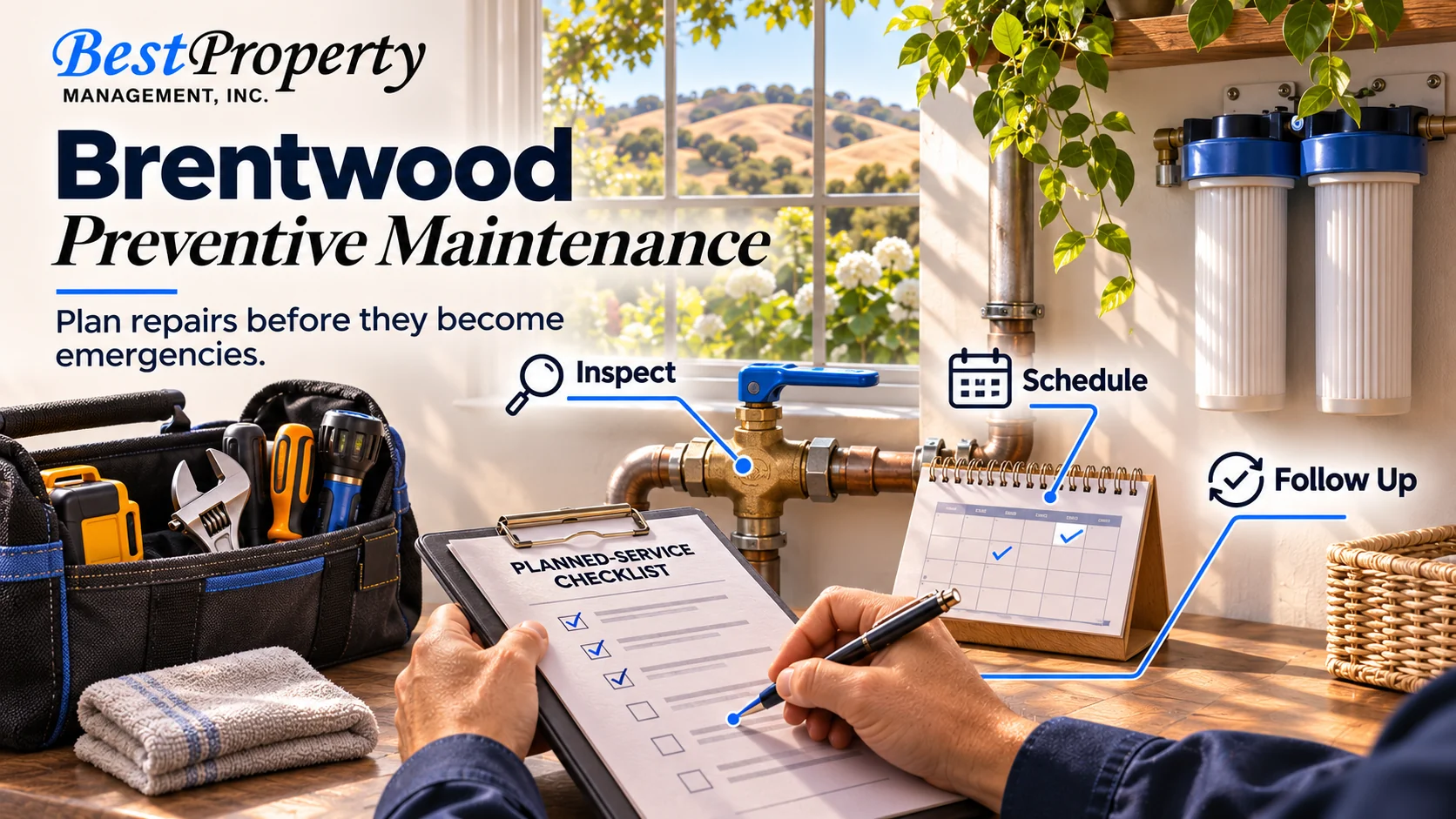
Brentwood Preventive Maintenance: Which Rental Repairs Should You Schedule Before They Become Emergencies?
Preventive maintenance for a Brentwood rental should begin with the home you actually own. An equipment list, repair history and unresolved inspection items are more useful than a generic calendar copied from another property. The goal is to identify work that deserves planned attention before a small concern becomes a larger interruption.
Build a preventive maintenance plan from the property’s systems, manufacturer guidance, qualified vendor recommendations and documented history. Assign each task, confirm access and approval needs, then record completion and follow-up. Planning can improve oversight, but it does not guarantee that equipment will not fail or that every emergency can be prevented.
Which Property Records Should You Review First?
Gather the equipment information you have, recent invoices, condition reports and open requests. Identify items that repeatedly need service and tasks that were recommended but never scheduled. A plan built from incomplete records should clearly identify the missing information.
Ask the manager to distinguish a routine reminder from a recommendation based on the property’s condition. A calendar entry is useful only when the task is appropriate and someone is responsible for it. Avoid scheduling unnecessary work simply because a generic list includes it.
Our Brentwood property management guide explains maintenance within ongoing service. The East Bay rental maintenance guide adds context for using records to make better repair decisions.
How Do You Decide Which Tasks Belong on the Schedule?
Use the relevant equipment guidance and qualified assessment. The condition, use and history of a system can affect what attention is appropriate. Owners should not invent a service interval from an online checklist when a manufacturer or qualified vendor provides property-specific guidance.
| Planning area | Information to use | Owner decision |
|---|---|---|
| Equipment service | Model guidance and qualified recommendations | Approve appropriate scope and schedule |
| Past leaks or repeat issues | Work history and current findings | Investigate unresolved causes |
| Visible condition concerns | Inspection observations | Arrange evaluation where needed |
| Access-dependent tasks | Tenant and vendor coordination needs | Confirm responsible contact and authorization |
The U.S. Department of Energy's home maintenance resources provide an official example of why equipment care needs attention. Use the actual equipment’s guidance and a qualified provider for the task itself.
How Should Inspections Feed the Maintenance Plan?
An inspection can identify visible concerns and items requiring further evaluation. The report should explain what was observed and what the visit did not cover. It should not be treated as proof that hidden systems are sound or as a substitute for specialist assessment.
Move each follow-up item into an action record. Identify the issue, the required evaluation, the person responsible and any approval needed. A report can be thorough and still fail operationally if nobody carries its recommendations forward.
Our rental inspection guide explains the relationship between visits, reports and owner oversight. For preventive maintenance, the important question is what changes after the report is delivered.
How Can Owners Plan Without Overspending on Every Recommendation?
Ask for the purpose and evidence behind the task. What concern does it address? What scope is proposed? What would trigger more work? Distinguish necessary evaluation from an optional improvement and avoid treating every suggestion as equally urgent.
Coordinate tasks when doing so is practical, but do not bundle them into an unexplained total. The owner should still understand what work is authorized and which items remain uncertain. A convenient schedule does not remove the need for a defined scope.
An illustrative Brentwood plan might connect a repeated fixture issue, an equipment service recommendation and a visible exterior concern to separate decisions. Each item has its own evidence and follow-up. The example is a planning method, not a claim about local failure rates or a particular client’s results.
Who Handles Scheduling, Access and Follow-Up?
Assign a coordination contact for each task. That person should understand the approved scope, vendor needs and the process for arranging lawful access. The tenant should receive clear information through the agreed communication channel rather than conflicting requests from several people.
After the visit, ask what was completed and what remains open. A vendor may recommend further evaluation or identify a different issue. Record that as a new decision rather than automatically authorizing an undefined extension of the original work.
Our article on maintenance response and tenant turnover explains why communication remains important even during planned work. A scheduled task can still be disruptive if nobody explains the access arrangement or next step.
How Should You Review the Plan Over Time?
Update the plan when equipment changes, a recurring issue is resolved or new information becomes available. Keep completed work in the history rather than deleting it from view. The record helps explain why a task is scheduled and whether a previous recommendation was addressed.
Review costs as property expenses and distinguish them from management charges. Our California management fees guide provides a useful comparison framework. Ask how coordination work is included in the agreement and how vendor invoices appear on statements.
Discuss Best Property Management’s property maintenance services for your home. Owner takeaway: A useful preventive plan combines appropriate tasks, clear responsibility and completion evidence. It should evolve with the property’s actual condition.
Frequently Asked Questions About Brentwood Preventive Maintenance
Is there one maintenance calendar for every rental?
No. Equipment, property features, condition and prior work differ. Use manufacturer guidance and qualified recommendations for the actual home. A general checklist can prompt questions, but it should not set every task or service interval without reviewing the property’s circumstances.
Can preventive maintenance eliminate emergency repairs?
No. Planning can improve oversight and address known concerns, but equipment and systems can still fail. Evaluate the process by how it identifies tasks, records work and handles new information. Avoid treating a maintenance plan as a guarantee that unexpected problems will not occur.
Should inspections automatically authorize repairs?
Not unless the applicable authority and scope support that action. An inspection observation may require evaluation before a repair is defined. Ask how findings become recommendations, who approves work and how urgent conditions are handled. Keep the observation and the authorization distinct in the record.
How do I prioritize several recommendations?
Ask what each item addresses, what evidence supports it and what consequences or uncertainty need review. Separate required evaluation from optional improvements. A qualified provider may need to assess technical conditions. Do not decide urgency from the order in which items appear on a generic list.
What if a vendor recommends more work during a scheduled visit?
Request the findings and proposed scope through the agreed approval process. Record the new recommendation separately if it was not part of the original authorization. Immediate action may be appropriate in some circumstances, but the agreement should explain how that situation is handled and reported.
Should the tenant know about planned maintenance?
Use the agreed communication and lawful access process. Clear information about the task and coordination contact helps avoid confusion. The owner or manager should not assume that a calendar entry alone arranges access or that the vendor can make independent commitments outside the authorized scope.
How should completed tasks be recorded?
Keep the work order, relevant findings, invoice and completion update with the property’s history. Record any follow-up recommendation and the responsible person. The next review should show what was done and what remains open without rebuilding the story from scattered emails.
How can the Brentwood team help organize a plan?
Bring equipment information, repair history and recent reports. Ask how the team identifies appropriate tasks, coordinates vendors and presents approvals. Use the office contact page to discuss the service scope and the records needed for your rental.
Related Articles
Brentwood property management services connects maintenance to the full agreement.
East Bay rental maintenance planning explains repair history and preventive decisions.
Rental inspection reports shows how observations become follow-up work.
Maintenance response and tenant turnover explores communication during service work.
Blog
Company News
Landlord Resources
Landlords
Legal
Linkedin
Local Market Insights
Maintenance & Repairs
Market
Owners
Property
Property Law & Compliance
Property Management
Rental Property
Tenants
Video
FILTER BY EASTBAY & TRI-VALLEY CITIES
AB 1482
AI Property Management
AI Rental Fraud
Antioch Property Management
Applicant Data Security
Applicant Information
Applicant Screening
Applicant Verification
Bank Statement Fraud
Brentwood
Brentwood property management
California Insurance
California Landlord Laws
California Property Management
California Rent Increase
Central Valley Property Management
Concord Property Management
Credit Reports
Danville Property Management
Danville rentals
Desert Hot Springs Property Management
Desert Property Maintenance
Desert Rentals
Document Fraud
Dublin property management
East Bay Landlords
East Bay Lease Renewals
East Bay property management
East Bay Rental Market
East Bay Rental Owners
East Bay Rental Property Maintenance
East Bay Rental Property Management
East Bay rental tips
East Bay Rentals
EV Charging
Eviction Notices
Eviction Support
Fair Housing
Fake Pay Stubs
Fall Leasing
find a property manager
Fremont
Fremont property management
full service property management
Full-Service Property Management
Good Tenants
Hayward Property Management
Hayward rentals
hiring a property manager
HOA Compliance
HOA Rental Management
HOA Rentals
Home Insurance Costs
Human Oversight
Identity Verification
Income Verification
Indian Wells Property Management
Inherited Rental Property
Landlord Compliance
Landlord Data Security
Landlord Insurance
Landlord Resources
Landlord Tips
Lease Renewal Strategy
Lease Renewals
Leasing Fees
Leasing Services
Livermore
Livermore property management
Livermore Rentals
Local Development
Local Market Insights
Local Rental Support
Long-Term Rentals
Luxury Rentals
maintenance coordination
Maintenance Response
Management Services
Manteca Property Management
Milpitas Property Management
Mountain House Property Management
New Housing San Ramon
Newark CA Property Management
Oakley Property Management
Online Rent Payments
Owner Onboarding
owner reporting
Palm Desert Property Management
Palm Springs Area Property Management
Palm Springs Property Management
Palm Springs Rentals
Pittsburg CA Property Management
Pleasanton property management
Pleasanton rentals
Preventive Maintenance
Property Inspections
Property Maintenance
Property Management
Property Management Companies
Property Management Fees
Property Management Services
Property Management Transition
Property Manager
Rancho Mirage Property Management
Real Estate
real estate investing
Redfin Rentals
Remote Property Management
Rent Collection
Rent Control
Rent Trends
Rental Application Fraud
Rental Application Privacy
Rental Competition
Rental Fees
Rental Fraud
Rental History
Rental Inspections
Rental Internet
rental leasing
Rental Market Analysis
Rental Market Trends
Rental Marketing
Rental Pricing
Rental Property
Rental Property Expenses
Rental Property Maintenance
rental property owners
rental property ROI
Renter Choice
Renter Experience
Repair Coordination
Resident Portal
Residential Leasing
Roommate Management
San Lorenzo Property Management
San Ramon Landlords
San Ramon Orchards
San Ramon property management
San Ramon Rental Market
Screening Red Flags
Seasonal Rentals
Security Deposits
Sell or Rent
Silicon Valley Rentals
single family rentals
Single-Family Rentals
Tenant Background Checks
Tenant Communication
Tenant Complaints
Tenant Expectations
Tenant Issues
Tenant Placement
Tenant Protection Act
Tenant Retention
tenant screening
Tenant Screening Data Security
Tenant Screening Fraud
Tenant Screening Red Flags
Tenant Turnover
Tracy Property Management
Tri-Valley
Tri-Valley Housing Market
Tri-Valley property management
Tri-Valley Rentals
Union City Property Management
Vacation Rental Management
Wildfire Risk
Winter Rental Safety
Zillow Rentals
 FILTER
 SEARCH BLOG