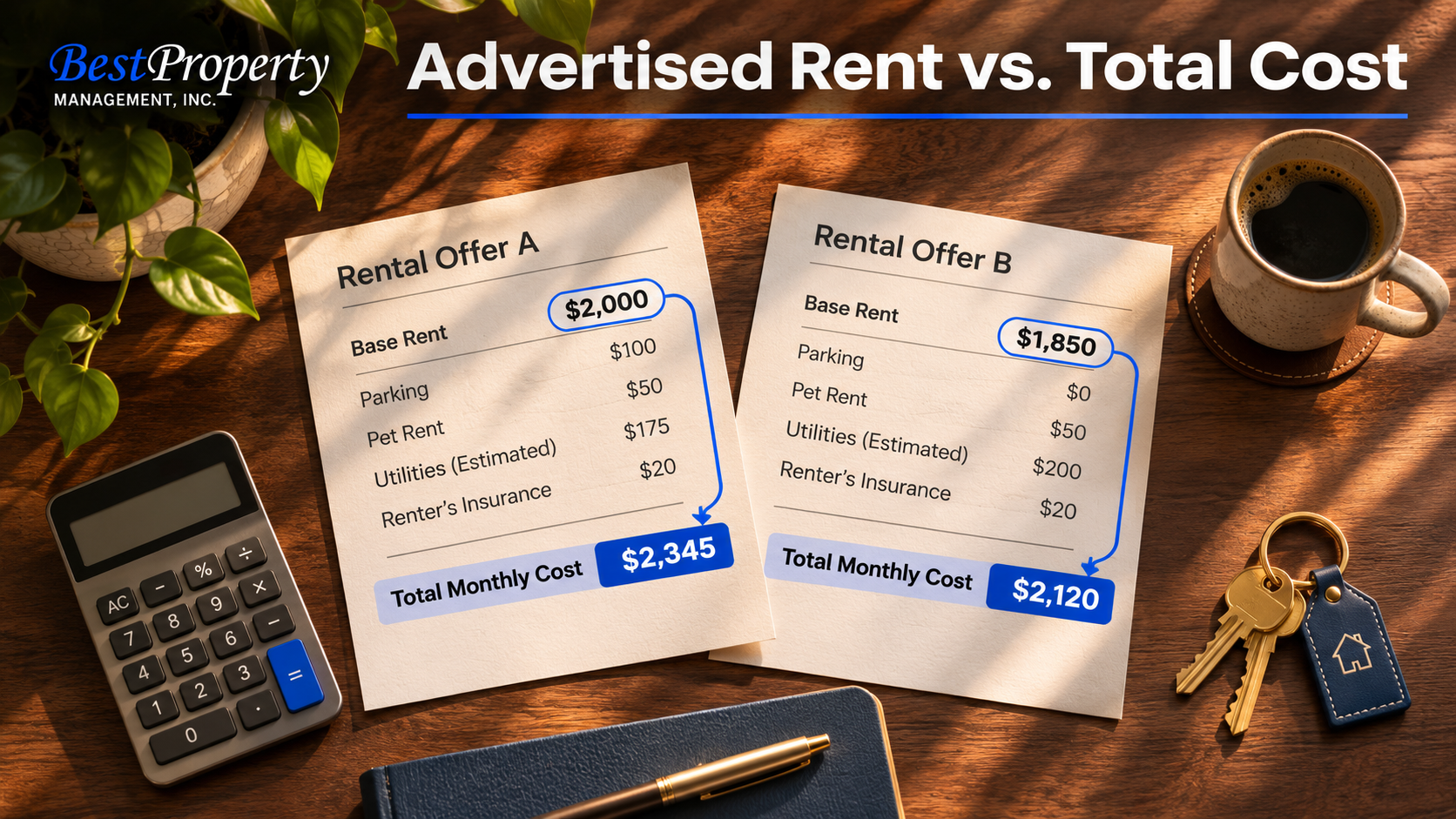
Advertised Rent vs. Total Monthly Cost: Which Number Should You Compare?
Two homes show the same rent. One has a required monthly service package. The other bills utilities differently. A listing-price comparison has not yet told you which home fits the budget.
Compare the total mandatory monthly commitment, then add realistic variable costs separately. Keep optional services, one-time charges and refundable deposits visible instead of folding every amount into one misleading rent number.
Begin with the amount that repeats every month
Write down the base rent and every required recurring charge. Ask whether a technology, management, amenity or service fee is mandatory for this particular home and lease. Do not infer that it is optional because it appears in a separate line.
Request the answer before paying an application or holding charge. The FTC’s current renter guidance recommends confirming the mandatory monthly rental price in writing.
A clear answer names the charge, amount, frequency and service. If the amount can change, ask how that change is determined and disclosed.
Use the same categories for both homes
The following numbers are purely illustrative. They are not Best Property prices, typical local fees or a statement that any charge is permitted. Home A has $2,400 base rent and a $60 required monthly package. Home B has $2,450 base rent with no additional mandatory package in this example.
Before utilities and optional choices, A’s fixed commitment is $2,460 and B’s is $2,450. A lower headline did not produce a lower fixed monthly total. Over twelve unchanged months, the $10 difference would be $120.
That calculation still does not establish the cheaper home overall. Utility arrangements, included services, lease duration and one-time costs can change the comparison.
| Illustrative comparison | Home A | Home B |
|---|---|---|
| Base rent | $2,400 | $2,450 |
| Required monthly package | $60 | $0 |
| Fixed monthly commitment | $2,460 | $2,450 |
| Utilities and optional costs | Compare separately | Compare separately |
Do not turn an estimate into a fixed price
Water, electricity and other consumption-based charges may vary. Ask who bills them, what service is included in rent and how any shared cost is allocated. A prior bill can provide context without guaranteeing what a different household will use.
Separate the provider’s charge from an administrative fee. If a bill includes both, each should be understandable. A single utility line does not tell a renter whether they are paying measured usage, an allocation or an added service charge.
Keep uncertain costs marked as estimates in your comparison. False precision is less useful than a clearly identified range supported by actual information.
Put one-time payments on their own line
Application charges, move-in costs and refundable deposits affect the cash needed to begin a tenancy. They should not disappear because the comparison focuses on monthly affordability.
Ask what is refundable, under which conditions and when. A deposit is not the same thing as a nonrefundable expense. For an individual charge, confirm current legal requirements rather than assuming the lease label settles the question.
When comparing different lease lengths, show the actual initial cash requirement and the recurring commitment separately. That avoids presenting a twelve-month average as the amount someone must bring to move in.
Test whether optional really means optional
Can the resident decline the service? Does declining remove the charge? Is there another requirement, such as providing acceptable insurance evidence, that changes the account? Request the actual conditions in writing.
A feature may be valuable without being necessary to every household. Compare what it does, the support offered and alternatives available under the agreement. Avoid treating every technology or convenience package as either automatically worthwhile or automatically abusive.
Save the comparison with the offer date
Listings and availability change. Save the dated offer, the written fee explanation and the lease package you are asked to sign. If the numbers do not match, ask before committing.
For owners and managers, run the same comparison from an applicant’s perspective. Consistent terminology across the listing, quote, lease and bill makes the home easier to evaluate and reduces avoidable billing questions.
Questions owners and tenants ask
Is base rent enough to compare two homes?
No. Identify required recurring charges, variable costs, optional services and initial cash requirements.
Should refundable deposits count as monthly rent?
No. Show them separately as funds required at move-in, with their refund conditions.
Can a utility estimate guarantee my future bill?
No. Usage, rates and allocation arrangements can change. Label estimates clearly.
What should I request in writing?
The mandatory monthly price, individual charges, variable-cost method, optional choices and one-time payment terms.
Are the example prices actual Best Property rates?
No. The example is invented solely to demonstrate the arithmetic and is not a market estimate.
What if the lease and advertisement disagree?
Ask for an explanation and a consistent written offer before proceeding. Obtain specific advice if a disputed charge remains unresolved.
Explore this article series
Rental Junk Fees: What Does the FTC’s $49.75 Million Case Mean for Tenants and Owners?
Rental Utility Fees: What Should Your Bill Explain?
Mandatory Smart-Home Fees: What Are Renters Paying For?
Tenant Reviews: Can a Lease Stop You From Posting a Negative Review?
Related articles
Evaluating rental resident benefits packages
Understanding rent payment financing costs
Talk with your local Best Property team
Ask your local office for the terms attached to a specific available home. A good comparison starts with the actual offer rather than an assumed fee schedule. Find your local office.
Research checked November 12, 2026. Price examples are illustrative, not client data or local rental estimates. Individual charge legality requires current legal review. AI-assisted editorial illustration; no actual tenant, client event or property is depicted.
Blog
Company News
Landlord Resources
Landlords
Legal
Linkedin
Local Market Insights
Maintenance & Repairs
Market
Owners
Property
Property Law & Compliance
Property Management
Rental Property
Tenants
Video
FILTER BY EASTBAY & TRI-VALLEY CITIES
AB 1482
AI Property Management
AI Rental Fraud
Antioch Property Management
Applicant Data Security
Applicant Information
Applicant Screening
Applicant Verification
Bank Statement Fraud
Battery Recalls
Brentwood
Brentwood property management
California Insurance
California Landlord Laws
California Property Management
California Rent Increase
Central Valley Property Management
Concord Property Management
Credit Reports
Danville Property Management
Danville rentals
Desert Hot Springs Property Management
Desert Property Maintenance
Desert Rentals
Document Fraud
Dublin property management
E-Bike Safety
East Bay Landlords
East Bay Lease Renewals
East Bay property management
East Bay Rental Market
East Bay Rental Owners
East Bay Rental Property Maintenance
East Bay Rental Property Management
East Bay rental tips
East Bay Rentals
EV Charging
Eviction Notices
Eviction Support
Fair Housing
Fake Pay Stubs
Fall Leasing
find a property manager
Fremont
Fremont property management
full service property management
Full-Service Property Management
Good Tenants
Hayward Property Management
Hayward rentals
Heat Pump Water Heaters
hiring a property manager
HOA Compliance
HOA Rental Management
HOA Rentals
Home Insurance Costs
Human Oversight
Identity Verification
Income Verification
Indian Wells Property Management
Inherited Rental Property
Landlord Compliance
Landlord Data Security
Landlord Insurance
Landlord Resources
Landlord Tips
Lease Renewal Strategy
Lease Renewals
Leasing Fees
Leasing Services
Livermore
Livermore property management
Livermore Rentals
Local Development
Local Market Insights
Local Rental Support
Long-Term Rentals
Luxury Rentals
maintenance coordination
Maintenance Response
Management Services
Manteca Property Management
Milpitas Property Management
Mountain House Property Management
New Housing San Ramon
Newark CA Property Management
Oakley Property Management
Online Rent Payments
Owner Onboarding
owner reporting
Palm Desert Property Management
Palm Springs Area Property Management
Palm Springs Property Management
Palm Springs Rentals
Pittsburg CA Property Management
Pleasanton property management
Pleasanton rentals
Preventive Maintenance
Property Inspections
Property Maintenance
Property Management
Property Management Companies
Property Management Fees
Property Management Services
Property Management Transition
Property Manager
Rancho Mirage Property Management
Real Estate
real estate investing
Redfin Rentals
Remote Property Management
Rent Collection
Rent Control
Rent Reporting
Rent Trends
Rental Application Fraud
Rental Application Privacy
Rental Competition
Rental Fee Transparency
Rental Fees
Rental Fraud
Rental History
Rental Inspections
Rental Internet
rental leasing
Rental Market Analysis
Rental Market Trends
Rental Marketing
Rental Pricing
Rental Property
Rental Property Expenses
Rental Property Maintenance
rental property owners
rental property ROI
Renter Choice
Renter Experience
Repair Coordination
Resident Portal
Residential Leasing
Roommate Management
San Lorenzo Property Management
San Ramon Landlords
San Ramon Orchards
San Ramon property management
San Ramon Rental Market
Screening Red Flags
Seasonal Rentals
Security Deposits
Sell or Rent
Silicon Valley Rentals
single family rentals
Single-Family Rentals
Tenant Background Checks
Tenant Communication
Tenant Complaints
Tenant Expectations
Tenant Issues
Tenant Placement
Tenant Protection Act
Tenant Retention
tenant screening
Tenant Screening Data Security
Tenant Screening Fraud
Tenant Screening Red Flags
Tenant Turnover
Tracy Property Management
Tri-Valley
Tri-Valley Housing Market
Tri-Valley property management
Tri-Valley Rentals
Union City Property Management
Vacation Rental Management
Wildfire Risk
Winter Rental Safety
Zillow Rentals
 FILTER
 SEARCH BLOG