EV Charging in a Condo Rental: Who Approves the Parking-Space Work?
The parking stall is assigned to your condo rental, and a wall is close enough for a charger. It looks like a simple installation. But the wall, power supply and route between them may involve more than one decision maker.
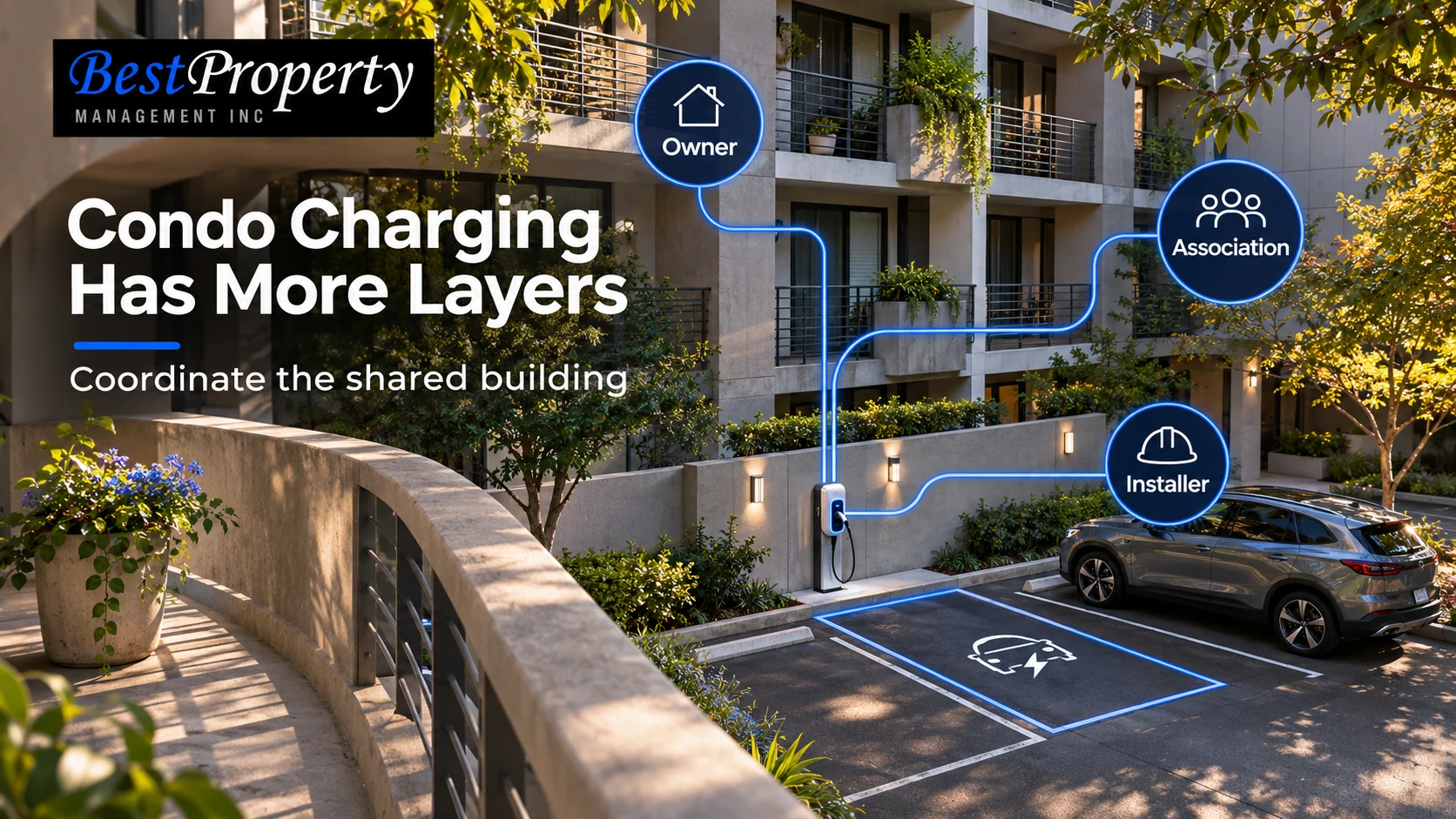
For a condo rental, separate the tenant’s request, the owner’s authority, the association’s lawful approval process and the qualified electrical scope. Agreement at one layer does not automatically complete every other layer.
This article is a companion to our rental EV charging guide. It focuses on coordination in shared buildings rather than promising that a particular stall can support charging.
Identify who controls the space and surrounding property
Start with the parking assignment and relevant association documents. A space may be deeded, exclusive-use common area or part of another arrangement. Nearby walls, conduits and electrical rooms can have different control.
The resident does not need to interpret every property document alone. Ask the owner or management contact to identify the applicable process and who will communicate with the association.
Do not attach equipment to a common wall or route a cable through a shared area based solely on informal permission to park. Our HOA maintenance responsibility guide explains why physical proximity does not settle authority.
Keep the tenant rule and HOA rule distinct
A tenant request can involve Civil Code section 1947.6, with its coverage conditions and exclusions. An owner’s association-related installation rights involve a separate framework, including Civil Code section 4745.
The association framework limits unreasonable restrictions while addressing applicable standards and approval requirements. It should not be described as an unrestricted veto or as permission to skip every review step.
Because these frameworks address different relationships, use qualified advice if the parties disagree about which rule applies or what a condition means. Our California tenant charger-request article explains why the first coverage check matters.
Designate a coordination contact
A resident emailing the association, an owner calling an installer and a manager waiting for a drawing can easily produce three incomplete versions of the same proposal.
Identify who will collect the documents, submit the applicable application and communicate the response. The tenant should know where to send questions without assuming the association’s property manager is also the tenant’s rental manager.
Keep one current scope and label revisions. If the location or equipment changes, identify whether the approving parties need to review the change. An approval for one route should not quietly become authority for a different installation.
Obtain a site-specific electrical scope
The EPA’s charging guide explains the basic distinction between charging types. The shared building still needs an appropriate evaluation of the proposed supply, equipment and installation.
A qualified electrician can address capacity, cable routing, required work and relevant permits or inspections. Common-area systems may require additional access and coordination. A retailer’s estimate does not establish the building’s available capacity.
Do not open electrical rooms, inspect wiring or trial an improvised connection. If the charger cannot be located without crossing a walkway or affecting another stall, that is a planning question for the authorized parties, not a problem to solve with a longer loose cable.
Resolve electricity and access before use
A charger connected to common power creates different billing questions from one connected to the resident’s own meter. Establish the permitted method and responsible payer in writing.
| Shared-building issue | Question | Record |
|---|---|---|
| Power supply | Which account supplies the charger? | Approved electrical and billing arrangement |
| Parking access | Who may use the space and equipment? | Current parking and use terms |
| Service access | Who can enter controlled areas? | Authorized contact and procedure |
| Equipment outage | Who receives and coordinates reports? | Service responsibility |
| Departure | What remains or is removed? | Written handoff and restoration terms |
Do not assume an app’s usage estimate is automatically an authorized billing system. Do not share a personal utility password to make a reimbursement easier.
Our charging cost guide expands on the financial categories and the records that help an owner understand the ongoing arrangement.
Consider the next resident, not only the current vehicle
A resident may move before the equipment reaches the end of its useful life. The current plan should say who owns it, whether it may remain and how any removal will be performed.
If the charger uses an app or network account, identify the authorized account handoff. A departing tenant should not retain control of property equipment, and a new resident should not need a former occupant’s personal login. Our smart-home privacy checklist addresses that distinction.
Document the condition at handoff and any remaining work. Our move-out documentation guide explains why physical condition and contractual release need clear records.
Keep a promising idea from becoming an unauthorized project
A practical sequence is to identify the parking and property interests, check the relevant legal framework, coordinate the qualified scope and lawful application process, then record the final authorized arrangement.
If an application is disputed or delayed, obtain advice about the actual statutory requirements rather than assuming there is no remedy or that work can simply begin. This guide does not determine deadlines or approval outcomes for an individual association.
For a Best Property-managed condo in Livermore, Fremont, Brentwood or Tracy, contact the appropriate office about the rental-management side and the actual association process. Our rental property management services should be matched to the home’s responsibilities. A successful charger plan needs the right people working from the same approved version.
Frequently Asked Questions
Does an assigned condo parking stall automatically allow charging work?
No. Identify the space’s legal arrangement and who controls the affected walls, power and common areas. Parking permission alone does not answer every installation question.
Is the tenant charging statute the same as the HOA charging statute?
No. They address different relationships and requirements. A tenant request and an owner’s association process may both need attention.
Can an HOA impose any restriction it wants?
Do not assume that. California’s association framework limits unreasonable restrictions and addresses the approval process. Obtain qualified advice about a disputed condition.
Who should communicate with the association?
Designate the appropriate owner or authorized representative and make the process clear to the resident. Avoid several parties submitting inconsistent scopes.
Can a tenant use a nearby common-area outlet temporarily?
Do not assume permission or suitability. Common power, electrical conditions and cable routing require the appropriate authorization and qualified review.
How should charging electricity be billed?
Use a lawful, agreed method that matches the actual power source. A common-area supply can require different coordination from a resident’s own utility account.
What if the installation scope changes after approval?
Identify the change and ask whether the affected approving parties must review it. Do not assume approval of one location or route covers a different project.
What should happen when the tenant moves out?
Follow the written ownership, removal, restoration and account-handoff arrangement. Use qualified service for physical work that requires it and document the completed handoff.
Related Articles
Fremont Condo Property Management: Who Handles Tenant Repairs and HOA Responsibilities? For the broader boundary between owner and association maintenance responsibilities.
Livermore Move-Out Inspections: What Should Owners Document Before Repairs Begin? For a documented equipment and condition handoff.
What Is Included in a San Ramon Property Management Agreement? Fees, Leasing, Maintenance and Termination Terms For clarifying the management role in a multi-party property decision.
Rental Income: Why Are You Taking Home Less? 5 Costs to Check For keeping new rental operating costs visible in an owner’s budget.
Blog
Company News
Landlord Resources
Landlords
Legal
Linkedin
Local Market Insights
Maintenance & Repairs
Market
Owners
Property
Property Law & Compliance
Property Management
Rental Property
Tenants
Video
FILTER BY EASTBAY & TRI-VALLEY CITIES
AB 1482
AI Property Management
AI Rental Fraud
Antioch Property Management
Applicant Data Security
Applicant Information
Applicant Screening
Applicant Verification
Bank Statement Fraud
Brentwood
Brentwood property management
California Insurance
California Landlord Laws
California Property Management
California Rent Increase
Central Valley Property Management
Concord Property Management
Credit Reports
Danville Property Management
Danville rentals
Desert Hot Springs Property Management
Desert Property Maintenance
Desert Rentals
Document Fraud
Dublin property management
East Bay Landlords
East Bay Lease Renewals
East Bay property management
East Bay Rental Market
East Bay Rental Owners
East Bay Rental Property Maintenance
East Bay Rental Property Management
East Bay rental tips
East Bay Rentals
EV Charging
Eviction Notices
Eviction Support
Fair Housing
Fake Pay Stubs
Fall Leasing
find a property manager
Fremont
Fremont property management
full service property management
Full-Service Property Management
Good Tenants
Hayward Property Management
Hayward rentals
hiring a property manager
HOA Compliance
HOA Rental Management
HOA Rentals
Home Insurance Costs
Human Oversight
Identity Verification
Income Verification
Indian Wells Property Management
Inherited Rental Property
Landlord Compliance
Landlord Data Security
Landlord Insurance
Landlord Resources
Landlord Tips
Lease Renewal Strategy
Lease Renewals
Leasing Fees
Leasing Services
Livermore
Livermore property management
Livermore Rentals
Local Development
Local Market Insights
Local Rental Support
Long-Term Rentals
Luxury Rentals
maintenance coordination
Maintenance Response
Management Services
Manteca Property Management
Milpitas Property Management
Mountain House Property Management
New Housing San Ramon
Newark CA Property Management
Oakley Property Management
Online Rent Payments
Owner Onboarding
owner reporting
Palm Desert Property Management
Palm Springs Area Property Management
Palm Springs Property Management
Palm Springs Rentals
Pittsburg CA Property Management
Pleasanton property management
Pleasanton rentals
Preventive Maintenance
Property Inspections
Property Maintenance
Property Management
Property Management Companies
Property Management Fees
Property Management Services
Property Management Transition
Property Manager
Rancho Mirage Property Management
Real Estate
real estate investing
Redfin Rentals
Remote Property Management
Rent Collection
Rent Control
Rent Trends
Rental Application Fraud
Rental Application Privacy
Rental Competition
Rental Fees
Rental Fraud
Rental History
Rental Inspections
Rental Internet
rental leasing
Rental Market Analysis
Rental Market Trends
Rental Marketing
Rental Pricing
Rental Property
Rental Property Expenses
Rental Property Maintenance
rental property owners
rental property ROI
Renter Choice
Renter Experience
Repair Coordination
Resident Portal
Residential Leasing
Roommate Management
San Lorenzo Property Management
San Ramon Landlords
San Ramon Orchards
San Ramon property management
San Ramon Rental Market
Screening Red Flags
Seasonal Rentals
Security Deposits
Sell or Rent
Silicon Valley Rentals
single family rentals
Single-Family Rentals
Tenant Background Checks
Tenant Communication
Tenant Complaints
Tenant Expectations
Tenant Issues
Tenant Placement
Tenant Protection Act
Tenant Retention
tenant screening
Tenant Screening Data Security
Tenant Screening Fraud
Tenant Screening Red Flags
Tenant Turnover
Tracy Property Management
Tri-Valley
Tri-Valley Housing Market
Tri-Valley property management
Tri-Valley Rentals
Union City Property Management
Vacation Rental Management
Wildfire Risk
Winter Rental Safety
Zillow Rentals
 FILTER
 SEARCH BLOG