Property Management Owner Statements: How Do You Check Rent, Fees and Repair Charges?
To check a property management owner statement, add income received to the opening balance, subtract paid charges and distributions, then compare the result with closing funds. Trace unfamiliar entries to the tenant ledger, agreement or invoice. Identify cash still held for the property separately from actual spending.
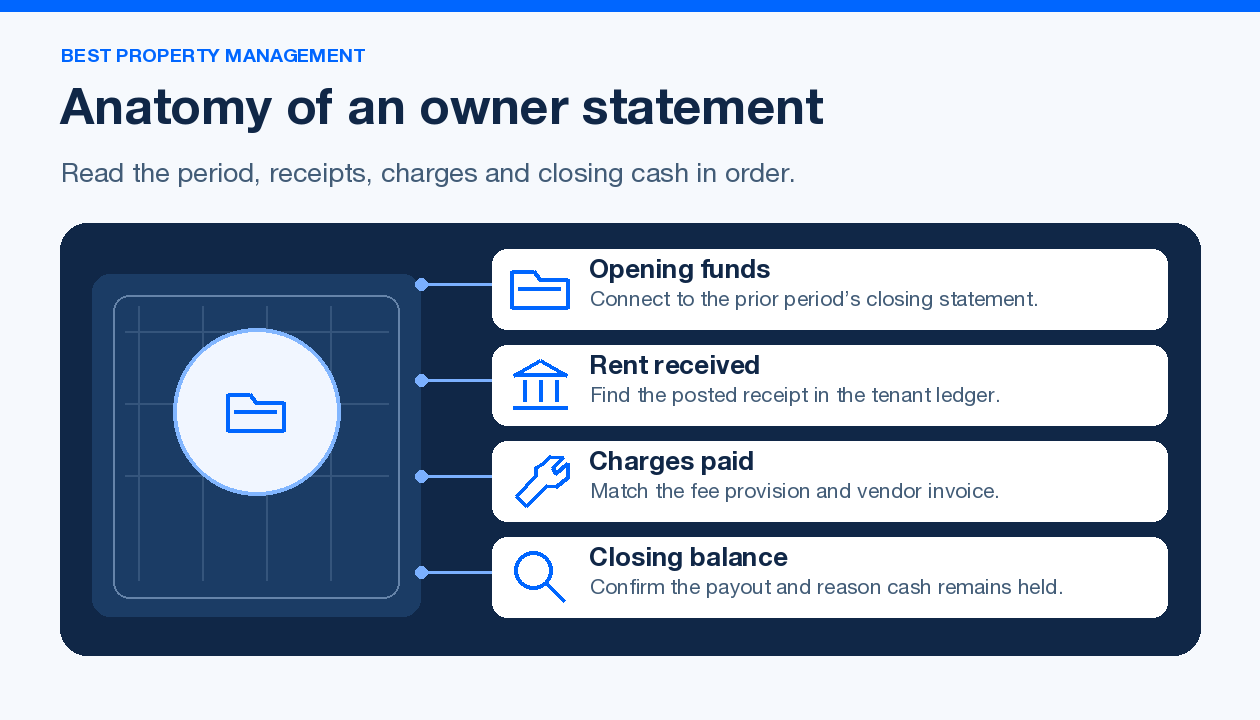
The latest statement has a repair charge and a payout smaller than your monthly rent. Before deciding what changed, read the report in order. Opening funds tell you where the month started. The transactions explain what moved. The closing amount tells you what remains to follow up next month.
Where should you start on an owner statement?
Verify the property, account and dates. A statement sent this month may cover the prior month. A bank transfer recorded at the end of that period may reach your bank after it closes. Keep the reporting dates and payment dates visible while you compare.
Locate the opening balance and match it to the prior closing balance. If they differ, request the adjustment history or explanation before analyzing the rest of the month. You cannot reconcile a statement confidently if the starting point remains unclear.
The rent collection and owner reporting guide explains how the manager’s income records fit together. Ask which type of report provides the amounts you want to check and how to access the source records. A redacted sample is useful when comparing two firms’ reporting systems.
How does a sample owner statement reconcile?
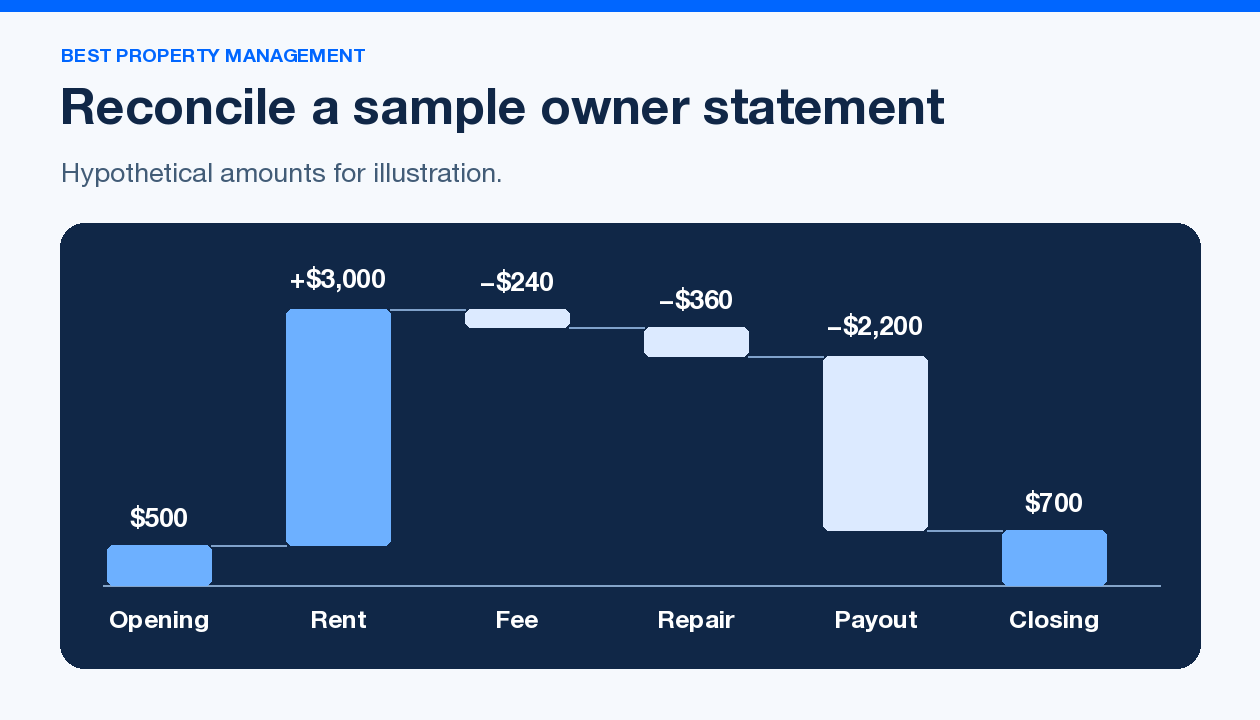
Consider an illustrative month. The account starts with $500, records $3,000 of collected rent and pays a $240 management charge and $360 vendor invoice. The owner receives $2,200. The account closes with $700 held.
| Statement movement | Illustrative amount | Record to verify |
|---|---|---|
| Opening funds | $500 | Prior period’s closing balance. |
| Rent received | +$3,000 | Posted receipt in the tenant ledger. |
| Management charge | −$240 | Calculation and agreement provision. |
| Vendor invoice | −$360 | Scope, property, invoice and approval. |
| Owner distribution | −$2,200 | Payment reference and bank receipt. |
| Closing funds | $700 | Held balance and purpose. |
The math is $500 + $3,000 − $240 − $360 − $2,200 = $700. These amounts are hypothetical and do not represent a Best Property rate or an expected payout. The retained balance increased by $200. Identify why the additional $200 remains held, such as an agreed reserve or documented obligation. It has not been paid to a vendor in this example.
How do you verify the rent figure?
A lease tells you what should be charged. The ledger tells you what was charged and received, and can identify adjustments, credits or reversals. If an expected payment is missing, check the date and status of the transaction. A payment covering two periods needs a different explanation from an unpaid balance.
Ask how the statement handles a payment received near the reporting cutoff. A tenant may have initiated the payment before it was posted. A later reversal can change the available amount after a preliminary report appeared. Request the specific entries so that you can connect the change to the correct month.
The owner distribution guide explains common reasons a payout can differ from collected rent. Use it to identify the next record you need. For example, a completed distribution record answers a different question from an outstanding tenant balance.
What should support management fees and repair charges?
For a management fee, consult the signed fee schedule and the agreed calculation base. A percentage on collected rent, a minimum and a flat monthly fee can behave differently for the same property. Ask for the actual calculation for any line you cannot reproduce. Read the relevant contract language instead of applying a price from another proposal.
For a repair charge, check the property, scope, vendor invoice and authorization. If the work proceeded under an emergency provision, look for an explanation and the related record. Separate evidence that a bill was paid from evidence that the issue was resolved.
Check for credits and corrections. A vendor may issue a refund after the original period closes. Save both entries with their supporting records. Our guide to rental budgeting and management fees helps distinguish charges you pay to the manager from other operating costs.
Why can a bank deposit be different from the income shown?
A distribution is the cash sent to the owner. It can reflect expenses, cash held for agreed needs and the timing of payments. A property may earn income in a period while part of the money remains in the account. Use the balance and distribution records to explain the difference.
Find the distribution reference and match it with your bank receipt. If a transfer has been initiated but has not arrived, ask for its status and confirm the destination through a secure channel. Avoid sending sensitive account details in an ordinary message.
Your own budget may include direct costs such as insurance or a repair you arranged. Keep those separately identified. The remote-owner reporting guide explains the benefit of reviewing financial records and repair activity together.
How should you ask about a line you cannot explain?
Send a short request with the property, statement period, description and amount. For instance, ask for the invoice and approval reference for a specific $360 repair and whether any credit remains pending. This gives the accounting team a record to locate.
Keep a running list of unresolved items with the request date, owner of the follow-up and expected next update. If the firm makes a correction, ask how it will appear in the current or following period. Save the original and corrected versions with the explanation.
A discrepancy can arise from timing, missing support, misclassification or an error. Give the manager a chance to identify what happened. If the records still do not reconcile, use the firm’s escalation process and seek qualified advice for a disputed amount.
What should you ask a prospective manager to demonstrate?
Request a redacted statement and ask them to explain the cash from opening funds to closing funds. Follow one charge to an invoice and one rent receipt to the ledger. Ask what the owner can download, who answers questions and how revised reports are identified.
Clarify how reserve movements appear and whether additional expense detail is available. Ask how records remain accessible if management ends. A readable report and an answerable follow-up process make a bigger difference over time than the number of charts on a dashboard.
What else do rental owners ask?
Is an owner distribution the same as rental income?
A distribution is the amount paid to the owner. It may reflect expenses, held money and timing. Review the ledger and statement for income activity.
Should the opening balance match the prior closing balance?
The two should connect through a documented reconciliation. Ask for the bridge when they differ.
Does retained reserve cash count as another repair cost?
Money held for future needs and money paid to a vendor are separate movements. Record them separately to avoid counting the same dollars twice.
What if the manager lists a repair without an invoice?
Ask for the supporting invoice, work description and any relevant approval. Request completion information if the status is unclear.
How can I check a management percentage?
Read the agreement’s stated base and billing period. Apply its formula to the documented transactions and ask about any difference.
Can this statement serve as my complete tax file?
Keep it as one source. A tax adviser may also need direct expenses, financing information and other property or ownership records.
Related articles for rental property owners
Best Guide to Rent Collection in the East Bay: Payment Systems, Late Rent and Owner Reporting
Rental Income: Why Are You Taking Home Less? 5 Costs to Check
Tracy Property Management Fees: What Should You Budget Beyond the Monthly Fee?
Tracy Remote Property Management: How Can You Track Rent, Repairs and Inspections From Out of Town?
What should you discuss with Best Property?
Bring a sample statement or a list of the lines you want to track. Ask how to access the transaction detail and supporting documents for your rental. Review Best Property’s owner financial reporting service or contact the Best Property team.
Editorial cover is AI-assisted and illustrative. Check the agreement and the rules that apply to your property.
Blog
Company News
Landlord Resources
Landlords
Legal
Linkedin
Local Market Insights
Maintenance & Repairs
Market
Owners
Property
Property Law & Compliance
Property Management
Rental Property
Tenants
Video
FILTER BY EASTBAY & TRI-VALLEY CITIES
AB 1482
AI Property Management
AI Rental Fraud
Antioch Property Management
Applicant Data Security
Applicant Information
Applicant Screening
Applicant Verification
Bank Statement Fraud
Battery Recalls
Brentwood
Brentwood property management
California Insurance
California Landlord Laws
California Property Management
California Rent Increase
Central Valley Property Management
Concord Property Management
Credit Reports
Danville Property Management
Danville rentals
Desert Hot Springs Property Management
Desert Property Maintenance
Desert Rentals
Document Fraud
Dublin property management
E-Bike Safety
East Bay Landlords
East Bay Lease Renewals
East Bay property management
East Bay Rental Market
East Bay Rental Owners
East Bay Rental Property Maintenance
East Bay Rental Property Management
East Bay rental tips
East Bay Rentals
EV Charging
Eviction Notices
Eviction Support
Fair Housing
Fake Pay Stubs
Fall Leasing
find a property manager
Fremont
Fremont property management
full service property management
Full-Service Property Management
Good Tenants
Hayward Property Management
Hayward rentals
Heat Pump Water Heaters
hiring a property manager
HOA Compliance
HOA Rental Management
HOA Rentals
Home Insurance Costs
Human Oversight
Identity Verification
Income Verification
Indian Wells Property Management
Inherited Rental Property
Landlord Compliance
Landlord Data Security
Landlord Insurance
Landlord Resources
Landlord Tips
Lease Renewal Strategy
Lease Renewals
Leasing Fees
Leasing Services
Livermore
Livermore property management
Livermore Rentals
Local Development
Local Market Insights
Local Rental Support
Long-Term Rentals
Luxury Rentals
maintenance coordination
Maintenance Response
Management Services
Manteca Property Management
Milpitas Property Management
Mountain House Property Management
New Housing San Ramon
Newark CA Property Management
Oakley Property Management
Online Rent Payments
Owner Onboarding
owner reporting
Palm Desert Property Management
Palm Springs Area Property Management
Palm Springs Property Management
Palm Springs Rentals
Pittsburg CA Property Management
Pleasanton property management
Pleasanton rentals
Preventive Maintenance
Property Inspections
Property Maintenance
Property Management
Property Management Companies
Property Management Fees
Property Management Services
Property Management Transition
Property Manager
Rancho Mirage Property Management
Real Estate
real estate investing
Redfin Rentals
Remote Property Management
Rent Collection
Rent Control
Rent Reporting
Rent Trends
Rental Application Fraud
Rental Application Privacy
Rental Competition
Rental Fee Transparency
Rental Fees
Rental Fraud
Rental History
Rental Inspections
Rental Internet
rental leasing
Rental Market Analysis
Rental Market Trends
Rental Marketing
Rental Pricing
Rental Property
Rental Property Expenses
Rental Property Maintenance
rental property owners
rental property ROI
Renter Choice
Renter Experience
Repair Coordination
Resident Portal
Residential Leasing
Roommate Management
San Lorenzo Property Management
San Ramon Landlords
San Ramon Orchards
San Ramon property management
San Ramon Rental Market
Screening Red Flags
Seasonal Rentals
Security Deposits
Sell or Rent
Silicon Valley Rentals
single family rentals
Single-Family Rentals
Tenant Background Checks
Tenant Communication
Tenant Complaints
Tenant Expectations
Tenant Issues
Tenant Placement
Tenant Protection Act
Tenant Retention
tenant screening
Tenant Screening Data Security
Tenant Screening Fraud
Tenant Screening Red Flags
Tenant Turnover
Tracy Property Management
Tri-Valley
Tri-Valley Housing Market
Tri-Valley property management
Tri-Valley Rentals
Union City Property Management
Vacation Rental Management
Wildfire Risk
Winter Rental Safety
Zillow Rentals
 FILTER
 SEARCH BLOG