Property Manager Not Paying You: What Should Rental Owners Check Before Taking Action?
If your property manager has not paid you, first establish whether rent was collected, which charges were posted, what funds are being held and whether a distribution was actually sent. Compare the tenant ledger, owner statement and payment reference. Escalate unexplained differences promptly, but do not assume that a late deposit by itself proves money was taken.
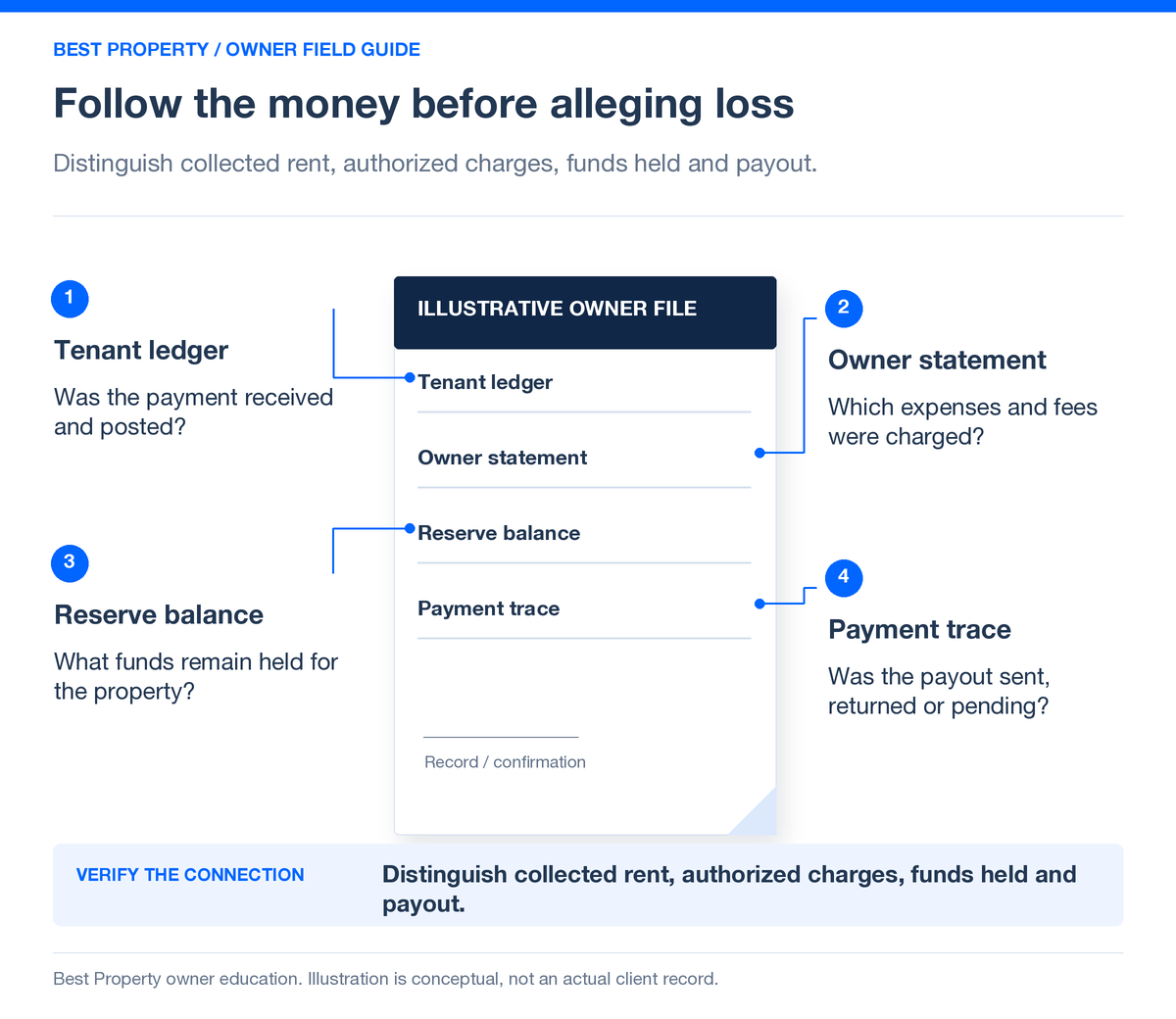
“The tenant paid” and “the owner payout cleared” describe different events. A useful investigation follows the money between them. It also distinguishes an ordinary processing issue from a missing record, an unexplained deduction or a larger problem that needs immediate professional attention.
Was the rent actually received or only expected?
Start with the tenant ledger for the correct property and period. Check the rent charge, payment received, posting date, credits, reversals and any outstanding balance. A screenshot of a tenant initiating a payment does not necessarily show that the payment settled or remained in the account.
Ask the manager to identify the status in plain language. Is the payment pending, received, returned, reversed or applied to another period? If a tenant reports paying an old manager after a transition, request the actual receipt and follow the transfer record rather than assuming the new ledger is the whole story.
The East Bay rent collection guide explains why expected rent, collected rent and owner reporting should be distinguished. Keep those categories separate before deciding that a short payout is a fee problem or that a missing payout is a collection problem.
Which records should explain the owner distribution?
Request the owner statement covering the payment period, the supporting tenant ledger and the distribution reference. Identify opening funds, money received, management charges, vendor expenses, retained reserves and the closing balance. Ask for the records behind any unfamiliar entry rather than a verbal total alone.
The California DRE property-management reference describes the importance of owner reporting and adequate trust-fund accounting. An owner’s practical check is whether a statement can be traced to actual transactions and supporting documents. A polished dashboard does not resolve an unexplained balance by itself.
| Question | Record to request |
|---|---|
| Was rent collected? | Tenant ledger and payment status. |
| What reduced available funds? | Itemized owner statement and relevant invoices. |
| What remains held? | Reserve or other retained-balance explanation. |
| Was a payout issued? | Distribution date, reference and destination confirmation. |
| Why does my bank show something different? | Payment trace, return or correction record. |
Could authorized expenses or reserves explain the difference?
Compare each deduction with the agreement and the property’s records. Management compensation, an approved repair or replenishment of an agreed reserve can reduce the distribution. They are different transactions and should not be collapsed into one vague “adjustment.”
For a hypothetical month with $3,000 rent received, a $240 management fee, a $360 approved repair and a $200 increase in retained reserve, the distribution would be $2,200. The $200 is still being held for the property in this example; it is not another repair expense. These are illustrative assumptions, not Best Property rates.
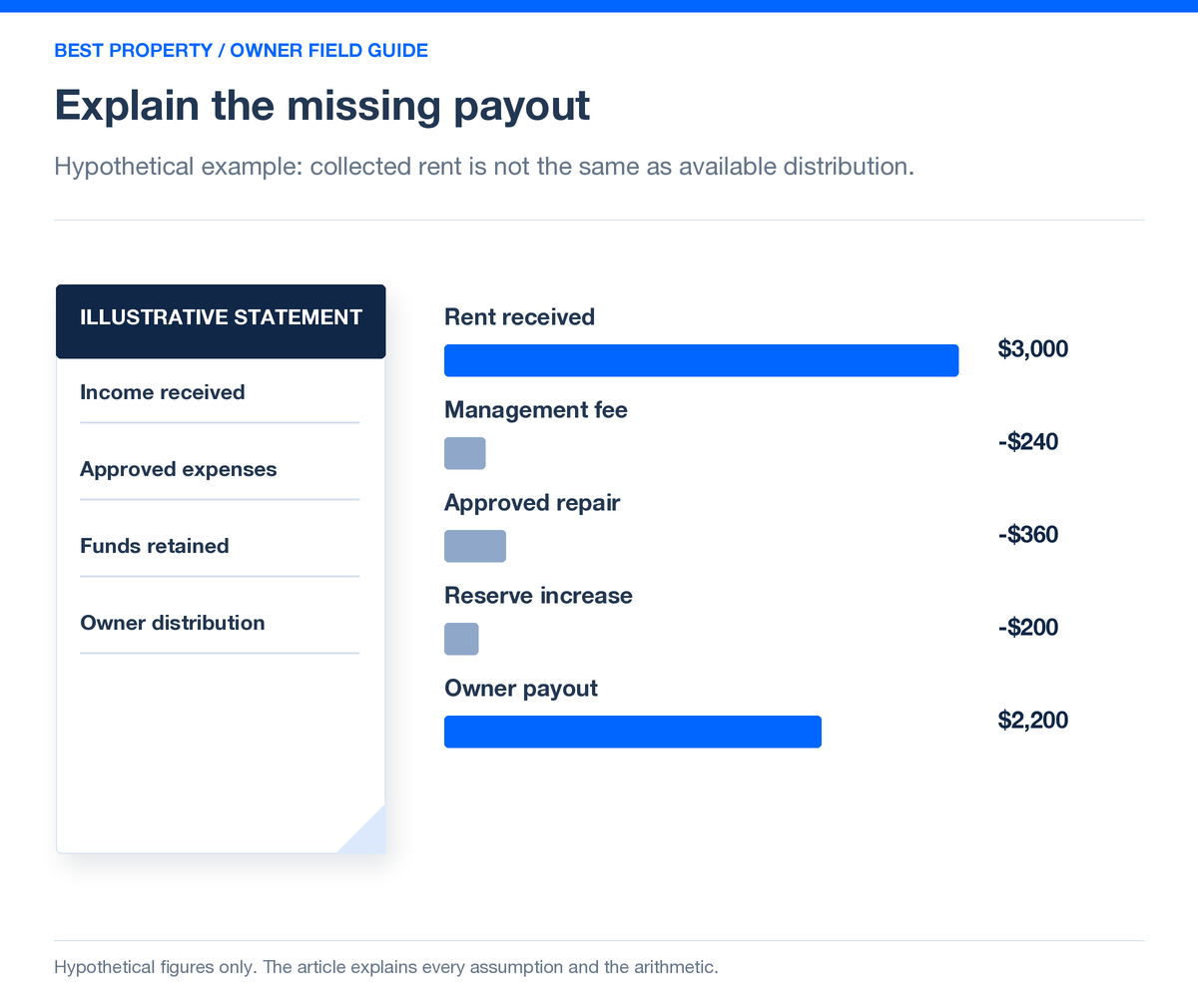
The figures reconcile only if the supporting records agree. If the statement includes a repair you did not recognize, ask for the scope, authorization and invoice. If the reserve changed, ask which term or instruction supports the change. Our guide to rental income and owner distributions provides a broader cost checklist.
Could the payment have been sent but failed to arrive?
Check the issue date and the payment method before assuming the distribution was never made. Ask whether it is pending, returned, rejected or sent to a previously authorized destination. Confirm the relevant bank-account identifiers securely without circulating complete financial details unnecessarily.
If you recently changed accounts, identify when the new instructions were received and took effect. Verify any request to change bank details through a known contact rather than replying to an unexpected message with sensitive information. Ask the manager how a returned payment will be corrected and what reference will confirm the replacement.
Keep the statement and bank evidence for the same period. A deposit arriving after the statement date can create an apparent mismatch that disappears when dates are aligned. Conversely, repeated promises that a payment “is coming” need a traceable status and checkpoint, not another unsupported reassurance.
What should you send when asking for an explanation?
Use a concise reconciliation request. Identify the property, reporting period, expected distribution, amount actually received and the entries you cannot explain. Attach the relevant statement and redact unrelated bank activity. Ask for the source record and next step for each difference.
An illustrative request might read: “Please reconcile the owner distribution for [period]. The statement shows [amount], while my bank shows [amount or no receipt]. Please confirm rent receipt status, itemized deductions, funds retained and the distribution reference, including any return or reissue.”
Name a reasonable requested response checkpoint based on the issue and the agreement. Do not present that requested date as a statutory deadline. If the problem is nonresponse, the owner communication escalation guide can help separate the factual record from the escalation process.
When should an unexplained payout become a formal concern?
Treat unavailable records, unexplained balances or inconsistent explanations seriously. Escalate to the responsible broker or supervising manager with the short chronology and supporting documents. Distinguish a question that has a documented explanation from an amount nobody can reconcile.
The DRE complaint guidance explains its jurisdiction and process for possible licensing violations. DRE cannot order a refund, cancel a contract or award damages. A lawyer or court process may be needed for a disputed recovery of money. Preserve the agreement, statements, correspondence and payment evidence rather than relying on memory.
Do not let the financial dispute erase ongoing property responsibilities. Confirm who is collecting current rent, responding to tenants and handling urgent work while you obtain advice or compare management alternatives. Protecting continuity and investigating the records can proceed together.
What should you ask a new manager about payout transparency?
Ask to see a redacted statement and the route for questioning a charge. Find out how rent receipt, reserves, vendor costs and owner distributions are shown, what access owners have and who handles an accounting question. Request the written disbursement arrangement for your property instead of relying on a broad service claim.
Best Property’s owner financial reporting page describes the service to discuss. Our remote owner-oversight guide also shows how income and repair records can support an owner who cannot visit frequently.
The aim is a reporting process you can understand and verify. You should not need to infer a payout from an expected rent figure or reconstruct an unexplained deduction from scattered emails.
What else do rental owners ask?
Does a late payout prove the manager stole the rent?
No. First check collection status, authorized charges, retained funds and the payment trace. Unexplained records or balances still deserve prompt escalation and appropriate advice.
Why is my payout lower than the monthly rent?
Expenses, management compensation, reserve changes and payment timing can affect the distribution. Ask for an itemized reconciliation rather than assuming the difference is one extra fee.
Should a reserve increase appear as a repair expense?
A reserve balance and an incurred expense are different. Ask how the statement distinguishes money retained for the property from money already spent.
What if the tenant has a payment screenshot?
Use it to identify the transaction, then confirm receipt, posting and any return or reversal with the manager. Initiating a payment does not always establish its final status.
Can I ask for the bank destination to be checked?
Yes. Use the manager’s secure verification process and a known contact. Avoid sending complete bank details through an unverified request or broad email thread.
Will DRE recover my missing distribution?
DRE reviews matters within its authority but cannot order money refunded or award damages. Ask an appropriate legal adviser about recovery when a balance remains disputed.
Related articles for rental property owners
Best Guide to Rent Collection in the East Bay: Payment Systems, Late Rent and Owner Reporting
Rental Income: Why Are You Taking Home Less? 5 Costs to Check
Property Manager Not Responding: When Should Rental Owners Start Looking Elsewhere?
Tracy Remote Property Management: How Can You Track Rent, Repairs and Inspections From Out of Town?
What should you discuss with Best Property?
Bring the agreement, current property records and your main unanswered questions. Ask Best Property to explain the service scope, responsibilities and reporting for your rental before choosing an arrangement. Discuss the relevant service, then contact the Best Property team about your property.
Sources and published service information checked November 20, 2026. This is general owner education. Confirm the current agreement and rules for the specific property. Original editorial cover is AI-assisted; illustrations do not depict actual clients or private records.
Blog
Company News
Landlord Resources
Landlords
Legal
Linkedin
Local Market Insights
Maintenance & Repairs
Market
Owners
Property
Property Law & Compliance
Property Management
Rental Property
Tenants
Video
FILTER BY EASTBAY & TRI-VALLEY CITIES
AB 1482
AI Property Management
AI Rental Fraud
Antioch Property Management
Applicant Data Security
Applicant Information
Applicant Screening
Applicant Verification
Bank Statement Fraud
Battery Recalls
Brentwood
Brentwood property management
California Insurance
California Landlord Laws
California Property Management
California Rent Increase
Central Valley Property Management
Concord Property Management
Credit Reports
Danville Property Management
Danville rentals
Desert Hot Springs Property Management
Desert Property Maintenance
Desert Rentals
Document Fraud
Dublin property management
E-Bike Safety
East Bay Landlords
East Bay Lease Renewals
East Bay property management
East Bay Rental Market
East Bay Rental Owners
East Bay Rental Property Maintenance
East Bay Rental Property Management
East Bay rental tips
East Bay Rentals
EV Charging
Eviction Notices
Eviction Support
Fair Housing
Fake Pay Stubs
Fall Leasing
find a property manager
Fremont
Fremont property management
full service property management
Full-Service Property Management
Good Tenants
Hayward Property Management
Hayward rentals
Heat Pump Water Heaters
hiring a property manager
HOA Compliance
HOA Rental Management
HOA Rentals
Home Insurance Costs
Human Oversight
Identity Verification
Income Verification
Indian Wells Property Management
Inherited Rental Property
Landlord Compliance
Landlord Data Security
Landlord Insurance
Landlord Resources
Landlord Tips
Lease Renewal Strategy
Lease Renewals
Leasing Fees
Leasing Services
Livermore
Livermore property management
Livermore Rentals
Local Development
Local Market Insights
Local Rental Support
Long-Term Rentals
Luxury Rentals
maintenance coordination
Maintenance Response
Management Services
Manteca Property Management
Milpitas Property Management
Mountain House Property Management
New Housing San Ramon
Newark CA Property Management
Oakley Property Management
Online Rent Payments
Owner Onboarding
owner reporting
Palm Desert Property Management
Palm Springs Area Property Management
Palm Springs Property Management
Palm Springs Rentals
Pittsburg CA Property Management
Pleasanton property management
Pleasanton rentals
Preventive Maintenance
Property Inspections
Property Maintenance
Property Management
Property Management Companies
Property Management Fees
Property Management Services
Property Management Transition
Property Manager
Rancho Mirage Property Management
Real Estate
real estate investing
Redfin Rentals
Remote Property Management
Rent Collection
Rent Control
Rent Reporting
Rent Trends
Rental Application Fraud
Rental Application Privacy
Rental Competition
Rental Fee Transparency
Rental Fees
Rental Fraud
Rental History
Rental Inspections
Rental Internet
rental leasing
Rental Market Analysis
Rental Market Trends
Rental Marketing
Rental Pricing
Rental Property
Rental Property Expenses
Rental Property Maintenance
rental property owners
rental property ROI
Renter Choice
Renter Experience
Repair Coordination
Resident Portal
Residential Leasing
Roommate Management
San Lorenzo Property Management
San Ramon Landlords
San Ramon Orchards
San Ramon property management
San Ramon Rental Market
Screening Red Flags
Seasonal Rentals
Security Deposits
Sell or Rent
Silicon Valley Rentals
single family rentals
Single-Family Rentals
Tenant Background Checks
Tenant Communication
Tenant Complaints
Tenant Expectations
Tenant Issues
Tenant Placement
Tenant Protection Act
Tenant Retention
tenant screening
Tenant Screening Data Security
Tenant Screening Fraud
Tenant Screening Red Flags
Tenant Turnover
Tracy Property Management
Tri-Valley
Tri-Valley Housing Market
Tri-Valley property management
Tri-Valley Rentals
Union City Property Management
Vacation Rental Management
Wildfire Risk
Winter Rental Safety
Zillow Rentals
 FILTER
 SEARCH BLOG