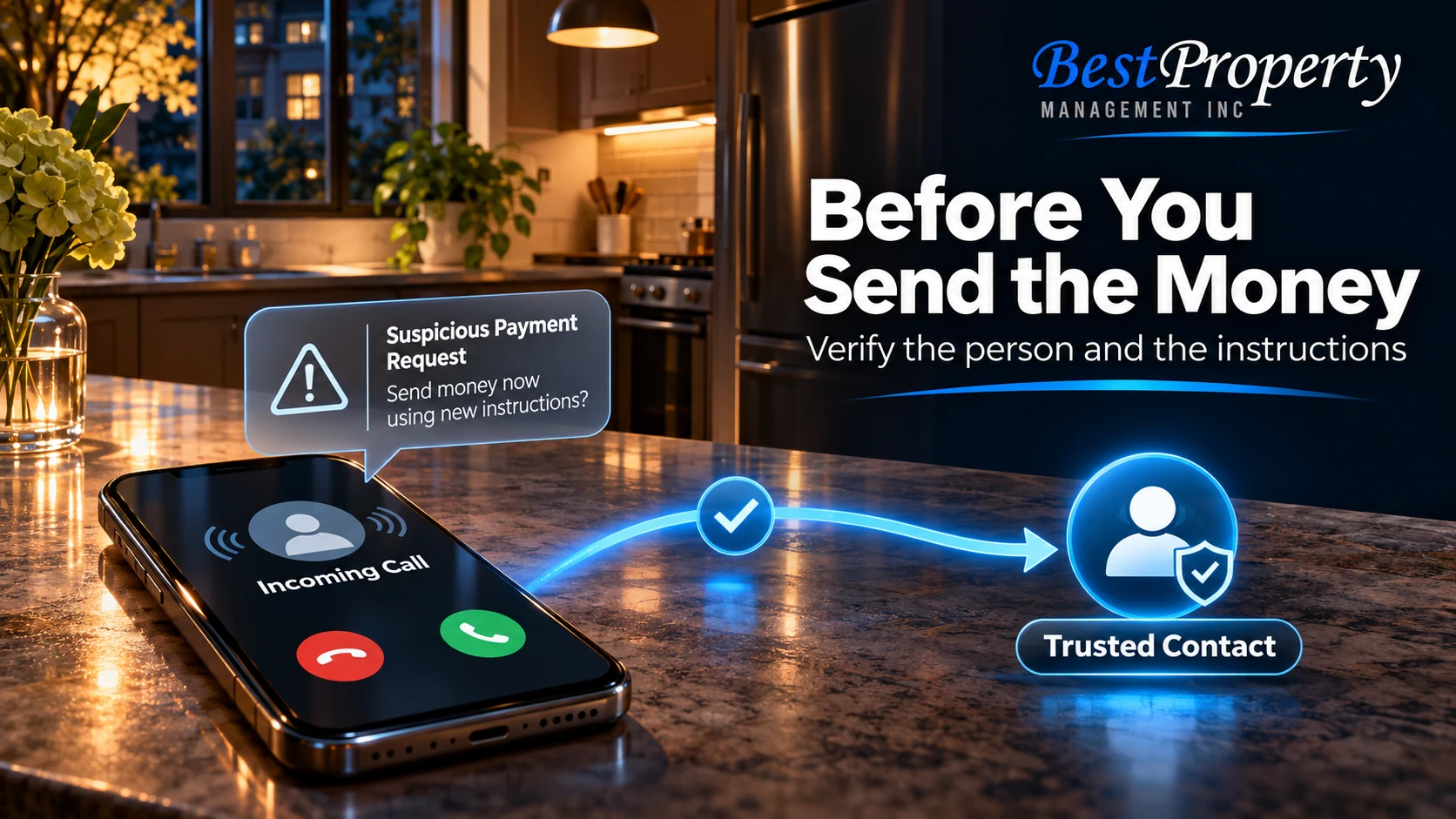
Was That Really Your Property Manager? 5 Checks Before Sending Money
Before sending money in response to a new instruction, contact your property manager through a number or portal you already trust. A familiar name, logo, voice or email thread is not independent verification.
Imagine receiving an urgent message that rent must go to a different account today. It includes your manager’s name and sounds knowledgeable about the property. The safest first step is a pause, not an argument with the sender.
This is a hypothetical scenario, not a report of a Best Property incident. The FBI’s business email compromise guidance describes how criminals impersonate trusted contacts to redirect payments. AI can make an imitation more convincing, but the verification process should work whether the message was produced by software or a person.
1. Verify through a contact you obtained independently
Use the phone number saved from your established relationship, a previously verified portal or the office directory you navigate to yourself. Do not call the “verification number” supplied in the suspicious message. That would let the sender verify their own story.
Tell the known office exactly what changed: the destination account, payment method, due date or supposed recipient. Ask whether the office issued that instruction. If you cannot reach the responsible person, keep the payment change on hold while using the established procedure.
The FTC’s small-business cybersecurity resources reinforce the value of checking unexpected requests through a trusted route. The principle applies to both a tenant paying rent and an owner approving a vendor payment.
2. Examine the change, not just the message’s appearance
A correctly spelled name or convincing signature is weak evidence. Even a real email account can be compromised. Compare the request with your normal arrangement.
- Is the recipient different from the one on the established account?
- Is a familiar payment method suddenly unavailable?
- Is the sender asking for secrecy or discouraging a callback?
- Is the request pushing an unusual transfer, gift card or cryptocurrency payment?
- Are you being asked for a login code or banking password?
A change can be legitimate, but legitimacy needs confirmation outside the message. Do not assume that urgency makes verification optional.
3. Confirm the purpose and amount against your records
Identify what the payment is supposed to cover. Is it rent already paid, a deposit, an invoice or a new charge? Compare the request with the lease, ledger or approved work documentation.
For owners, ask for the relevant invoice and authorization trail through the usual system. An image of an invoice sent in a text message is not the same as a verified payable. For residents, a payment reminder should be reconciled with the actual account rather than paid twice because it appears overdue.
Our rent-collection and owner-reporting guide explains why payment records need to connect to the ledger. A clear record makes an unexpected request easier to evaluate.
4. Protect the credentials that control the money
Never supply a password, recovery code or one-time authentication code to someone claiming they need it to confirm your payment. Use the official app or website directly. Avoid signing in through an unsolicited payment link.
If you accidentally entered credentials on an unfamiliar page, use the provider’s official recovery and security process promptly. Contact the financial institution through its verified channel if an account may be at risk. Keep this separate from debating the suspicious sender.
Our rental data-security article covers the same principle in another context: the right question is what information is necessary and where it should be provided.
5. Resolve uncertainty before sending, then preserve the result
A useful verification record identifies who you contacted, when, what was confirmed and which approved method you used. It should not include full bank credentials. If the office confirms a genuine change, follow its established documentation process rather than relying on a verbal fragment.
| Request | Safe next step | Avoid |
|---|---|---|
| New rent destination | Verify through the established office contact | Using the new message’s callback number |
| Urgent owner transfer | Match the invoice and approval record | Paying because the signature looks right |
| Login-code request | Open the official provider directly | Sharing a one-time code with a caller |
| Duplicate payment demand | Reconcile the ledger and transaction reference | Sending a second payment immediately |
What if the money has already been sent?
Contact the bank or payment provider immediately through a verified channel and ask what recovery or fraud-reporting steps are available. Recovery is not guaranteed. Notify the actual property manager so the account can be reviewed and other legitimate communications are not confused with the scam.
Preserve messages, transaction references and the destination details without forwarding sensitive credentials. The FBI provides reporting information through IC3’s business email compromise resources. Follow the financial provider’s instructions and report promptly.
Make verification part of normal rental operations
Owners can establish an approval process for changed vendor banking details. Residents can save the office and payment support contacts before an urgent situation arises. Both can agree that a callback is routine when money instructions change.
For Best Property rentals, use the appropriate team listed in the office directory to confirm the current process. A legitimate request can withstand a sensible verification step. Pressure to skip it is a reason to slow down.
Our rent-collection services are a useful starting point for confirming the established payment process with the responsible office.
If a suspicious request arrives during a system problem, follow the rent-portal outage checklist while verifying the payment status.
Frequently Asked Questions
Can caller ID prove that a property manager is calling?
No. Caller information and voices can be imitated. End an unexpected payment conversation and contact the office through a number you already verified. Do not use a replacement number supplied by the caller as the independent check.
What if the message appears in a real email thread?
Treat changed payment instructions as something to verify independently. A genuine-looking thread does not rule out a compromised account. Confirm the change through the established office or vendor contact before transferring money.
Should I trust a voice that sounds like my manager?
A familiar voice is not sufficient payment verification. The caller may be genuine, but the same independent callback process should apply. Focus on confirming the transaction through a trusted route rather than trying to detect a synthetic voice yourself.
Is every changed bank account a scam?
No. Businesses can legitimately change payment arrangements. The change should still be confirmed through the established process and documented appropriately. Verification protects both the payer and the legitimate recipient.
What should I do if I receive a second rent demand?
Compare it with your transaction confirmation and account ledger, then ask the actual office to reconcile the discrepancy. Do not pay twice simply because a new message says the first payment failed.
Can support staff ask for my one-time banking code?
Do not share banking authentication codes or passwords with a caller or chat contact. Use the financial provider’s official app or verified support channel. A payment confirmation should not require giving another person control of your account.
Can a fraudulent transfer always be reversed?
No. Recovery depends on the payment method, timing and provider. Contact the financial institution immediately and ask about available fraud and recovery procedures. Keep the transaction details and report through the appropriate official channels.
Does this article describe a scam involving Best Property?
No. The examples are general and hypothetical. They explain a verification process for renters and owners, not an allegation about a particular company, employee or incident.
Related Articles
Best Guide to Rent Collection in the East Bay: Payment Systems, Late Rent and Owner Reporting Understand the records behind legitimate rent payments.
Tenant Screening Data Security: What Applicant Information Should Landlords Protect? Protect the personal information that can make impersonation more convincing.
Brentwood Rent Collection: What Should Owners Do When Rent Is Late? Separate a genuine late-rent issue from an unverified payment demand.
Tracy Remote Property Management: How Can You Track Rent, Repairs and Inspections From Out of Town? Build a clearer approval trail for remote rental ownership.
Blog
Company News
Landlord Resources
Landlords
Legal
Linkedin
Local Market Insights
Maintenance & Repairs
Market
Owners
Property
Property Law & Compliance
Property Management
Rental Property
Tenants
Video
FILTER BY EASTBAY & TRI-VALLEY CITIES
AB 1482
AI Property Management
AI Rental Fraud
Antioch Property Management
Applicant Data Security
Applicant Information
Applicant Screening
Applicant Verification
Bank Statement Fraud
Brentwood
Brentwood property management
California Insurance
California Landlord Laws
California Property Management
California Rent Increase
Central Valley Property Management
Concord Property Management
Credit Reports
Danville Property Management
Danville rentals
Desert Hot Springs Property Management
Desert Property Maintenance
Desert Rentals
Document Fraud
Dublin property management
East Bay Landlords
East Bay Lease Renewals
East Bay property management
East Bay Rental Market
East Bay Rental Owners
East Bay Rental Property Maintenance
East Bay Rental Property Management
East Bay rental tips
East Bay Rentals
EV Charging
Eviction Notices
Eviction Support
Fair Housing
Fake Pay Stubs
Fall Leasing
find a property manager
Fremont
Fremont property management
full service property management
Full-Service Property Management
Good Tenants
Hayward Property Management
Hayward rentals
hiring a property manager
HOA Compliance
HOA Rental Management
HOA Rentals
Home Insurance Costs
Human Oversight
Identity Verification
Income Verification
Indian Wells Property Management
Inherited Rental Property
Landlord Compliance
Landlord Data Security
Landlord Insurance
Landlord Resources
Landlord Tips
Lease Renewal Strategy
Lease Renewals
Leasing Fees
Leasing Services
Livermore
Livermore property management
Livermore Rentals
Local Development
Local Market Insights
Local Rental Support
Long-Term Rentals
Luxury Rentals
maintenance coordination
Maintenance Response
Management Services
Manteca Property Management
Milpitas Property Management
Mountain House Property Management
New Housing San Ramon
Newark CA Property Management
Oakley Property Management
Online Rent Payments
Owner Onboarding
owner reporting
Palm Desert Property Management
Palm Springs Area Property Management
Palm Springs Property Management
Palm Springs Rentals
Pittsburg CA Property Management
Pleasanton property management
Pleasanton rentals
Preventive Maintenance
Property Inspections
Property Maintenance
Property Management
Property Management Companies
Property Management Fees
Property Management Services
Property Management Transition
Property Manager
Rancho Mirage Property Management
Real Estate
real estate investing
Redfin Rentals
Remote Property Management
Rent Collection
Rent Control
Rent Trends
Rental Application Fraud
Rental Application Privacy
Rental Competition
Rental Fees
Rental Fraud
Rental History
Rental Inspections
Rental Internet
rental leasing
Rental Market Analysis
Rental Market Trends
Rental Marketing
Rental Pricing
Rental Property
Rental Property Expenses
Rental Property Maintenance
rental property owners
rental property ROI
Renter Choice
Renter Experience
Repair Coordination
Resident Portal
Residential Leasing
Roommate Management
San Lorenzo Property Management
San Ramon Landlords
San Ramon Orchards
San Ramon property management
San Ramon Rental Market
Screening Red Flags
Seasonal Rentals
Security Deposits
Sell or Rent
Silicon Valley Rentals
single family rentals
Single-Family Rentals
Tenant Background Checks
Tenant Communication
Tenant Complaints
Tenant Expectations
Tenant Issues
Tenant Placement
Tenant Protection Act
Tenant Retention
tenant screening
Tenant Screening Data Security
Tenant Screening Fraud
Tenant Screening Red Flags
Tenant Turnover
Tracy Property Management
Tri-Valley
Tri-Valley Housing Market
Tri-Valley property management
Tri-Valley Rentals
Union City Property Management
Vacation Rental Management
Wildfire Risk
Winter Rental Safety
Zillow Rentals
 FILTER
 SEARCH BLOG