Tenant Screening Services: What Should Landlords Receive Besides a Credit Score?
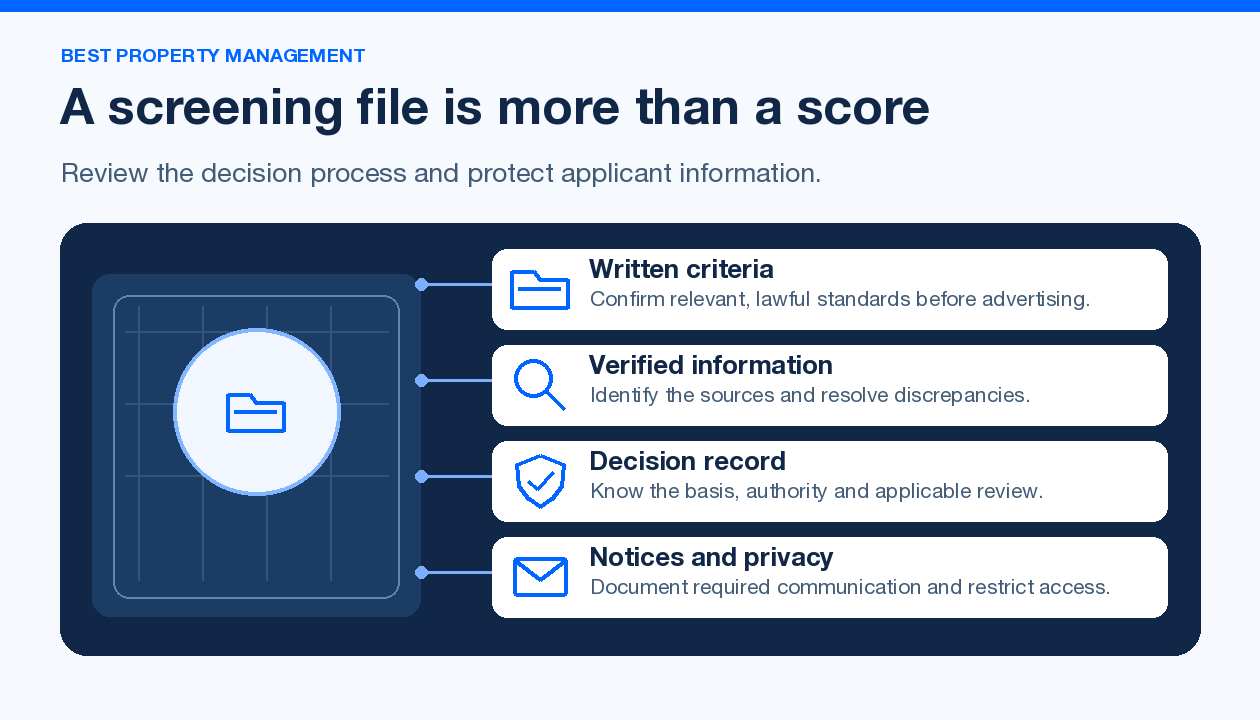
A tenant screening service should explain the lawful criteria used, what information was verified, how discrepancies were resolved and how the decision and required notices are documented. Ask for an appropriate summary and a secure way to access relevant records. A credit score is one input and cannot tell you whether the underlying information was accurate or the process was followed.
An owner may receive a short message saying an applicant passed or did not meet a threshold. That message leaves several questions unanswered. What did the reviewer verify? Did the data belong to the applicant? Which decision rule applied? A good screening process can answer these questions without circulating someone’s entire personal file.
What should a screening service explain before advertising?
Ask for the written, property-appropriate criteria and the process for applying them consistently. Discuss which records are requested, how verification works, who administers the review and who makes the decision. Ask who handles a request for an accommodation or a correction to information.
Review the California Civil Rights Department’s fair housing guidance with the manager. California’s fair housing requirements reach landlords, management firms and tenant screening services. Protected characteristics, reasonable accommodations and lawful source-of-income treatment are relevant to the procedure. Local and property-specific requirements can also affect the review.
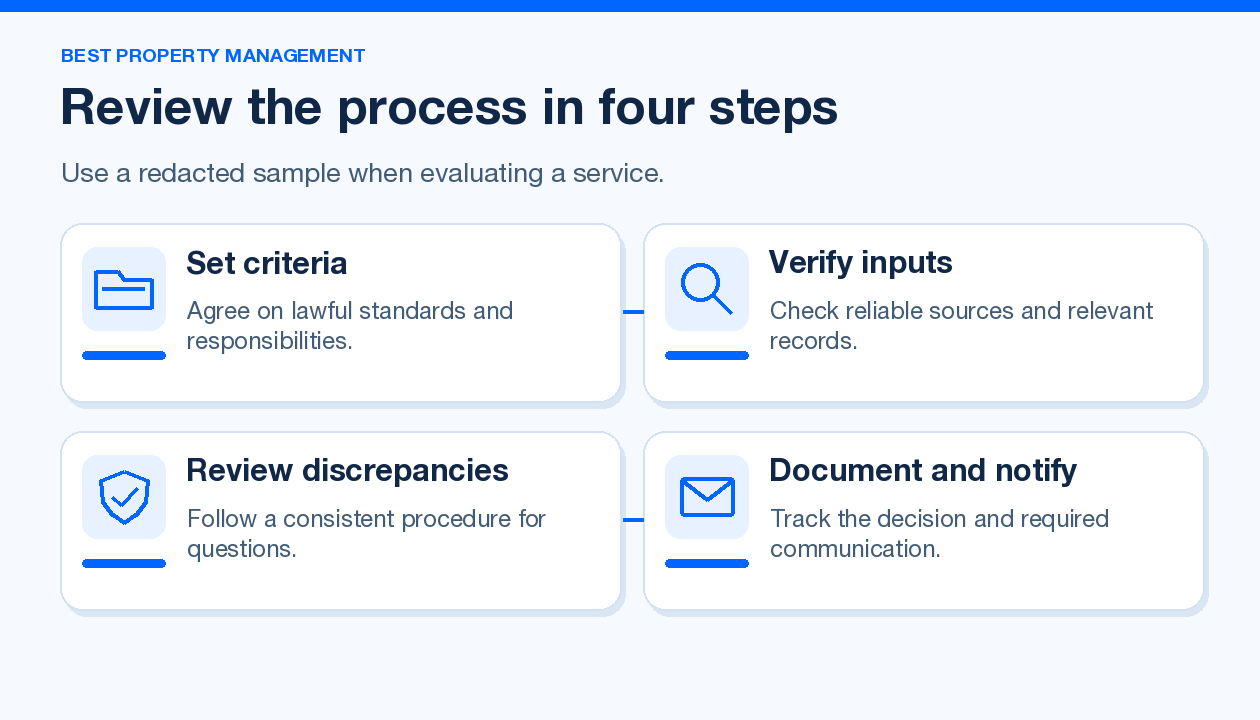
Use the published criteria and a lawful verification method for each application. Avoid inventing new tests after seeing an applicant’s records. Ask the manager to show the process through a fictional or redacted example.
What information should be verified besides credit?
Dig into the process for verifying identity, relevant income information and rental references where appropriate. Ask how the service reconciles inconsistent names, addresses or dates and how it handles a missing or unclear record. A reviewer should distinguish verified information from data supplied by an applicant or reported by a third party.
Verification needs consistent procedures and attention to the applicable rules. If the service accepts a particular way to verify qualifying information, ask how it evaluates equivalent lawful documentation. Income and assistance arrangements should be handled according to relevant state and local requirements. Our income verification guide provides additional questions to ask.
A report can contain information that is incomplete, out of date or associated with another person. Ask who reviews possible errors and how the applicant can address relevant discrepancies. Our screening risk guide explains why accuracy and fair treatment belong in the same conversation.
What should the owner receive after screening?
Ask for the minimum information you need to understand the decision and exercise any role the agreement assigns to you. Depending on the arrangement, that could include the criteria applied, steps completed, unresolved items and whether a required notice was sent. Confirm appropriate availability of supporting evidence and who can see it.
| Screening area | Useful record or answer | Owner’s follow-up |
|---|---|---|
| Criteria | Written standards applied to the property. | Confirm the manager reviews applicable rules. |
| Verification | What was verified and which source was used. | Ask who resolves unclear or conflicting information. |
| Decision | Basis and authority to make it. | Identify the party responsible for the decision. |
| Notices | Procedure and confirmation as appropriate. | Know who handles required notice and follow-up. |
| Privacy | Access controls and retention practice. | Ask how information is restricted and disposed of. |
Keep sensitive data out of ordinary progress updates. A report can describe the verification or action without attaching an identity document to an email. Ask how the manager protects applicant information, as discussed in our rental application data security guide.
What if a consumer report influenced an adverse decision?
The Federal Trade Commission’s landlord guidance explains that consumer reports require a permissible purpose. When an adverse action is based in whole or in part on a consumer report, the Fair Credit Reporting Act requires notice. The FTC also describes what that notice must include and additional information when a credit score is used.
Ask in advance which party obtains the report, assesses discrepancies, issues any required notice and records the action. A screening service can provide inputs and workflow support. Confirm who is accountable for each obligation under the actual arrangement and applicable rules.
An unfavorable action can involve conditions as well as a denial. Check the procedure and legal requirements before imposing any different terms. Ask qualified counsel or compliance staff about the actual policy if you are unsure how to apply it.
How can you handle uncertain or conflicting information?
Ask for the specific issue and its source. For example, a reference may be unavailable or a record may appear to belong to someone else. Identify what is unresolved, who can verify it and which appropriate follow-up is permitted. Avoid transforming a missing data point into a conclusion without a documented basis.
Treat applicants consistently while making any required accommodation or allowing applicable dispute and correction processes. If a rule changes, determine how it applies before using it in an active review. The goal is a reliable, lawful decision process that can be explained later.
Request a redacted procedure from providers you are comparing. Our East Bay screening pillar offers a broader overview of how marketing, verification and leasing can fit together. Ask the company what it does with uncertainty instead of focusing exclusively on how quickly it produces a score.
How should a manager protect the screening records?
Ask who has access, how records are transmitted, how long they are retained and what happens when access ends. The owner and manager can confirm which documents are appropriate to share and in which system. Limit access to people with an authorized role.
Keep the decision record and notice history in the agreed system. Avoid duplicating identity or financial documents unless there is a reason and a secure process to do so. Ask about disposal procedures and how the firm handles an access or data incident.
If you change managers, confirm which records can be transferred and which records must remain restricted. A sound handoff follows the applicable requirements and avoids handing over a broad archive just because it exists.
What should you ask when comparing screening services?
Ask each firm to walk through a sample review. Who publishes the criteria, verifies data, handles disputes and documents the decision? How are notices delivered? Which information will you receive and where is it kept? Ask for a clear division of duties for the specific service you are considering.
Compare how the firm handles a straightforward file and an unclear one. A useful answer should identify responsibility and a route for follow-up under the same standards. If the only deliverable is a score, ask which records and services you still need to manage responsibly.
What else do rental owners ask?
Is a tenant credit score enough to explain the outcome?
Ask about the lawful criteria, verification, decision and relevant notices. A score offers limited context about accuracy and procedure.
Should landlords receive every applicant document?
Share only information that is needed and appropriate for the role and process. Confirm access, storage and privacy rules with the manager.
Who sends a required adverse action notice?
Clarify who takes the action, who administers the notice and who records it. Review the applicable legal requirements for the specific decision.
Can a screening provider fix inaccurate information?
Ask who supplied the data and how corrections or disputes are handled. The applicant may have rights under applicable consumer reporting rules.
Does hiring a screening service remove fair housing obligations?
Housing providers and screening firms have responsibilities under applicable law. Clarify how the agreement assigns each step, including accommodations and consistent criteria.
What sample should I request before hiring?
Ask for a fictional or redacted criteria sheet, verification summary and process for decisions and required notices.
Related articles for rental property owners
What Are the Biggest Tenant Screening Risks? Rental Fraud, Fake Documents and Fair Housing
Tenant Screening: Should Landlords Verify Income Directly Instead of Relying on Pay Stubs?
Tenant Screening Data Security: What Applicant Information Should Landlords Protect?
What should you discuss with Best Property?
Ask how Best Property administers a property’s approved screening criteria and what decision and notice records an owner can appropriately receive. Review Best Property’s tenant screening service or contact the Best Property team.
Editorial cover is AI-assisted and illustrative. Check the agreement and the rules that apply to your property.
Blog
Company News
Landlord Resources
Landlords
Legal
Linkedin
Local Market Insights
Maintenance & Repairs
Market
Owners
Property
Property Law & Compliance
Property Management
Rental Property
Tenants
Video
FILTER BY EASTBAY & TRI-VALLEY CITIES
AB 1482
AI Property Management
AI Rental Fraud
Antioch Property Management
Applicant Data Security
Applicant Information
Applicant Screening
Applicant Verification
Bank Statement Fraud
Battery Recalls
Brentwood
Brentwood property management
California Insurance
California Landlord Laws
California Property Management
California Rent Increase
Central Valley Property Management
Concord Property Management
Credit Reports
Danville Property Management
Danville rentals
Desert Hot Springs Property Management
Desert Property Maintenance
Desert Rentals
Document Fraud
Dublin property management
E-Bike Safety
East Bay Landlords
East Bay Lease Renewals
East Bay property management
East Bay Rental Market
East Bay Rental Owners
East Bay Rental Property Maintenance
East Bay Rental Property Management
East Bay rental tips
East Bay Rentals
EV Charging
Eviction Notices
Eviction Support
Fair Housing
Fake Pay Stubs
Fall Leasing
find a property manager
Fremont
Fremont property management
full service property management
Full-Service Property Management
Good Tenants
Hayward Property Management
Hayward rentals
Heat Pump Water Heaters
hiring a property manager
HOA Compliance
HOA Rental Management
HOA Rentals
Home Insurance Costs
Human Oversight
Identity Verification
Income Verification
Indian Wells Property Management
Inherited Rental Property
Landlord Compliance
Landlord Data Security
Landlord Insurance
Landlord Resources
Landlord Tips
Lease Renewal Strategy
Lease Renewals
Leasing Fees
Leasing Services
Livermore
Livermore property management
Livermore Rentals
Local Development
Local Market Insights
Local Rental Support
Long-Term Rentals
Luxury Rentals
maintenance coordination
Maintenance Response
Management Services
Manteca Property Management
Milpitas Property Management
Mountain House Property Management
New Housing San Ramon
Newark CA Property Management
Oakley Property Management
Online Rent Payments
Owner Onboarding
owner reporting
Palm Desert Property Management
Palm Springs Area Property Management
Palm Springs Property Management
Palm Springs Rentals
Pittsburg CA Property Management
Pleasanton property management
Pleasanton rentals
Preventive Maintenance
Property Inspections
Property Maintenance
Property Management
Property Management Companies
Property Management Fees
Property Management Services
Property Management Transition
Property Manager
Rancho Mirage Property Management
Real Estate
real estate investing
Redfin Rentals
Remote Property Management
Rent Collection
Rent Control
Rent Reporting
Rent Trends
Rental Application Fraud
Rental Application Privacy
Rental Competition
Rental Fee Transparency
Rental Fees
Rental Fraud
Rental History
Rental Inspections
Rental Internet
rental leasing
Rental Market Analysis
Rental Market Trends
Rental Marketing
Rental Pricing
Rental Property
Rental Property Expenses
Rental Property Maintenance
rental property owners
rental property ROI
Renter Choice
Renter Experience
Repair Coordination
Resident Portal
Residential Leasing
Roommate Management
San Lorenzo Property Management
San Ramon Landlords
San Ramon Orchards
San Ramon property management
San Ramon Rental Market
Screening Red Flags
Seasonal Rentals
Security Deposits
Sell or Rent
Silicon Valley Rentals
single family rentals
Single-Family Rentals
Tenant Background Checks
Tenant Communication
Tenant Complaints
Tenant Expectations
Tenant Issues
Tenant Placement
Tenant Protection Act
Tenant Retention
tenant screening
Tenant Screening Data Security
Tenant Screening Fraud
Tenant Screening Red Flags
Tenant Turnover
Tracy Property Management
Tri-Valley
Tri-Valley Housing Market
Tri-Valley property management
Tri-Valley Rentals
Union City Property Management
Vacation Rental Management
Wildfire Risk
Winter Rental Safety
Zillow Rentals
 FILTER
 SEARCH BLOG