Charging an E-Bike in an Apartment: 7 Checks Before You Plug In
The charger is plugged in. The bike is out of the rain. That can feel like the whole routine—until the cord crosses the doorway or charging continues while everyone sleeps. A safer routine starts before the plug goes into the wall.
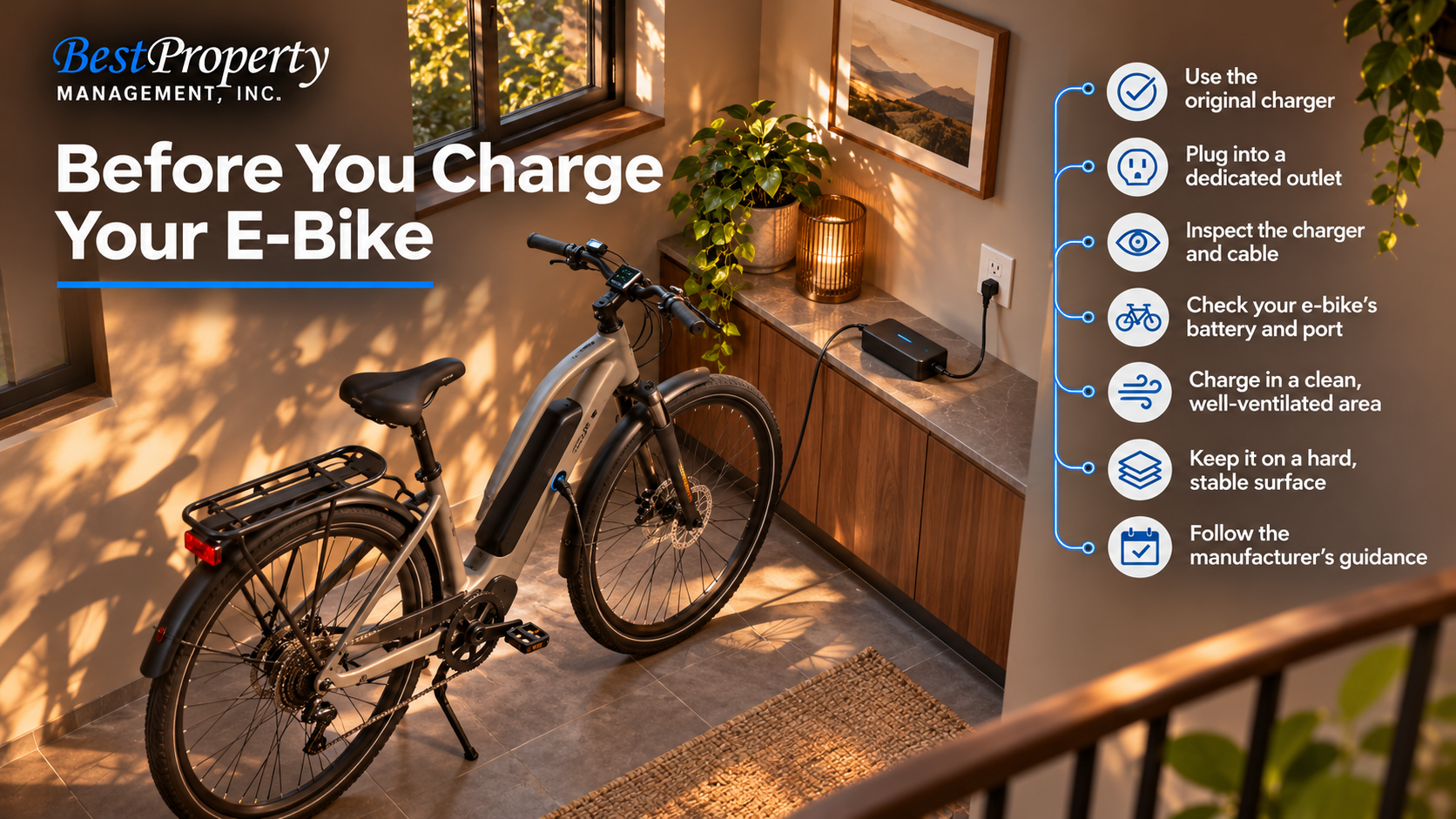
Before charging, check the equipment, charger, outlet, location, supervision, end-of-charge instructions and emergency plan. Follow the manufacturer and your property’s lawful policy; this checklist does not certify a particular installation as safe.
1. Check the battery and device
Look for visible damage, swelling, leaking or other changes without opening the pack. If the equipment was dropped, exposed to water or is behaving abnormally, stop and obtain manufacturer guidance.
Use the correct approved battery for the device. An unqualified rebuild or unidentified replacement should not be treated as equivalent to the original system.
The CPSC’s micromobility guidance also recommends checking the broader device and following its safety information. Charging care does not replace ordinary equipment maintenance.
2. Match the charger to the actual device
Use the charger supplied or approved by the manufacturer. The word universal and a matching connector do not establish compatibility.
If the charger is missing, ask the manufacturer for the exact suitable replacement. Do not experiment with an adapter borrowed from another resident or a different battery pack.
3. Use an appropriate outlet without a workaround
The State Fire Marshal’s battery guidance recommends plugging directly into a wall outlet. Do not run an extension cord or power-strip chain across the room to create a charging location.
Report a damaged, loose or otherwise concerning outlet through the repair process. A qualified professional should assess electrical questions. Residents should not open a receptacle, change wiring or decide that a circuit is adequate merely because charging begins.
4. Keep the exit route clear
Choose a permitted location consistent with the manufacturer instructions and fire guidance. Keep the battery away from combustible furnishings, unsuitable heat and moisture. Do not charge on a bed or couch.
The bike, battery and cord must not obstruct the route people need to leave. A wide-looking hallway can still be the home’s primary exit path.
If the available space makes these conditions difficult, ask about the property’s approved arrangement. A dangerous location does not become suitable because it is the only convenient one.
5. Stay awake and present
The CPSC advises against charging while sleeping or away. Plan charging for a period when someone is present and able to notice a problem.
A smart plug, camera or phone notification is not a replacement for following the charging guidance. If the routine depends on leaving the pack unattended, change the routine rather than assuming technology eliminates the risk.
6. Finish according to the instructions
Follow the manufacturer’s charging process and disconnect when the charge is complete as directed. Do not keep charging indefinitely because the bike will be used again tomorrow.
Keep the equipment in its specified storage conditions afterward. Unplugged does not mean a damaged or recalled pack can be ignored. Check official notices and respond to any observed change.
7. Know the difference between a question and an emergency
A product question belongs with the manufacturer or a qualified service provider. A damaged outlet belongs in the property’s repair process. Smoke, fire or immediate danger calls for evacuation and 911.
The U.S. Fire Administration advises people not to try to extinguish a lithium-ion battery fire. Do not move a hot or smoking pack through an occupied building.
Discuss the emergency route before there is an emergency. Every resident should know how to leave without depending on a path blocked by charging equipment.
| Check | A reason to stop and ask |
|---|---|
| Product | Damage, unusual condition or uncertain replacement |
| Charger | No manufacturer confirmation |
| Outlet | Damage or need for an improvised extension |
| Location | Blocked exit or unsuitable surface |
| Supervision | Charging while asleep or away |
| Completion | Unclear charging instructions |
| Emergency | Smoke, fire or immediate danger |
Questions owners and tenants ask
Can I charge overnight?
Do not charge while sleeping. Follow the manufacturer’s instructions and CPSC guidance to remain present.
Can I use an extension cord?
Use a suitable direct wall outlet as the State Fire Marshal advises. Do not improvise a charging location with cords or power strips.
What if the only outlet is next to the front door?
Do not block the exit. Ask about a suitable permitted arrangement and obtain qualified advice on electrical questions.
Is a smart plug enough supervision?
No. It does not replace the guidance to stay present and awake.
Should I keep using a pack that looks swollen?
Stop use and obtain appropriate guidance. Do not open or attempt to repair it.
What if there is smoke?
Evacuate safely and call 911. Do not handle or transport the smoking pack.
Explore this article series
E-Bike Battery Safety in Rentals: What Should Owners and Tenants Know?
Is Your E-Bike Battery Recalled? How to Check the Model and Serial Number
E-Bike Storage in California Rentals: Can Landlords Restrict Charging?
E-Bike Battery Disposal: Where Can Renters Take a Damaged or Recalled Battery?
Related articles
Portable heaters and rental electrical safety
EV charging from a regular outlet
Talk with your local Best Property team
If you are unsure about a building outlet or permitted charging location, contact your local office before improvising. Product compatibility questions belong with the manufacturer. Find your local office.
Research checked November 12, 2026. This checklist summarizes official safety guidance; it is not an installation approval, equipment certification or permission to modify a rental. AI-assisted editorial illustration; no actual tenant, client event or property is depicted.
Blog
Company News
Landlord Resources
Landlords
Legal
Linkedin
Local Market Insights
Maintenance & Repairs
Market
Owners
Property
Property Law & Compliance
Property Management
Rental Property
Tenants
Video
FILTER BY EASTBAY & TRI-VALLEY CITIES
AB 1482
AI Property Management
AI Rental Fraud
Antioch Property Management
Applicant Data Security
Applicant Information
Applicant Screening
Applicant Verification
Bank Statement Fraud
Battery Recalls
Brentwood
Brentwood property management
California Insurance
California Landlord Laws
California Property Management
California Rent Increase
Central Valley Property Management
Concord Property Management
Credit Reports
Danville Property Management
Danville rentals
Desert Hot Springs Property Management
Desert Property Maintenance
Desert Rentals
Document Fraud
Dublin property management
E-Bike Safety
East Bay Landlords
East Bay Lease Renewals
East Bay property management
East Bay Rental Market
East Bay Rental Owners
East Bay Rental Property Maintenance
East Bay Rental Property Management
East Bay rental tips
East Bay Rentals
EV Charging
Eviction Notices
Eviction Support
Fair Housing
Fake Pay Stubs
Fall Leasing
find a property manager
Fremont
Fremont property management
full service property management
Full-Service Property Management
Good Tenants
Hayward Property Management
Hayward rentals
Heat Pump Water Heaters
hiring a property manager
HOA Compliance
HOA Rental Management
HOA Rentals
Home Insurance Costs
Human Oversight
Identity Verification
Income Verification
Indian Wells Property Management
Inherited Rental Property
Landlord Compliance
Landlord Data Security
Landlord Insurance
Landlord Resources
Landlord Tips
Lease Renewal Strategy
Lease Renewals
Leasing Fees
Leasing Services
Livermore
Livermore property management
Livermore Rentals
Local Development
Local Market Insights
Local Rental Support
Long-Term Rentals
Luxury Rentals
maintenance coordination
Maintenance Response
Management Services
Manteca Property Management
Milpitas Property Management
Mountain House Property Management
New Housing San Ramon
Newark CA Property Management
Oakley Property Management
Online Rent Payments
Owner Onboarding
owner reporting
Palm Desert Property Management
Palm Springs Area Property Management
Palm Springs Property Management
Palm Springs Rentals
Pittsburg CA Property Management
Pleasanton property management
Pleasanton rentals
Preventive Maintenance
Property Inspections
Property Maintenance
Property Management
Property Management Companies
Property Management Fees
Property Management Services
Property Management Transition
Property Manager
Rancho Mirage Property Management
Real Estate
real estate investing
Redfin Rentals
Remote Property Management
Rent Collection
Rent Control
Rent Reporting
Rent Trends
Rental Application Fraud
Rental Application Privacy
Rental Competition
Rental Fee Transparency
Rental Fees
Rental Fraud
Rental History
Rental Inspections
Rental Internet
rental leasing
Rental Market Analysis
Rental Market Trends
Rental Marketing
Rental Pricing
Rental Property
Rental Property Expenses
Rental Property Maintenance
rental property owners
rental property ROI
Renter Choice
Renter Experience
Repair Coordination
Resident Portal
Residential Leasing
Roommate Management
San Lorenzo Property Management
San Ramon Landlords
San Ramon Orchards
San Ramon property management
San Ramon Rental Market
Screening Red Flags
Seasonal Rentals
Security Deposits
Sell or Rent
Silicon Valley Rentals
single family rentals
Single-Family Rentals
Tenant Background Checks
Tenant Communication
Tenant Complaints
Tenant Expectations
Tenant Issues
Tenant Placement
Tenant Protection Act
Tenant Retention
tenant screening
Tenant Screening Data Security
Tenant Screening Fraud
Tenant Screening Red Flags
Tenant Turnover
Tracy Property Management
Tri-Valley
Tri-Valley Housing Market
Tri-Valley property management
Tri-Valley Rentals
Union City Property Management
Vacation Rental Management
Wildfire Risk
Winter Rental Safety
Zillow Rentals
 FILTER
 SEARCH BLOG